Every contact center leader has seen the pattern. A customer calls in, hears a non-native accent, and the interaction unravels — not because the agent lacks skill, but because bias has already taken over. Accent bias in customer service is one of the most under-documented, over-experienced challenges in the BPO industry today. It quietly drains CSAT scores, inflates turnover rates, and chips away at agent morale.
The scale of the problem deserves attention. According to a meta-analysis by ContactBabel, a single negative interaction tied to accent-related bias can drop customer retention likelihood by 33%. Contact centers lose an estimated $15 billion annually due to inefficiencies rooted in communication barriers. Meanwhile, the accent reduction tool BPO market is exploding precisely because companies are recognizing that training alone cannot close this gap. Technology is now entering the conversation — and not a moment too soon.
The Hidden Costs of Accent Bias: What the Data Actually Reveals
The data reveals that accent bias is responsible for operational inefficiency and financial loss.
Impact on Customer Satisfaction and Operations
- Declining Satisfaction: Customer satisfaction plummets drastically when contact centers move offshore, driven largely by communication discomfort rather than actual service quality.
- Increased Operational Costs: With rising individual calls cost to service, any communication friction—including that caused by accent bias—increases call duration and directly inflates overhead.
- The Bottom Line: Beyond individual calls, retraining expenses, recruitment cycles, and revenue lost from customer churns create a cumulative financial burden that impacts the organization’s profitability.
Impact on Employee Well-being and Retention
- Diminished Morale: According to a 2022 Gallup survey, 67% of agents report feeling undervalued when their accents are criticized.
- Higher Turnover: This widespread dissatisfaction exacerbates the contact center industry’s already high annual turnover rate, which currently stands between 30% and 45%.
“Identity Tax” in the Workplace
- Forced Assimilation: Research indicates that 60% of employees feel compelled to modify their accents to advance their careers.
- Behavioral Masking: 81% of employees report altering their behavior to match their environment simply to be taken seriously.
- Culture of Exclusion: These statistics demonstrate that many workplaces treat identity as a liability, ultimately undermining talent retention, trust, and overall performance.
Real-Time Accent Conversion and the Technology Reshaping Contact Centers
The most forward-thinking contact center operators are no longer relying solely on accent neutralization training. They recognize two things simultaneously: that training takes months to show results, and that customer-side accent challenges are completely outside an agent’s control. This is where technology earns its seat at the table.
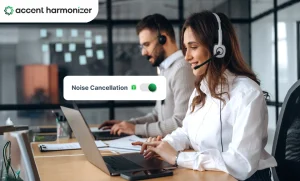
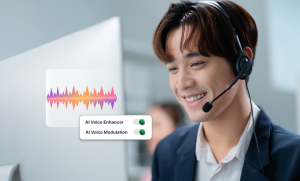
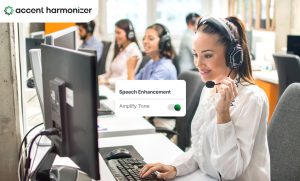
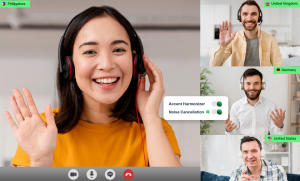
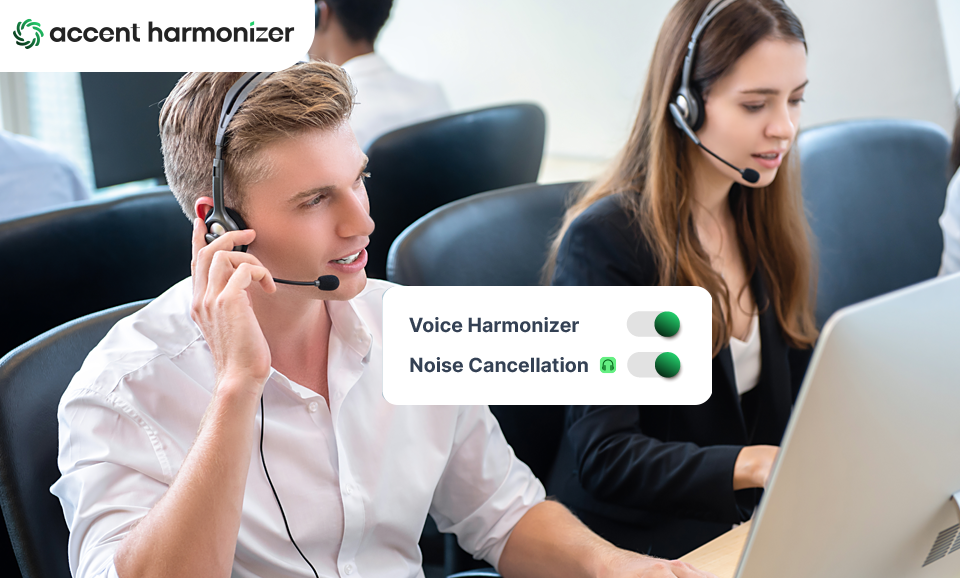
Real-time accent conversion tools like Accent Harmonizer AI neutralize accents mid-call. Agents gain control over the pace of the conversation, adjusting how quickly or slowly a customer speaks in real time.
The broader lesson here is that the accent reduction tool for BPO is maturing fast. Companies that adopt these tools now are not just solving a communication problem — they are investing in agent dignity, operational efficiency, and customer experience simultaneously. That is a rare trifecta in an industry where tradeoffs are constant.
Building an Accent-Inclusive Contact Center: Strategy Before Technology
Technology is a force multiplier, but it amplifies the foundation beneath it. Before deploying AI communication tools, organizations must dismantle the structural biases embedded in hiring and performance reviews. You cannot “patch” accent bias with a software update.
Understanding the SEEDS Model of Bias
Bias operates at a near-unconscious level. Research from Friedrich Schiller University Jena indicates that people categorize others more by their accent than by their physical appearance. To counter this, organizations should address the five SEEDS categories:
| Common Accent-Related Biases and Organizational Countermeasures | ||
|---|---|---|
| Bias Type | Definition | Organizational Countermeasure |
| Similarity | Favoring familiar or “like-me” accents. | Structured recruitment & blind hiring. |
| Expedience | Making snap judgments based on speech. | Objective, skill-based assessment rubrics. |
| Experience | Letting past stereotypes drive perception. | Cross-cultural empathy training. |
| Distance | Distrust of geographically unfamiliar speech. | Global exposure & diversity initiatives. |
| Safety | Treating accented speech as a “risk.” | Regular bias audits of performance data. |
Conclusion
Accent bias in customer service is neither inevitable nor untreatable. It is a measurable, costly, and ultimately solvable business problem — one that sits at the intersection of human psychology, organizational culture, and emerging technology. The companies that get ahead of it are not doing so purely out of social obligation, though that reason alone would be sufficient. They are doing so because the data makes the case clearly: biased interactions cost money, lose customers, and drive out talented agents. Addressing this challenge requires a layered approach:
- Honest internal audits
- Smart adoption of real-time communication tools
The contact centers that thrive in the next decade will be those that treat linguistic diversity not as a liability to manage, but as a dimension of human richness worth protecting.
Ready to know more? Lets book a demo now!!