
Most contact centers rely on Customer Satisfaction Score (CSAT) to understand customer experience. But CSAT is a lagging indicator. By the time it moves, friction has already occurred inside the conversation. One of the most overlooked contributors to that friction is accent clarity in call centers. Not because accents are “wrong,” but because even minor comprehension gaps increase cognitive effort. That effort shows up early—through hesitation, repetition, and slower decisions—long before dissatisfaction is ever expressed.
Most conversation friction does not trigger dissatisfaction. It slows understanding first.
Accent Clarity in Call Centers Is a Decision-speed Issue
Accent friction in customer conversations directly affects how quickly a customer can follow, process, and respond during a live conversation.
When clarity drops:
- Customers pause longer before responding
- Agents repeat or rephrase information
- Conversations progress more slowly
None of these behaviors automatically translate into dissatisfaction. Customers may remain polite, cooperative, and even satisfied at the end of the call. But the decision velocity inside the interaction decreases. CSAT does not measure that slowdown.
Accent Friction in Customer Conversations Appears
Accent friction in customer conversations is rarely explicit. Customers do not say, “I’m having trouble understanding you.” Instead, friction appears indirectly, such as:
- Requests to repeat information already explained
- Follow-up questions that restate the same point
- Longer silence between turns
- Agents receive answers multiple times
These patterns are audible and observable in call recordings. They indicate additional processing effort, not dissatisfaction.
Observable Signals of Accent Friction in Live Conversations
Accent friction rarely appears as a single breakdown. It emerges through a pattern of small, repeatable signals during live calls, which become visible only when conversations are reviewed in full.
One common indicator is repetition density—how often customers ask for information to be restated, even when the content itself is straightforward. This is often followed by agent paraphrasing, where agents instinctively rephrase responses to maintain flow. While effective in the moment, this adds incremental time to the interaction.
Another signal is turn-taking latency. When accent clarity in call centers is reduced, customers take longer to respond after an agent speaks. These pauses do not signal dissatisfaction. They indicate additional processing time required to confirm understanding.
Accent friction in customer conversations also increases clarification-to-resolution ratios. More of the call is spent confirming what was said rather than progressing toward a decision or next step. Across large call volumes, these micro-delays accumulate into longer conversations and slower decision flow.
Because these signals rarely trigger complaints, they are easy to normalize. They become visible only through structured conversation reviews that focus on how information moves through a call, not just how the call ends.
Accent Challenges in Contact Center Environments Extend Conversations
Accent challenges in contact center environments are amplified by scale and operating conditions:
- Global delivery models with diverse speech patterns
- Call compression, background noise, and network variability
- High call volumes that limit time for adjustment
Even skilled agents can experience reduced clarity under these constraints. The issue is not agent capability. It is consistency of comprehension across thousands of interactions.
Decision Hesitation Happens Before Customers Ever Sound Dissatisfied
Decision hesitation often occurs when customers are still trying to confirm understanding. Common signals include:
- “Can you say that again?”
- “So you’re saying that…”
- “Let me just make sure I understood”
These moments reflect incomplete clarity, instead of buyer rejection or frustration. Customers may still complete the call successfully and provide neutral or positive feedback afterward.
Why CSAT Fails to Surface Accent Clarity Issues in Call Centers
CSAT struggles to capture accent clarity in call centers for structural reasons:
- Surveys occur after the conversation, not during it
- Customers normalize effort once the issue is resolved
- Sampling misses subtle conversational friction
- Scores reflect outcome satisfaction, not process efficiency
As a result, accent-related clarity issues remain invisible unless conversations are directly reviewed.
What Conversation Reviews Reveal About Accent Friction
Conversation reviews make accent friction in customer conversations measurable. By analyzing live or recorded calls, teams can observe:
- Repetition density
- Clarification frequency
- Turn-taking delays
- Time spent rephrasing information
These indicators provide evidence of friction without relying on subjective interpretation or customer self-reporting.
Improving Accent Clarity in Call Centers Without Changing Agents
Improving accent clarity in call centers does not require changing who agents are or how they speak.
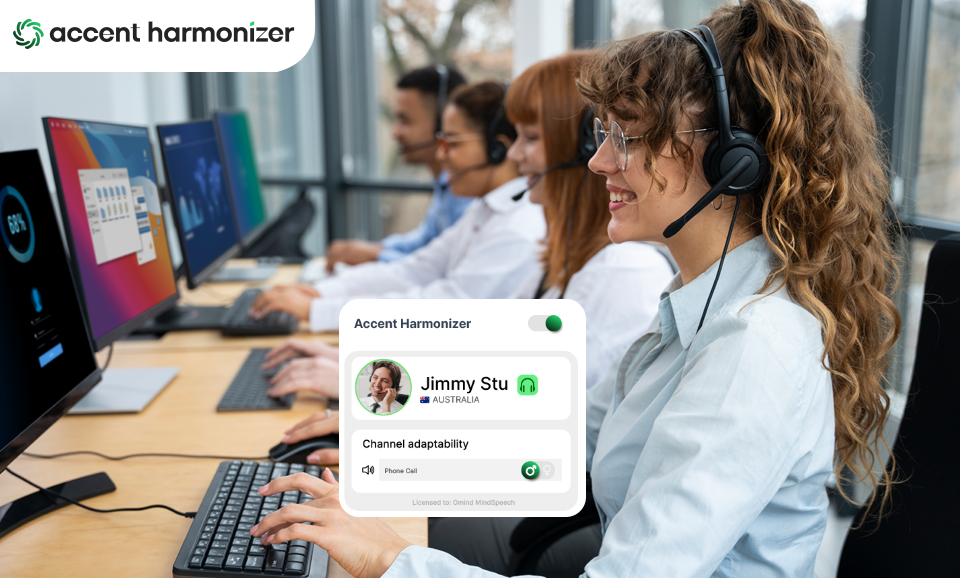
Speech normalization technologies are designed to reduce variability in how spoken language is heard by customers, while allowing agents to communicate naturally. Solutions like Accent Harmonizer address clarity at the conversation level, focusing on consistency of comprehension rather than correction or retraining.
Modern voice systems can normalize speech patterns in real time, so customers receive more consistent auditory output while agents speak naturally. The goal is not correct. It is comprehension consistency.
When clarity improves:
- Fewer repetitions are required
- Information lands faster
- Conversations move forward with less effort
This directly addresses decision delays without altering agent behavior.
Accent Challenges in Contact Center Conversations
Accent challenges in contact center conversations should be reviewed when teams observe:
- Increasing call duration without clear complexity drivers
- High repetition rates in QA reviews
- Neutral CSAT scores paired with operational inefficiencies
Reviewing conversations at this stage helps identify friction before it escalates into dissatisfaction.
Conclusion
Accent friction shows up gradually, through small delays that compound across conversations. By the time CSAT reflects a problem, the opportunity to act early has already passed.
- Accent clarity in call centers affects how quickly customers can process and act on information
- Accent friction in customer conversations appears as repetition, clarification loops, and longer pauses
- Accent challenges in contact center environments extend conversations without triggering dissatisfaction
- CSAT fails to surface these issues, because it measures outcomes, not in-call effort
Review the Conversation, Not Just the Score
If your contact center sees longer calls, repeated explanations, or slower decision flow alongside stable CSAT scores, the next step is not another survey. Accent friction can slow customer decisions in your conversations, start by reviewing how those conversations unfold. Let’s schedule a demo to know more.