
Pronunciation differences in global contact center conversations often cause breakdowns during critical moments. When a customer struggles to parse an agent’s speech patterns, the immediate result is repetition, clarification, and intense cognitive strain on both ends of the line. Over a thousand calls a day, this friction compounds into longer queues, elevated agent burnout, and degraded customer satisfaction.
Accent translation AI solves this operational bottleneck by processing and adjusting specific pronunciation characteristics in real time, delivering clear, intelligible speech to the listener without altering the underlying language or meaning.
What Is Accent Translation AI?
Accent translation AI is a specialized subfield of real-time speech-to-speech technology designed to modify targeted acoustic and phonetic elements of a speaker’s voice during a live call. The system ingests an incoming audio stream, isolates pronunciation features that create comprehension friction, adjusts those specific phonetic markers, and outputs reconstructed audio—all while maintaining the original language, meaning, and conversational flow.
| Real-Time Audio Processing Architecture |
|---|
Step 1 Incoming Audio (Agent Speech) ➜ Step 2 Acoustic & Phonetic Feature Analysis ➜ Step 3 Targeted Speech Transformation ➜ Output Reconstructed Audio (Enhanced Clarity) |
Industry terminology around this category includes AI accent translation, AI voice accent translation, speech accent translation, and speech-to-speech accent translation.
It is vital to separate operational goals from marketing exaggeration: accent translation AI does not “erase” or “remove” a human accent entirely. Instead, it alters selected speech characteristics to reduce pronunciation-driven misunderstandings, allowing global teams to communicate clearly without forcing agents into artificial vocal performance.
How Does Accent Translation AI Work?
Modern real-time speech processing relies on a multi-stage pipeline designed to transform audio into milliseconds.
| Accent Harmonizer Real-Time Neural Processing Architecture |
|---|
Step 1 Input Speech Signal ➜ Step 2 Acoustic & Phonetic Feature Analysis ➜ Step 3 Targeted Transformation (Selected Phonemes) ➜ Step 4 Low-Latency Neural Synthesis & Reconstruction ➜ Output Intelligible Audio (Harmonized Output) |
Capture and Analyze the Speech Signal
The process begins at the digital signal processing (DSP) layer. As the agent speaks into their headset, the software intercepts the raw digital audio stream. Deep neural networks analyze the signal’s acoustic frame, mapping spectral features, pitch contours, fundamental frequencies, and temporal cadence.
Identify Accent-related Phonetic Patterns
Next, machine learning models evaluate the stream against target phonetic benchmarks. The system identifies specific regional pronunciation variations, such as:
- Subtle shifts in vowel duration and formant frequencies.
- Consonant substitution or softening (e.g., interdental fricatives like “th” rendered as “t” or “d”).
- Syllable-stress variations and articulation boundaries.
The engine does not evaluate whether an accent is “good” or “bad.” It identifies specific acoustic divergence points that predictably increase listener cognitive load.
Adjust Selected Speech Characteristics
The software executes targeted modifications rather than replacing the entire speech wave. It asks: which specific sounds require alignment to maximize listener comprehension? By modifying only high-friction phonemes and leaving the rest of the acoustic signal untouched, the transformation preserves natural cadence while removing structural ambiguity.
Reconstruct and Deliver the Voice in Real Time
Once adjusted, a neural synthesis layer reconstructs the audio signal and streams it directly to the softphone or CCaaS platform. To prevent awkward pauses or overlapping speech, this entire pipeline must execute in under 200 milliseconds—the threshold of human perception for natural turn-taking.
What Changes and What Should Remain Unchanged?
| Real-Time Voice Processing and Dynamic Adaptation Parameters | |
|---|---|
| May Change (Acoustic Harmonization) | Should Remain Unchanged (Identity Preservation) |
| Selected pronunciation patterns | Intended meaning |
| Target phonemes and articulation | Primary language |
| Syllable stress and prosody | Speaker identity and vocal timbre |
| Speech intelligibility markers | Emotional expression and tone |
Accent Translation AI Is Not Language Translation
Because the term “translation” traditionally refers to converting words from one language into another, enterprise buyers often conflate accent translation with cross-lingual machine translation. They perform fundamentally different tasks:
| Accent Harmonizer vs. Language Translation | ||
|---|---|---|
| Dimension | Accent Translation AI | Language Translation |
| Language Scope | Same primary language retained throughout session | Converts source Language A to target Language B |
| Optimization Focus | Phonetic pronunciation & acoustic clarity alignment | Linguistic meaning, grammar, & syntax mapping |
| Signal Transformation | Speech In → Adjusted/harmonized speech Out | Speech/Text In → Alternate language output |
| Practical Example | Offshore English → Clearer, intelligible English | English Speech → Spanish Speech/Text |
Speech-to-speech accent translation does not translate text or alter vocabulary. It ensures that when two people speak the same language, regional pronunciation differences do not impede mutual understanding.
How Accent Translation Relates to Conversion, Neutralization, and Harmonization?
The speech technology market uses several terms to describe voice adaptation. Understanding these distinctions prevents buying the wrong architecture:
- Accent Conversion: Maps a speaker’s pronunciation heavily toward a specific geographic accent pattern (e.g., transforming a South Asian accent into a synthetic Pacific Northwest American accent).
- Accent Neutralization: Flattens distinct regional speech characteristics to create a standardized, generalized acoustic profile.
- Accent Harmonization: Modifies only high-friction phonetic elements to optimize intelligibility while retaining the speaker’s original voice identity, warmth, and emotion.
- Accent Translation AI: Broad umbrella terminology used across the market to describe real-time speech-to-speech adjustment systems.
Where Accent Translation AI Creates Operational Value?
Deploying real-time speech processing targets specific root-cause operational inefficiencies across voice operations.
Comprehension
When customers struggle to understand an agent, they ask for information to be repeated. These micro-delays add 30 to 90 seconds of unnecessary duration per call. Removing sound-level ambiguity allows data exchange to flow naturally on the first attempt.
Agent Cognitive Effort
Offshore and nearshore agents frequently experience high mental fatigue from continuously over-monitoring their pronunciation, slowing down their natural speech, or forcing unnatural vocal postures. Mitigating pronunciation stress lets agents concentrate entirely on customer problem-solving, product knowledge, and empathy.
Operational Friction
When pronunciation barriers drive up interaction times and customer frustration, targeted clarity technology impacts core contact center metrics:
- Average Handle Time (AHT): Minimizes time wasted on repetition and clarifying statements.
- First Contact Resolution (FCR): Prevents miscommunications that cause incorrect ticket logging or unnecessary callbacks.
- Escalation Rates: Reduces customer irritation stemming from initial comprehension strain.
- Agent Confidence: Lowers voice-channel anxiety and early-tenure attrition across global delivery centers.
When Accent Translation AI Won’t Solve the Problem?
Accent translation software is an acoustic processing tool, not an operational cure-all. Enterprise teams should recognize where the technology reaches its limits:
- Packet Loss and Jitter: If network latency is high or packet loss corrupts the underlying audio stream, fix the network infrastructure first.
- Severe Background Noise: High ambient noise requires dedicated directional noise suppression algorithms, not accent modification.
- Substandard Microphones: Hardware-level distortion cannot be parsed accurately by AI models; replace low-quality headsets.
- Language Barriers: If the customer and agent do not share a common language, deploy cross-lingual translation.
- Gaps in Knowledge: No amount of audio clarity will compensate for an agent who lacks product training or operational guidance.
- Broken Workflows: Complex, poorly designed IVR routing and SOPs require process re-engineering, not voice modification.
Accent translation AI addresses pronunciation-related intelligibility. It should never be treated as a substitute for network stability, hardware quality, comprehensive agent training, or efficient operational workflows.
Speech Clarity Without Erasing Speaker Identity
A central question facing CX executives is ethical and cultural: Why modify a speaker’s voice at all?
Historically, vendor approaches forced complete accent replacement, flattening an agent’s speech into synthetic, cloned American or British voices. This legacy model treats regional accents as defects to be erased, stripping away human authenticity and making interactions feel uncanny or deceptive.
A modern, responsible deployment prioritizes clarity over conformity:
| Legacy Voice Replacement vs. Modern Accent Harmonization |
|---|
Legacy Voice Replacement Model Agent Speech → Complete Vocal Override → Synthetic Standard Accent(Identity Erased) |
Modern Accent Harmonization Model Agent Speech → Selective Phoneme Alignment → Authentic, Intelligible Voice(Identity Preserved) |
The goal of speech processing should be evaluated by whether customers understand speech effortlessly—not by how closely an agent conforms to a specific regional prototype. Systems must preserve natural voice tone, emotional cadence, and individual identity, eliminate cognitive friction.
How Accent Harmonizer Approaches Accent Translation?
Rather than applying aggressive voice replacement, Accent Harmonizer delivers real-time voice enhancement anchored in speaker authenticity. Powered by Sanas technology, it functions as a lightweight virtual audio layer across existing CCaaS and softphone setups.
Accent Harmonizer targets intelligibility through a balanced operational model:
- Sub-200ms Latency: Processes and reconstructs speech instantly to ensure zero conversational lag or talk-over.
- Identity Preservation: Adjusts only high-friction phonetic variations, keeping the agent’s natural voice identity, pitch, and emotional tone intact.
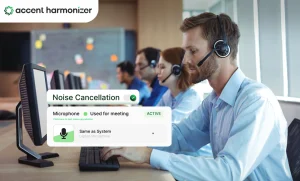
- Integrated Clarity: Combines targeted accent harmonization with omnidirectional background noise cancellation in a single, low-footprint layer.
Explore the accent translation software capability or review the product directly on the.
Drive Seamless Voice Conversations
Stop letting regional pronunciation barriers inflate handle times and cause customer friction. Accent Harmonizer aligns high-friction phonemes while preserving your agents’ confidence.
[ Request a Live Technical Walkthrough ] | [ Explore Accent Translation Solution]