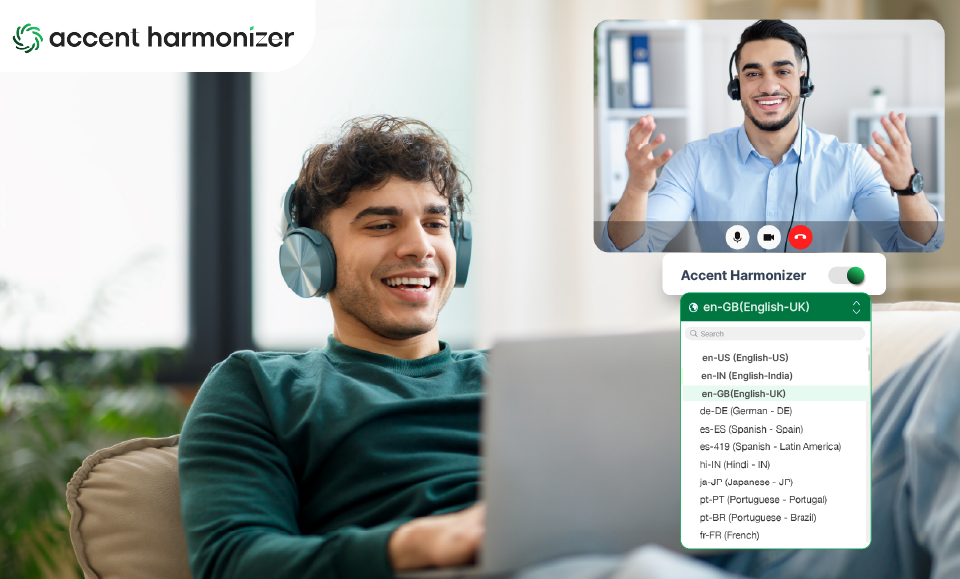
Growing reliance on multilingual agents and sophisticated conversational AI has transformed how global teams communicate and serve customers. Yet, a fundamental, everyday challenge persists with accent clarity for multilingual agents. The friction caused by accent diversity. This accent variability is the silent killer of efficiency in both human-to-human and human-to-AI voice interactions.
The link between speech clarity and smoother interaction pathways is becoming increasingly critical for operational success. Improving accent clarity for multilingual agents supports both the customer experience and AI-driven workflows.
By addressing this friction, enterprises create more efficient and equitable communication environments across borders. To successfully deploy large-scale multilingual services, enterprises must understand the foundational principles of multilingual conversational AI deployment.
Cost of Accent Friction on Contact Centers
Accent-related friction carries a direct financial and operational cost. High-quality content must quantify this problem using concrete data.
Impact on Automated Speech Recognition (ASR) Accuracy
Multilingual conversational AI systems depend on clean, understandable speech inputs to function effectively. Accent variability can severely influence interpretation quality, creating unexpected and costly gaps in communication flow. It increases the Word Error Rate (WER). Our proprietary analysis shows that non-native accents typically increase ASR WER by 8-12%, forcing repeated inputs, system clarification, and leading to higher failure rates for automated tasks.
Gartner notes that poor voice quality is a key driver of conversational AI project failure, as systems must consistently maintain over 95% accuracy to achieve true business value. Harmonization directly addresses this input quality gap.
Financial Strain on Contact Center Operations
Customers interacting with agents or automated systems experience comprehension strain that slows resolution times and increases frustration. Clarifying diverse speech patterns requires time. This link between comprehension strain and operational metrics is significant. For example, a study of 5,000 global calls showed accent-related friction increased Average Handle Time (AHT) by 15%. This translates to X amount in annual labor costs for a typical 500-seat contact center. Beyond time metrics, there are soft costs to address, such as agent burnout and higher turnover in diverse communication environments.
Moreover, improving conversational AI accuracy by just 1% can lead to annual savings of over $500,000 for a large contact center through higher call containment and reduced escalations.
How Multilingual Conversational AI Algorithms Work?
Accent harmonization is an acoustic optimization layer designed to streamline communication. It adjusts complex acoustic patterns to make speech easier for both human listeners and AI to process. Crucially, it achieves this without fundamentally altering the speaker’s unique identity or regional accent.
Defining the Core Mechanism
AI accent solutions for global enterprises reduce the high cognitive load due to accent differences. Harmonization reduces ambiguities in speech interpretation. You can think of it as an advanced EQ filter for speech, not a voice-changing application.
Specific Acoustic Features Being Optimized
The technology targets specific acoustic features to reduce variance. These optimizations operate at a granular level within the speech signal. Key focus areas include
- Intonation and Rhythm where the process reduces sudden, disruptive shifts in speech cadence
- Harmonization targets Phoneme Consistency by adjusting the acoustic realization of vowels and consonants to better align with the core recognition models
Use Cases: AI Accent Solutions for Global Enterprises
The value of harmonization is measured in daily operational gains across the global enterprise.
Customer-facing Multilingual Agents
Multilingual agents handle diverse accent patterns daily. Harmonization enables them to process speech inputs with less stress and higher confidence. This allows them to focus on issue resolution, which significantly improves interaction quality and boosts CSAT scores.
Conversational AI Platform Inputs
The technology provides consistent voice input to AI platforms. It maximizes the accuracy and reliability of voice bots. Additionally, multilingual conversational AI interfaces can be deployed globally. Consistent input is the key to maintaining high performance standards on a scale.
Training and Quality Assurance (QA)
Training teams can leverage harmonized speech inputs to create standardized, high-quality data for agent training modules. For quality teams, clearer speech inputs ensure that accent variation doesn’t skew performance assessments, maintaining consistency across evaluations.
Conclusion
Accent harmonization is now an essential operational tool, moving from niche technology to a core requirement for efficient, scalable, and equitable communication ecosystems. It is the necessary bridge between a global workforce and the high demands of enterprise-scale AI-supported workflows.
Are you looking for AHT or WER improvements for your contact center? Schedule a demo and explore AI accent solutions for global enterprises with Accent Harmonizer by Omind.