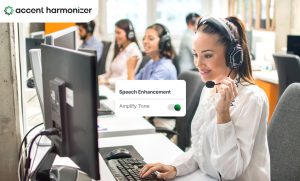

Ensuring clear communication in enterprise contact centers goes beyond investing in high-quality audio infrastructure. Even with VoIP, cloud telephony, and unified communications platforms, enterprises frequently encounter comprehension gaps. These gaps often stem not from signal quality but from the linguistic diversity of agents and customers. Voice clarity solutions for enterprise improve pronunciation and accent variability to achieve intelligible conversations.
Why Enterprise Voice Clarity Still Breaks Down in Contact Centers?
Modern contact centers have largely solved technical audio challenges. High-definition phones, adaptive noise-canceling headsets, and cloud-based VoIP systems minimize packet loss, jitter, and echo. Yet, technical clarity alone cannot prevent misunderstandings caused by varying accents. Clear audio does not always translate into clear comprehension, leaving gaps that affect customer satisfaction, call-handling time, and compliance adherence.
Hidden Gap in Voice Clarity Solutions
While infrastructure ensures voice is delivered clearly, the human element introduces variability. Pronunciation, stress patterns, and intonation can differ significantly among agents and callers. These differences, if left unaddressed, compromise communication effectiveness even with perfect audio. Recognizing and managing this linguistic variability is critical to achieve voice clarity solutions for the enterprise.
Multilingual Contact Center Challenges That Technology Alone Can’t Fix
Accents reflect regional and linguistic diversity rather than lack of skill. Even highly trained agents can encounter comprehension issues when speaking with customers whose pronunciation differs from what they are accustomed to.
How Accent Friction Impacts Contact Center Outcomes?
The result is often repetitive conversations, misheard names or numbers, and repeated confirmations. In sensitive or regulated interactions, misunderstandings can lead to compliance risks. Addressing accent-related friction is therefore a crucial step toward smoother communication and more efficient operations in multilingual contact center environments.
What Is Accent Translation?
The term “accent translation,” in the context of enterprise communication, is often a misnomer for real-time language translation. It is a sophisticated process designed to solve a language barrier, not a pronunciation barrier within the same language.
Understanding Real-time Language Translation
This technology fundamentally changes the words being spoken. The process typically relies on a multi-stage AI pipeline:
- ASR (Automatic Speech Recognition): The spoken language is transcribed into text.
- Machine Translation (MT): The transcribed text is converted to a different target language (e.g., Spanish to English).
- TTS (Text-to-Speech): Synthesizes text into speech for the listener.
This approach is invaluable and constitutes proper cross-language support. It is the optimal solution when an agent speaking Language A needs to communicate with a customer speaking Language B.
Valid Use Cases vs. The Live Call Limitation
While language translation is crucial for multilingual knowledge transfer, compliance documentation, and general cross-language communication, its application in live, high-volume contact center calls faces severe operational limits:
| Live Translation vs. Accent Harmonization | |
|---|---|
| Use Case (Excellent Fit for Translation) | Limitation (Poor Fit for Live Clarity with Accent Harmonization) |
| Multilingual Content | Translating support articles or chat transcripts for a global audience. |
| Latency | The multi-step ASR/MT/TTS pipeline introduces noticeable delays, disrupting the natural rhythm of a live conversation. |
| Language Barrier | Communicating across two entirely different languages (e.g., English to Mandarin). |
| Speaker Obscurement | Translation replaces the speaker’s voice with a synthetic TTS voice, losing the agent’s natural tone, empathy, and identity. |
| Compliance | Documenting or transcribing calls where language conversion is necessary for regulatory purposes. |
| Pronunciation Gap | Translation focuses on converting words into a new language; it does not resolve comprehension issues caused by subtle pronunciation differences when both parties speak the same language (e.g., a strong regional accent). |
What Is Accent Harmonization and Why Is It Different?
Accent Harmonization is fundamentally different from translation. While translation converts language, harmonization refines pronunciation. It is a real-time, in-line speech-processing layer designed to address linguistic diversity and pronunciation variability within a common language (e.g., English, Spanish, French).
Core Mechanism of Voice Clarity Solutions
Accent harmonization modifies the acoustic properties of speech without altering the words or the speaker’s identity. Three key characteristics define the process:
- Intra-Language Focus: It operates entirely within the same language, targeting variations in stress, intonation, and vowel/consonant sounds caused by regional or non-native accents.
- Voice Preservation: Crucially, it preserves the speaker’s original voice, ensuring that empathy, gender, and personal identity are conveyed clearly—unlike the synthetic voices used in TTS.
- Real-Time Processing: The adjustment occurs with near-zero latency, ensuring the conversation flows naturally without the disruptive lag associated with multi-stage translation pipelines.
Simply put, harmonization makes the existing words easier to understand without changing their meaning or the speaker’s core identity.
Seamless Integration into the Enterprise Voice Clarity Stack
Accent harmonization is a unique addition to the modern voice clarity solutions enterprise stack. It is designed to complement—not replace—existing infrastructure:
| Accent Harmonization in the Existing Stack | ||
|---|---|---|
| Existing Stack Element | Function | How Harmonization Integrates? |
| VoIP / Cloud Telephony | Ensures clear audio signal transmission (low jitter, packet loss). | Sits on top of the transport layer, addressing the clarity of the speech content after the audio signal is confirmed clean. |
| Noise Cancellation | Removes environmental acoustic interference. | Focuses on linguistic interference (accent friction) that remains even in a hushed, high-definition call. |
Enterprises often implement this using dedicated platforms, such as Accent Harmonizer by Omind, as an AI-powered enhancement that plugs into the voice pathway. The approach requires no agent retraining and delivers consistent clarity, immediately improving operational metrics such as first-call resolution and customer satisfaction.
Accent Harmonization vs. Accent Translation
The choice between these two advanced speech technologies depends entirely on the fundamental source of the communication gap. Enterprises must align the solution with specific goals, such as converting multiple languages or ensuring pronunciation clarity within the same language.
The table below outlines the practical application differences across key contact center criteria:
| Accent Harmonization vs. Accent Translation | ||
|---|---|---|
| Feature | Accent Harmonization | Accent Translation |
| Core Problem Solved | Pronunciation variability (accents) within the same language. | Language barrier between two different languages. |
| Real-Time Latency | Low/Near-Zero. Operates as a single-step adjustment. | High. Requires a multi-step pipeline (ASR $\to$ MT $\to$ TTS). |
| Speaker Identity | Preserved. Modifies acoustics but keeps the original voice. | Lost. Replaced by a synthetic Text-to-Speech (TTS) voice. |
| Operational Fit | Seamlessly integrated into live customer calls; zero agent retraining. | Best suited for asynchronous tasks, content translation, or specialized interpretation calls. |
| Compliance/Auditing | Ensures consistent speech intelligibility for accurate transcription and compliance. | Focuses on language conversion for documentation; may introduce transcription errors due to TTS quality. |
| Primary Goal | Intelligibility (Clear understanding). | Language Conversion (Understanding meaning in a different tongue). |
Aligning Solution to Source Problem
If your contact center frequently struggles with agents and customers who speak the same language but have different accents or regional pronunciations, the issue is one of intelligibility. In this common scenario, Accent Harmonization offers the most direct and operationally seamless solution.
For most global enterprises running multilingual centers that rely on a common language (e.g., English, Spanish) to serve diverse regions, the core challenge is not language conversion but accent friction. Accent Harmonization is the only technology specifically engineered to close this gap efficiently, making it the most impactful final layer in the enterprise stack for modern voice clarity solutions.
How Accent Harmonization Fits Enterprise Voice Clarity Solutions?
While network optimization and high-definition devices improve audio, accent harmonization ensures the spoken words are understood as intended. Together, these elements create a holistic approach to enterprise communication clarity.
Building a Complete Enterprise Voice Clarity Stack
An effective stack combines technical audio solutions, AI speech enhancement, and accent harmonization. By integrating these layers, organizations can minimize misunderstandings, improve customer interactions, and maintain operational efficiency.
We invite you to schedule a personalized demo of Accent Harmonizer by Omind. See how this intelligibility layer integrates seamlessly with your existing infrastructure and delivers consistent voice clarity across enterprise-wide, real-time, high-volume environments.