An accent harmonizer for COOs of BPO firms is no longer a niche training tool. It is becoming operational infrastructure for contact centers under constant pressure to improve AHT, FCR, CSAT, and cost per resolution.
BPO COOs track performance metrics relentlessly. However, one operational problem often escapes measurement: customers struggle to understand agents during live calls. In many cases, the issue is not agent knowledge. The conversation itself keeps breaking apart. Customers ask agents to repeat information. Calls stretch longer than they should. Frustration builds on both sides of the line.
Most QA reviews never classify these moments as accent friction. Instead, the damage appears later in the metrics: longer handle times, repeat contacts, lower CSAT, rising escalation rates, and agent burnout.
What Is an Accent Harmonizer and Why Do BPO COOs Need It?
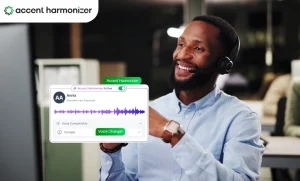
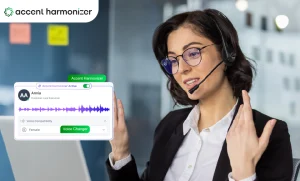
An accent harmonizer is real-time voice-layer software that improves speech intelligibility during live customer calls. Specifically, it processes the agent’s audio stream to reduce accent-related miscommunication without changing the agent’s voice, workflow, or tools.
For BPO COOs, this matters because communication friction is a measurable operational cost — not a soft-skills problem. Unlike traditional methods, accent harmonization vs training provides a scalable way to solve clarity issues without the lag time for coaching. Research by Interaction Metrics consistently shows that comprehension failures are a leading driver of repeat contacts and elevated handle time.
Consequently, when COOs treat accent harmonization as infrastructure rather than training, the financial framing changes entirely.
The Real Operational Cost of Accent Friction
Every misunderstanding scales up operational costs. Mitigating this means tackling the hidden comprehension tax hiding within healthy baseline QA metrics. Operations leaders aiming to expand agent utilization must eliminate capacity loss from unaddressed voice delays across non-native pools.
Every Repeat Sentence Quietly Burns Payroll Minutes
A customer asks for clarification three times. An agent repeats an account number twice. A billing explanation stretches an extra minute because both sides keep recalibrating to each other’s speech patterns.
Those moments do not feel significant in isolation. However, multiplied across millions of calls, they become a margin problem.
| What Happens on the Call | What the Supervisor Sees Later | What the COO Eventually Pays For |
|---|---|---|
| Customer asks the agent to repeat information multiple times | AHT creeps upward across the queue | Recovered capacity disappears |
| Account details get misheard | Repeat contacts increase | FCR penalties and callback costs rise |
| Agent slows speech unnaturally to compensate | Queue times extend during peak hours | Service levels destabilize |
| Customer loses patience mid-call | Escalation rates increase | CSAT erosion shows up in client reviews |
| Agent spends entire shifts overcorrecting pronunciation | Fatigue and confidence decline | Attrition and rehiring costs climb |
| Speech analytics struggle to interpret unclear audio | QA data becomes noisy | AI and analytics investments underperform |
Every repetition loop directly inflates operational overhead. Forward-thinking COOs protect their margins by utilizing an AI accent harmonizer to support communication clarity across their global centers.
Traditional Accent Programs Rarely Solve This Cleanly
Unaddressed acoustic friction in global delivery centers erodes margin gains, making offshore team voice optimization a core operational requirement. Pronunciation workshops look productive on paper, so do coaching sessions and nesting support.
However, most COOs eventually hit the same wall: the spend is visible while the operational impact stays fuzzy. Nobody can isolate the effect confidently. Consequently, most accent initiatives get classified as HR expenses rather than operational infrastructure — and never get the measurement rigor they deserve.
Real-Time Accent Harmonization Works Inside BPO Operations
Real-time accent harmonization software integrates directly into existing contact center platforms. Specifically, deployment behaves more like infrastructure activation than operational surgery — measured in days to weeks, not quarters. The ultra-low latency voice AI ensures that the audio is harmonized in real-time without the ‘robotic’ lag that plagues older systems.
You Can Test It Before You Bet the Floor on It
COOs do not have to gamble the entire operation on vendor promises. Phased rollout is straightforward: one site first, one client program first, one agent group first.
Because the effect appears in live call metrics almost immediately, AHT movement becomes visible inside a controlled environment before deployment expands. That changes the internal conversation from theoretical to evidential.
Why Voice Clarity Is Infrastructure, Not Training?
Most BPOs are running speech analytics, agent assist tools, and automated QA scoring. However, all of those tools depend on accurate transcription and accurate transcription depends on clean audio.
When conversations are difficult to parse, speech-to-text accuracy weakens. Topic detection becomes unreliable. Sentiment scoring produces noise. Compliance flags get missed. Consequently, analytics teams make decisions from flawed dashboards without realizing the root cause is upstream.
Executives blame the AI models. Often the real issue is simpler: the underlying audio quality was never clean enough to support accurate transcription. Accent clarity often breaks down at enterprise scale, turning your expensive analytics into a source of ‘noisy’ data.
| “ Most contact centers overestimate their AI maturity because they underestimate how bad audio corrupts downstream analytics. If the transcript is flawed, every insight built on top of it becomes less reliable. ” |
When Transcripts Are Wrong, the Dashboards Lie
Real-time accent harmonization improves the input quality for every downstream system. Speech-to-text accuracy improves. QA scoring becomes more reliable. Agent assist tools surface better recommendations. Conversation analytics stop misclassifying interactions.
The AI suddenly looks smarter — because the input stopped fighting the system. For COOs investing in AI-driven contact center transformation, voice clarity is therefore prerequisite infrastructure, not an optional enhancement.
Specifically, Omind AI’s Accent Harmonizer is engineered for large-scale BPO environments where small communication failures become expensive operational problems very quickly.
What This Means for Client Retention and Renewal Conversations?
Addressing systemic margin leaks means tackling the hidden repetition loops that inflate labor costs. They prove why speech clarity optimization targets hidden customer complaints directly at the source. If a BPO can show measurable improvements in AHT, FCR, CSAT, and escalation rates after deployment, the renewal of conversation changes entirely. However, if CSAT has slipped and the explanation is another training initiative, clients grow skeptical.
How to Evaluate an Accent Harmonizer for Your BPO Operation?
Before committing to any voice-layer solution, operations leaders should pressure-test vendor claims with specific operational questions:
- Integration: Does it work natively with your current CCaaS platform without requiring workflow changes?
- Measurability: Can you isolate AHT and FCR impact by agent cohort within the first 30 days?
- Phasing: Can you deploy to a single client program before expanding across the floor?
- Downstream effects: Does the vendor provide data on transcription accuracy improvement across connected speech analytics tools?
Specifically, any vendor unable to answer the measurability question with real deployment data from comparable BPO environments should not advance past the evaluation stage.
Conclusion
Most COOs have already optimized routing. They have refined scripts, invested in QA, and overhauled workforce management. However, the communication friction inside live conversations often remains untouched — because it never showed up cleanly on a dashboard.
Real-time accent harmonization surfaces that friction, measures its operational cost, and removes it at the source. The result is an operation that runs cleaner: shorter calls, stronger FCR, lower attrition, consistent multi-site performance, and AI tools that finally perform as promised.
Voice clarity is infrastructure. And infrastructure changes operations when it works quietly in the background every single day.
Ready for the next step?
You have already optimized routing, QA, staffing, and scripts. If calls are still stretching longer than they should, the problem may not be workflow anymore. See how Accent Harmonizer performs in your workflow.