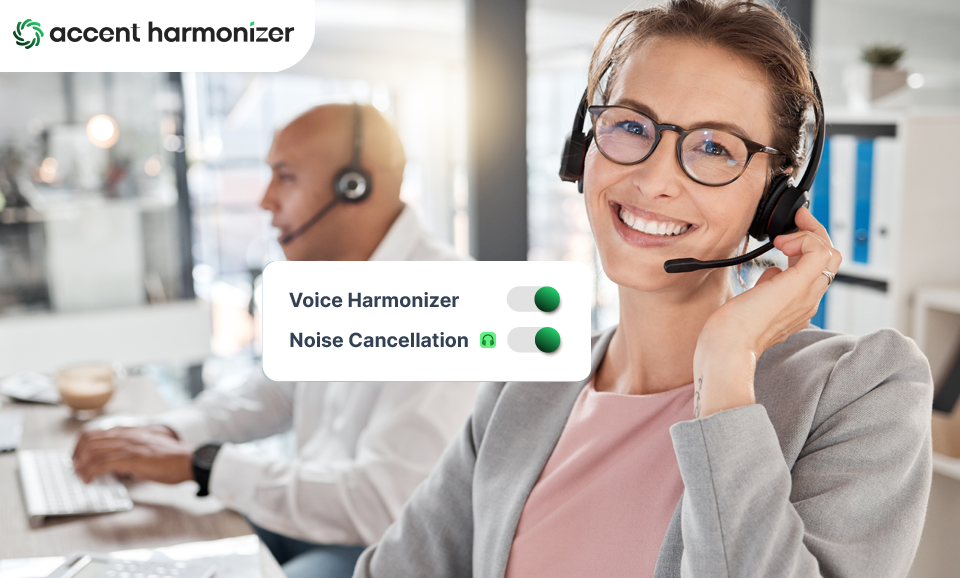
In global contact centers, communication problems rarely come from knowledge gaps. They come from accent friction — small phonetic differences that force customers to repeat questions, mishear numbers, and lose confidence during critical conversations.
A real-time accent changer powered by AI speech processing solves this problem at the moment it happens, improving clarity without forcing agents to retrain their voices. The result: smoother conversations, faster resolutions, and customers who feel heard — every time, regardless of where your agents are located.
What Is a Real-Time Accent Changer?
A real-time accent changer is a software layer that analyzes an agent’s spoken audio, identifies phoneme-level pronunciation patterns, and modifies specific sounds. Organizations evaluating accent harmonization often compare it with accent neutralization software to determine the best approach for improving communication clarity in customer conversations.
It is fundamentally different from two older approaches to accent management:
- Voice filters alter the overall sound profile of a speaker — pitch, resonance, or timbre — without targeting specific pronunciation patterns. They change how a voice sounds, not whether it is understood.
- Accent training programs coach agents over weeks or months to modify how they speak. While effective for long-term development, they offer no immediate impact and do not scale quickly across a growing workforce.
Real-time accent changing operates at the phoneme level — the smallest units of sound that carry meaning in speech. By detecting when a phoneme is likely to cause a comprehension failure for the listener, and replacing or adjusting it in milliseconds, the system acts as a live pronunciation bridge between speaker and listener.
Why Accent Friction Slows Down Global Customer Conversations?
Every unfamiliar accent places an additional cognitive burden on the listener. Researchers describe this as listening load: the extra mental effort required to decode speech when it deviates from the listener’s phonetic expectations. It also increases cognitive load for call center agents, contributing to fatigue and reduced performance over time.
| LIVE CALL SCENARIO: The Cost of Phoneme Mismatch | ||
|---|---|---|
| What the Agent Says | What the Customer Hears | Consequence |
| Your shipment arrives on the fourteenth. | Your shipment arrives on the fortieth. | Customer calls back three days late |
| The reference number is 1-5-0. | The reference number is 1-5-4. | Authentication fails; agent escalates |
| Your balance is one thousand dollars. | Your balance is one-hundred dollars. | Customer disputes account statement |
Even small pronunciation mismatches can create costly misunderstandings during live customer interactions. At scale, these communication gaps increase handle times, drive repeat contacts, and negatively impact customer satisfaction.
Voice Clarity Matters More Than Accent Neutrality
Many organizations search for accent-neutralization technology to manage accents-related miscommunications. In reality, customers rarely evaluate agents based on local sounds. They evaluate whether the interaction is easy to understand. This is why enterprises are increasingly shifting their focus from AI voice clarity solutions that improve customer understanding without requiring agents to change how they naturally speak.
Voice clarity refers to how easily listeners can understand spoken information in real time. High voice clarity reduces listening effort, minimizes requests for repetition, and allows customers to focus on the content of the conversation rather than decoding speech patterns.
A real-time voice clarity solution addresses communication challenges in real-time. Instead of requiring agents to change how they naturally speak, AI-powered harmonization technology improves the speech clarity. It results in a more natural customer experience.
How AI Accent Changing Technology Works During a Live Call?
Understanding how real-time accent conversion actually functions at the infrastructure level is important for buyers evaluating integration requirements and latency risk. This process is closely related to real-time accent conversion, where AI dynamically adapts speech patterns while preserving the speaker’s natural voice. The process consists of five sequential stages, each optimized for minimal delay.
- Stage 1 — Audio Capture: Audio is captured directly from the agent’s headset or softphone client. The system establishes a parallel audio stream alongside the standard call audio path, ensuring that the customer-facing output can be processed and modified without interrupting the original recording or compliance monitoring stream.
- Stage 2 — AI Phoneme Detection: The incoming audio stream is passed to a phoneme recognition model. The model identifies which phonemes are being produced in real time and compares them against a listener comprehension profile that defines which phoneme variants are likely to cause processing load for the target listener group.
- Stage 3 — Accent Harmonization Model: Flagged phonemes are passed to the harmonization model. This model does not replace the voice — it adjusts specific phoneme characteristics (vowel height, consonant articulation, prosodic rhythm) to align more closely with the listener’s phonetic expectations, while preserving the speaker’s vocal identity, tone, and pacing.
- Stage 4 — Real-Time Speech Synthesis: The adjusted phonemes are re-synthesized into a continuous audio stream using a neural voice model. This stage is the most latency-sensitive: the synthesis must be completed before the original audio gap closes or the listener’s ear detects discontinuity. The ultra-low latency in voice AI processing keep conversations natural.
- Stage 5 — Output Stream to Customer: The harmonized audio stream is delivered to the customer via the existing call infrastructure. From the customer’s perspective, the call sounds natural, the agent’s voice is recognizable, and comprehension is significantly improved.
Accent Harmonization vs Accent Neutralization vs Accent Conversion
The market uses several overlapping terms to describe accent-related technology. Understanding what each category does and what it costs in voice quality.
| Comparison of Accent & Voice Technologies | ||||
|---|---|---|---|---|
| Technology | How It Works | Speed to Deploy | Voice Identity Preserved? | Limitations |
| Accent Training | Human coaching over weeks or months to shift pronunciation habits | Slow (months) | Yes | Cannot scale quickly; no real-time impact; effectiveness varies by agent |
| Accent Neutralization | Flattens or removes regional phoneme patterns to produce a ‘neutral’ output | Fast (software) | Partially | Strips vocal warmth and naturalness; perceived as robotic by many listeners |
| Voice Conversion | Replaces agent voice with a synthesized alternative voice profile | Fast (software) | No | Artificial sound quality; agent identity lost; compliance and consent concerns |
| Accent Harmonization | Adjusts specific phonemes toward listener expectations while preserving speaker identity | Fast (software) | Yes | Requires accurate accent-pair modeling; effectiveness depends on model coverage |
For enterprise contact centers, accent harmonization represents the most operationally viable option: it deploys as software, requires no agent retraining, preserves the human quality of the interaction, and targets only the phonemes that generate comprehension failures — leaving the agent’s natural voice and personality intact. This is why many procurement teams now prioritize harmonization over traditional neutralization when evaluating vendors.
“Neutralizing an accent is not the same as improving comprehension. When you strip phonetic identity, you also remove prosodic cues that carry emotional meaning. The listener may understand the words, but lose the tone.”
What to Look for in a Real-Time Voice Clarity Solution
Speech technology improves comprehension during live customer conversations. When evaluating a real-time voice clarity solution, organizations should focus on the factors that directly affect customer understanding, agent experience, and operational performance.
Key Evaluation Criteria
While voice clarity software improves speech comprehension, many contact centers also combine it with noise reduction software to minimize background distractions and further improve conversation quality.
| Voice Harmonization Software Evaluation Parameters | |
|---|---|
| Evaluation Area | Why It Matters |
| Processing Latency | Delays can disrupt conversation flow and negatively impact customer experience. |
| Voice Preservation | Agents should remain recognizable while speech clarity improves. |
| Accent Coverage | The platform should support multiple accent routes across global operations. |
| Speech Naturalness | Adjustments should sound human and conversational rather than synthetic. |
| Enterprise Scalability | The solution must support thousands of simultaneous interactions. |
| Security and Compliance | Voice processing should align with enterprise governance requirements. |
| Integration Flexibility | Compatibility with CCaaS, telephony, and contact center infrastructure is essential. |
The most effective solutions improve comprehension without introducing noticeable latency, altering the speaker’s identity, or disrupting conversation flow. For enterprise contact centers, the right balance of clarity, speed, scalability, and voice preservation is critical for successful deployment.
Real-time Accent Changing Software Delivers the Most Business Value
Real-time accent harmonization technology does not deliver uniform value across all contact center types. Its highest-impact deployments share a common profile: high call volume, cross-regional accent exposure, and KPIs directly tied to communication quality.
Industries with the Highest Impact
- BPO Contact Centers: With large offshore or nearshore agent populations handling customer interactions for US, UK, and Australian clients, BPOs carry the highest accent-friction risk of any industry. Even marginal improvements in phoneme clarity generate measurable AHT reductions across millions of calls. Also, accent misunderstanding impacts BPO quality assurance and operational costs.
- Financial Services Support: Account management, loan servicing, and payment dispute calls require precise communication of numbers, dates, and account identifiers — exactly the categories most vulnerable to phoneme-level miscommunication.
- Healthcare Service Desks: Patient scheduling, insurance verification, and care navigation calls carry both communication-clarity requirements and regulatory compliance stakes. Miscommunication here creates patient safety and risk liability.
- SaaS Technical Support: Technical support conversations involve dense jargon, version numbers, and precise instruction sequences. Phoneme errors in technical terminology generate significantly higher repeat-contact rates.
- Global Sales Teams: In outbound sales contexts, perceived communication difficulty reduces customer confidence and increases early call termination. Accent harmonization removes a friction point that sales training cannot address.
How Real-Time Voice Clarity Software Impacts Contact Center KPIs?
Improving communication clarity can influence both customer experience and operational performance. By making conversations easier to understand, real-time voice clarity software helps contact centers improve key service and efficiency metrics.
| Operational Impact of Improved Voice Clarity | |
|---|---|
| KPI | Expected Impact |
| Average Handle Time (AHT) | Reduced due to fewer repetitions and clarifications. |
| First Contact Resolution (FCR) | Improved through clearer communication. |
| Customer Satisfaction (CSAT) | Increased as conversations become easier to follow. |
| Escalation Rate | Reduced because misunderstandings occur less frequently. |
| Repeat Contacts | Lower due to more accurate information exchange. |
| Agent Confidence | Improved through smoother customer interactions. |
The business impact becomes increasingly significant at scale. Even modest improvements in communication clarity can contribute to shorter call times, better customer experiences, and more efficient contact center operations.
Closing the Clarity Gap with Accent Harmonization
In a global economy, an agent’s geography should never be a barrier to a customer’s understanding. The traditional hurdles of “listening load” and phoneme mismatch do more than just frustrate callers. They inflate AHT, erode customer trust, and create invisible operational costs that drain contact center efficiency.
Real-time accent harmonization represents a fundamental change in how enterprises approach voice quality. By moving away from slow, unscalable training programs and robotic “neutralization,” businesses can now protect the human element of every call while ensuring technical clarity.
For modern BPOs and global enterprises, implementing a real-time accent changer is no longer just a technical upgrade—it is a strategic necessity for maintaining a competitive edge in customer experience.
Experience Real-time Accent Harmonization in Live Calls
Hear the difference between before-and-after harmonization on real call recordings. Test clarity improvements across your specific agent-to-customer accent routes.