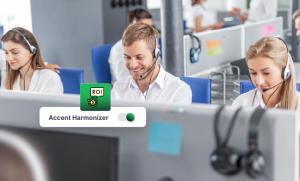

Jenna works as an agent in a busy global contact center. She answered the phone and greeted the caller: “Good morning, this is Jenna, how can I assist you today?” The customer, calling from a small town in Scotland, replied with a strong accent: “Aye, I need help with me internet speeds, it’s slower than a Sunday driver.” Jenna, who often speaks with people from different backgrounds, tried to keep the conversation on track. As the call went on, she had to ask the customer to repeat information. Even with her best efforts, the call took longer than usual. Accent harmonization for BPOs aims to solve this problem.
This scenario highlights the accent-related misunderstanding and its hidden costs that often go unnoticed in standard reporting. Language differences are common in global contact centers. With teams and customers from many regions, agents often work with a range of accents. This is a normal part of daily operations and does not mean there are problems with hiring or training.
Accent harmonizers can improve speech clarity, but how well they work depends on the situation. This article looks at when AI accent harmonization is most useful in contact centers, when it may be less effective, and how teams test tools like Accent Harmonizer by Omind before using them more widely.
What “Accent Clarity” Means in Real Contact Center Environments?
People often mix up accent clarity with things like background noise, how fast someone talks, language skills, or microphone quality. Accent harmonization focuses on pronunciation and speech differences that make it harder for listeners to understand.
Accent-related friction causes:
- High-volume transactional calls requiring fast exchanges
- First-contact interactions with no prior familiarity
- Calls involving numbers, addresses, or technical terminology
Operational Impact of Accent-related Misunderstanding
When accent clarity is a problem, the effects are often indirect. Supervisors may notice longer call times because agents have to repeat themselves. QA teams might see ‘communication clarity’ issues but not find clear skill gaps. Agents can also feel frustrated when they have to repeat simple details.
Common operational patterns include:
- Repetition loops that prolong calls
- Clarification cycles that delay resolution
- Escalations triggered by misunderstanding rather than policy disputes
Many BPOs are now focused on slashing repeat calls with real-time voice clarity to prevent these skews in performance metrics.
Why Traditional Accent Training Hits a Scalability Ceiling?
Accent training is still a common part of onboarding and coaching in BPOs. It works well in small, controlled groups, but is difficult to use with large or changing teams.
Training results can fade over time, especially when agents speak with customers from many regions. Coaching also has trouble keeping up with new product terms, busy periods, or changes in vocabulary during calls. This is a major reason why contact centers are adopting software over traditional training for immediate, scalable results.
Operators commonly face trade-offs such as:
- Weeks of training versus immediate staffing needs
- Inconsistent retention across agents
- High coaching investment relative to measurable gains
Training is still important, but it cannot solve real-time communication problems by itself.
How Real-time Accent Harmonization Works in Live Calls?
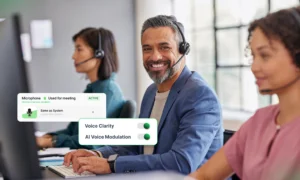
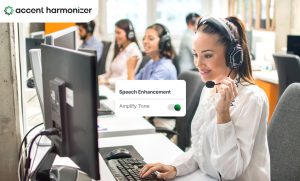
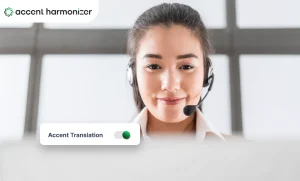
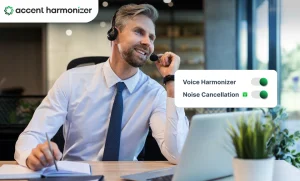
Real-time accent harmonization systems, also known as accent translation solutions, work like instant subtitles for your ears. They adjust speech during calls, making pronunciation more neutral while keeping the speaker’s tone and emotion. Agents talk as they normally would, but customers hear the modified audio. This helps conversations flow better and solves accent-related issues as they come up.
In practice, tools like Accent Harmonizer by Omind provide this feature during live calls, not after the call is over.
Latency is important. Even small delays can disrupt a conversation, so real-time systems need to work quickly.
To achieve this without robotic distortion, the system relies on inside real-time phonetic modeling. For call centers, speech clarity systems tend to be most effective when:
- Latency remains imperceptible
- Emotional cues are largely preserved
- Agent workflows remain unchanged
Practical Limits and Considerations Teams Must Evaluate
Accent harmonization does not help every call in the same way. Advisory or emotionally complex calls may not benefit much, since understanding is not the main problem.
There are also technical and perceptual considerations:
- Language and accent coverage may vary
- Over-processing can introduce unnatural speech characteristics
- Some customers may perceive voice modification negatively
In regulated environments, teams must check if real-time voice tools affect compliance or audits. For this reason, it is important to test these tools carefully before using them widely.
Measuring Outcomes Without Overstating Impact
Organizations that pilot accent harmonization typically avoid relying on a single KPI. Instead, they monitor directional trends across multiple indicators.
Common evaluation signals include:
- Variance in average handle time rather than absolute reduction
- Reduction in clarification-related QA flags
- Shifts in how training resources are allocated
Results can vary. They depend on factors like location, customer types, call topics, and how the system is set up.
Where Accent Harmonization Fits in the Contact Center Tech Stack?
Accent harmonization has become an important part of contact center technology. It keeps voice data clear, which helps other tools like speech analytics and AI quality checks work more effectively.
For Omind, Accent Harmonizer improves clarity early in the process, which helps later analytics. It works with other technologies to prevent overlap or loss of quality.
Use Patterns Across BPO Verticals
In these industries, AI speech tools for agents are mainly used to solve problems on calls where clarity is most important, not as a general fix for customer experience.
- Customer support BPOs: Agents often manage high-volume, time-sensitive calls where quick understanding is crucial. For example, a customer support agent may need to resolve billing issues for customers with different accents.
- Banking and financial services: Accuracy and trust are key for the BFSI domain. When implementing AI voice harmonization for banking financial companies, the focus shifts from general “support” to high-stakes precision. Picture a bank representative carefully relaying routing numbers between accents to ensure customer security; here, the technology acts as a fail-safe against costly transcription errors.
- Healthcare contact centers: These centers need clear communication because of the sensitive information involved. For instance, a nurse may need to give medical advice to patients who speak different dialects.
- Telecom and utilities: Clarity is very important in this industry. For example, an agent may have trouble explaining how to reconfigure a modem if the customer has a different accent.
How do Enterprises Pilot and Scale Accent Harmonization?
Large organizations usually start with controlled pilot programs. These pilots use small groups of agents, specific call queues, and set evaluation periods. One agent, Tom, shared his experience: “At first, I was unsure how much difference the Accent Harmonizer would make. But after a few calls, I noticed the conversations flowed smoothly, and I spent less time repeating information.”
Standard pilot practices include:
- Selecting agents across experience levels
- Comparing similar queues with and without real-time harmonization
- Collecting agent feedback alongside operational metrics
Teams often choose to expand after seeing consistent results, not just one-time improvements. Managing change is important, especially when gathering agent feedback and making sure everyone is involved.
Direction of Speech Augmentation in Contact Centers
Accent harmonization is part of a bigger trend in adaptive communication technology. These tools help with communication barriers as they happen, supporting human agents instead of replacing them.
Future updates may go beyond just neutralizing accents and instead help convey authentic identity across regions. As clarity improves, there is a chance to keep the unique rhythms and tones that show individual and cultural identities. Balancing these changes with real-time adaptation will help the technology stay effective and build trust.
Conclusion
Accent harmonization can help solve call clarity problems in global contact centers, especially when accent misunderstandings happen often. These tools work best when used for specific issues and measured carefully, not as a one-size-fits-all solution.
For CX and operations leaders, the key question is whether speech clarity AI solves a real problem in their contact center, not just if it works in theory. Tools like Accent Harmonizer by Omind should be tested with clear goals and pilot programs before being used everywhere.
Explore Accent Harmonizer by Omind
If your team is looking into accent harmonization, Omind offers the Accent Harmonizer for focused testing rather than a blanket rollout. Contact us to schedule a demo and learn more.