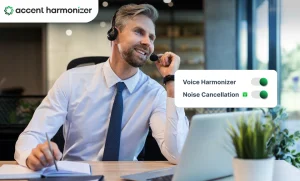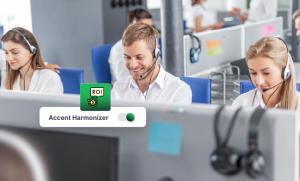

A customer service agent in Manila expertly handles a stream of technical support calls, yet customers still ask her to repeat herself. Despite her product knowledge, quick responses, and empathy, these requests undermine her confidence. By the end of her shift, she feels worn out from the extra effort required just to be understood. Accent Harmonizer Software helps reform this issue.
It is one of the hidden costs of accent friction. One study found that misunderstandings of accents can increase call time by up to 10%, affecting metrics such as Average Handle Time and First Call Resolution. By seamlessly eliminating this comprehension breakdown, Omind’s Accent Harmonizer solves this problem.
Hidden Cost of Accent Friction in Contact Centers
Accent friction is not reflected in standard performance dashboards, yet it has a real impact on agent well-being and efficiency. It leads to anxiety, inefficiency, and cognitive overload. Gartner consistently highlights that agents are at high risk of burnout, mainly due to the high cognitive load required for complex, high-friction interactions. This category includes managing communication barriers such as accent-related friction. Here are some hidden costs of accent friction:
Agents Go through Accent Anxiety
Many agents in global centers speak fluent English but with regional accents. These accents can make agents self-conscious if customers seem frustrated or confused. Agents may monitor pronunciation, alter sentences, or avoid certain words, leading to hesitation, less natural conversation, and lower confidence.
Accent Clarity Issues Slow Down Calls
When clarity drops, conversations take longer. Agents repeat themselves, and customers ask for clarification. Even simple tasks like confirming an account number or explaining a step take longer. These delays add up over hundreds of calls, increasing Average Handle Time (AHT) and lowering First Call Resolution (FCR).
Mental Overhead for Agents
Contact center agents already juggle several demands: managing screens, following scripts, reading emotions, and making fast decisions. Monitoring their accent adds to the pressure. The brain can only handle so much, so focusing on pronunciation can undermine skills like empathy and problem-solving.
Is Accent Harmonizer by Omind Helpful?
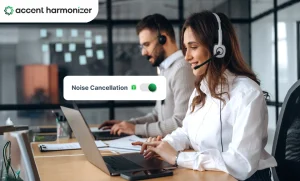
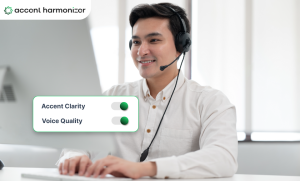
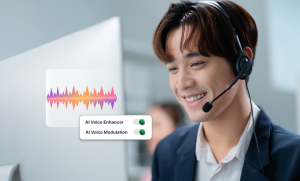
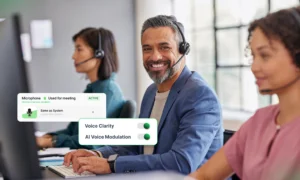
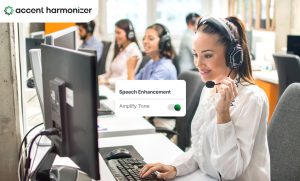
Accent Harmonizer by Omind is an enterprise-grade AI tool for more transparent communication. It helps agents speak more clearly in real time, so customers can better understand them. The platform smooths regional accents and blocks background noise.
The real-time accent correction tool improves vowels and consonant sounds and adjusts speech speed as needed. It removes background noise, so customers hear the agent clearly and with almost no delay, making conversations smoother.
Preserves Natural Tone, Emotion, And Cultural Vocal
Accent Harmonizer keeps an agent’s natural rhythm, tone, and feeling. Unlike older accent tools that sound flat and emotionless, it retains warmth, urgency, and empathy. This improves customer experience and builds a connection with real human interaction.
Integrations With Existing Telephony
Accent Harmonizer works with existing telephony platforms. It can be set up with minimal workflow changes or extra training. The AI voice clarity solution involves evaluating current systems, conducting a pilot test with a few agents, and then rolling it out fully in a few weeks. Support teams help address issues promptly and minimize disruptions. The real-time accent correction tool ensures immediate benefits.
How Accent Harmonizer Reduces Agent Cognitive Load?
Accent Harmonizer’s main benefit is mental relief. Clearer audio lets agents focus on solving customer problems instead of worrying about being understood. Here is how the software dramatically reduces agent cognitive load and stress:
- Eliminates Self-Monitoring: Agents no longer must constantly track and rephrase their own speech or worry about whether their accent is creating a barrier. This frees up significant mental bandwidth.
- Reduces Guesswork and Repetition: When customers understand the agent immediately, the agent avoids the time and stress of guessing at customer confusion and having to repeat or clarify instructions multiple times.
- Facilitates Deeper Engagement: By simplifying the transactional conversation, the agent’s mental energy is redirected to higher-value activities, allowing them to focus entirely on empathy, complex problem-solving, and improving the overall customer experience.
- Increases Resilience: Over time, this reduction in effort leads to a direct decrease in daily fatigue and burnout, making the entire workforce more effective and resilient.
How Accent Harmonizer Builds Agent Confidence and Natural Flow?
AI solutions for accent clarity and confidence help agents be heard and understood. Before Accent Harmonizer, an agent might say, ‘I’m sorry, can you repeat that?’ uncertainly. With it, the same agent replies, ‘I understand, let me assist you with that,’ with confidence. It also helps in:
Agent Communication Enhancement Allows Professionals to Speak in Their Real Voice
With Accent Harmonizer and its agent communication enhancement, professionals stop trying to sound different. Authenticity makes agents feel valued and benefits the business. Agents who feel respected are more engaged and less likely to leave. Fewer misunderstandings give agents more control in conversations.
Consistent Clarity Across Customer Interactions
For agents serving customers from different regions, consistency matters. Accent Harmonizer ensures an agent in Bangalore sounds just as clear to customers in Dallas, Dublin, or Dubai. This geographic neutrality cuts a major anxiety source: the fear that some customers will understand and others won’t. With this, every conversation starts on equal terms.
Harmonization vs. Neutralization
Here is the difference between voice harmonization and neutralization:
| Feature | Accent Harmonization by Omind | Accent Neutralization (Generic Applications) |
|---|---|---|
| Goal | To make speech more transparent and comprehensible. | To remove vocal identity and create a plain, generic sound. |
| Authenticity | Preserves the speaker’s original emotional melody, rhythm, and tone, maintaining cultural nuance. | Removes or flattens the expressive elements, risking a robotic or artificial tone. |
| Customer Trust | Builds Trust by keeping the agent’s voice natural and human. The customer hears a real person. | Risks: Breaking Trust as customers sense the unnatural or scripted quality of the voice. |
| Technology | Adaptive AI that respects and adapts to each unique speech pattern for inclusion. | Distorting technology that forces a single, standardized pattern, promoting conformity. |
Use Cases Where Accent Harmonizer Delivers the Most Value
Accent Harmonizer is flexible, but some industries and workplaces benefit even more because of their specific communication needs.
Contact centers
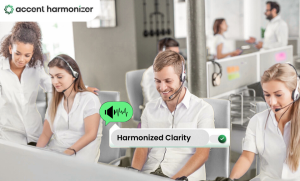
Busy contact centers are the ideal place for accent harmonization technology. Agents in support, sales, retention, and collections require real-time accent correction tools for clear communication. Multilingual support desks, where agents switch languages or help non-native English speakers, also benefit from noise reduction and real-time clarity improvements.
Global Enterprise Collaboration
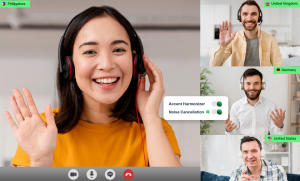
Accent Harmonizer also helps with teamwork in large organizations. Remote meetings, cross-team projects, and global leadership calls all run more smoothly when everyone can communicate clearly, no matter where they are or what their first language is. This reduces meeting problems, speeds up decisions, and helps everyone feel safe to speak up.
High-stakes Verticals
Some industries, such as healthcare, travel, education, and banking, can face severe problems due to miscommunication. In these fields, the AI voice clarity solution works as a helpful tool. It reduces risk and protects both customers and organizations from mistakes.
What Enterprises Should Evaluate When Considering Accent Harmonizer?
Choosing an accent harmonization solution means looking at its technical performance, how well it fits your operations, and its security standards.
Latency & Real-time Performance
Low latency is essential. If a solution causes noticeable delays, it disrupts the conversation and creates new problems. Companies should test latency in real-world conditions, including during peak periods and under different network conditions.
Language, dialect & accent coverage
Not every AI model is trained in a wide range of accents. Companies should make sure the solution supports the specific accents and languages their agents and customers use. It is important to check for coverage of regional dialects, such as Indian English, Latin American Spanish, and Southeast Asian English.
Privacy, compliance & data security
Voice data is sensitive. Enterprises must ensure that the AI voice clarity solution complies with regulations such as GDPR, CCPA, and industry-specific standards (e.g., HIPAA for healthcare, PCI-DSS for payments). Data handling practices, whether voice is stored, anonymized, or processed in real time, should be transparent and auditable.
Conclusion
Accent Harmonizer by Omind is more than just an audio tool. It helps relieve mental strain, boosts confidence, and levels the playing field for global communication. By removing the hidden burden of accent friction, agents can focus on solving problems, building relationships, and providing excellent customer service. Today, when inclusion, mental health, and efficiency all matter, solutions that respect people and deliver tangible business results are not just helpful. They are essential.
For organizations considering real-time AI accent clarity to help agents at scale, the real question is not if this technology is essential. It is whether you are ready to invest in tools that help your people and your customer experience truly succeed.
How Much is Agent Confidence Worth in Your Business?
Are you interested in relieving agent stress, cutting AHT, and leveling the playing field for your global teams? Schedule a 15-minute consultation to discuss agent communication enhancement with Accent Harmonizer by Omind