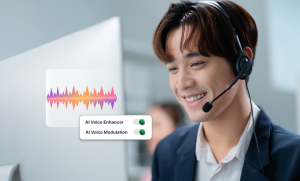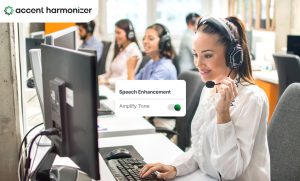

Global contact centers rely on offshore talent, yet accent variance often creates communication friction that lengthens calls, frustrates customers, and disrupts AI automation workflows. Traditional accent training programs rarely scale across large BPO teams — they are time-intensive, inconsistent, and slow to adapt as teams grow.
Modern AI accent neutralization software for contact centers harmonizes speech in real time. It improves clarity while preserving the speaker’s natural voice. Understanding how this technology works — and how it fits into the modern AI contact center stack — has become critical for enterprises operating global customer support teams.
Accent Neutralization Matters in Modern Contact Centers
Global BPO workforces span regions including the Philippines and Latin America, where accent differences can affect comprehension for customers calling from North America, the UK, or Australia. The operational consequences are measurable: longer average calling times, lower first-call resolution rates, increased escalations, and reduced CSAT scores.
But there is an often-overlooked dimension to this challenge. As contact centers adopt AI-powered voice automation, accent variance creates a second layer of friction. Speech recognition models trained primarily on standardized accents can struggle with regional phonetic variation, reducing transcription accuracy and undermining automation reliability.
In short, accent clarity is no longer just a human communication issue. It is a system reliability issue for AI-driven contact centers.
What Is Accent Neutralization Software?
Several related terms appear in this space, and they are often confused. Here is a clear breakdown:
- Accent Neutralization: AI adjusts speech patterns to improve intelligibility for the listener, without necessarily shifting to a specific regional accent.
- Accent Translation: The system transforms speech to sound closer to a target regional accent — for example, shifting from a Filipino accent toward a neutral American accent.
- Accent Harmonization: AI subtly aligns phonetic patterns while preserving voice identity, tone, and naturalness, making it different from generic voice changers.
- Accent Reduction: Traditional training programs designed to modify speech habits over time. Effective at the individual level but difficult to scale across thousands of agents.
| Comparison of Accent Improvement Approaches | ||
|---|---|---|
| Approach | Method | Scalability |
| Accent Training | Human coaching | Limited |
| Accent Neutralization AI | Real-time processing | Highly scalable |
| Accent Harmonization AI | Phonetic alignment + tone preservation | Enterprise-grade |
| Accent Translation AI | Full regional conversion | Scalable |
How Real-Time Accent Harmonization Works?
Real-time accent harmonization processes speech through a multi-stage pipeline that operates within milliseconds to avoid perceptible latency. The stages are:
- Audio capture: The agent’s voice is captured via headset or softphone integration.
- Phonetic analysis: A speech model analyzes incoming audio at the phoneme level — the smallest units of sound.
- Accent pattern detection: The system identifies patterns that may reduce intelligibility for the target listener.
- Real-time phoneme adjustment: Specific phonemes are adjusted to improve clarity while preserving the speaker’s pitch, cadence, and tone. AI identifies accent patterns in milliseconds, providing quick results.
- Voice reconstruction: The refined audio is output in real time to the customer’s end of the call.
Does Accent Neutralization Affect Voice Tone or Naturalness?
Modern accent harmonization systems use tone preservation algorithms that maintain pitch consistency across the processing pipeline. Phonetic smoothing techniques ensure that adjustments do not produce unnatural transitions between sounds. The result should be speech that sounds like a slightly clearer version of the original speaker — not a robotic or artificially generated voice.
There are also valid cultural and identity concerns worth acknowledging. Accent harmonization is not designed to eliminate accents or impose a single “neutral” standard. It is designed to reduce intelligibility barriers while respecting the speaker’s voice. The goal is communication equity — making it easier for customers to understand agents, and for AI systems to accurately process speech, without requiring agents to suppress their natural way of speaking.
Where Accent Harmonization Fits in the Contact Center Technology Stack?
Accent harmonization functions as a voice infrastructure layer — sitting between the agent’s audio input and the downstream systems that process it. A typical integration looks like this:
Real-time flow: Agent audio → Harmonization → ASR → Voicebot/CRM → Analytics/QA
This middleware position means accent harmonization improves performance for every downstream system simultaneously — speech recognition becomes more accurate, AI voicebots process intent more reliably, and call recordings produce cleaner transcripts for QA analysis.
From a deployment perspective, modern solutions are designed for compatibility with major CCaaS platforms and low-latency operation. Enterprises should evaluate solutions on latency performance under production load, integration flexibility, and support for multilingual environments.
Benefits of Accent Neutralization for Global BPO Teams
The accent harmonization benefits extend across both human and AI-assisted workflows:
- Improved call clarity reduces the number of repeated clarifications, shortening average handle time.
- Faster issue resolution improves first-call resolution rates and reduces escalation volume.
- Higher CSAT scores follow from customers experiencing clearer, more confident interactions.
- AI automation reliability improves as speech recognition engines process more consistent phonetic input.
- Voice analytics accuracy increases, producing cleaner data for performance monitoring and quality assurance.
- Reducing cognitive load for agents leads to better performance and retention.
For large BPO operations running thousands of agents across multiple geographies, these gains compound significantly. Technology also supports multilingual environments where agents may be handling calls across language variants, making it a scalable solution for the most complex global operations.
Evaluating Accent AI Solutions for Contact Centers
When evaluating real-time speech AI vendors, enterprise buyers should evaluate against the following criteria:
- Real-time processing capability: Does the system operate with sub-100ms latency under production load?
- Voice naturalness: Does the output preserve the agent’s tone, pitch, and identity?
- Integration flexibility: Is the solution compatible with your existing CCaaS platform and telephony stack?
- Multilingual support: Can the system handle the accent diversity of your agent population?
- AI voicebot performance: Does accent harmonization measurably improve downstream speech recognition accuracy?
- Customer experience measurement: What metrics does the vendor provide to demonstrate impact on CSAT and handle time?
The most rigorous evaluation approach involves running accent diversity testing across your agent population before deployment, followed by a controlled rollout that measures customer experience metrics alongside technical performance indicators.
The Future of Voice Communication in Global Contact Centers
AI-powered Accent harmonization sits at the intersection of two major trends reshaping the contact center industry: the globalization of BPO workforces and the rapid adoption of AI voice automation.
As AI voice agents become more capable and more central to customer experience delivery, the quality of speech input becomes increasingly critical. Poor acoustic clarity degrades every AI system that depends on it — from intent recognition to sentiment analysis to compliance monitoring.
Real-time accent harmonization is likely to become a standard layer in enterprise voice infrastructure — not as a replacement for skilled human agents, but as the infrastructure that allows both human agents and AI systems to perform at their best. Contact centers investing in AI-based communication models will be better positioned to scale global voice experiences reliably.
Experience Real-Time Accent Harmonization for Your Contact Center
Learn how AI-powered accent harmonization can improve speech clarity across global teams while preserving natural voice tone.