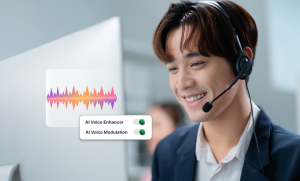
Customers don’t complain about accents—they disengage when conversations feel hard to follow. In global contact centers, that friction quietly increases handle time, reduces conversions, and limits how far automation can scale. A modern accent neutralization system isn’t just about clarity. It’s a performance layer for revenue, CX, and AI accuracy.
What Is an Accent Neutralization System?
The term “accent neutralization” has stuck around longer than it should. It implies erasure—stripping away a speaker’s voice until it sounds like something easier to categorize. That framing is both technically inaccurate and commercially short-sighted.
Why “Harmonization” Is the Better Model?
An accent neutralization system is software that modifies speech in real time to reduce intelligibility friction between speakers with different accent patterns. An accent harmonizer takes a more precise approach: rather than rebuilding how someone sounds, it identifies the specific phonemes causing confusion and adjusts only those, leaving tone, rhythm, and identity intact.
The category has evolved through three distinct stages:
- manual accent training programs (slow, inconsistent),
- full-voice conversion models (robotic, trust-eroding), and
- now phoneme-level harmonization (targeted, real-time, scalable)
The third stage is where enterprise CX is moving.
Why Accent Friction Is a Hidden Revenue and CX Risk?
Accent friction is rarely a line item in a budget, but its impact is felt across every major contact center KPI. When communication isn’t seamless, costs rise and “silent” revenue leaks occur.
The Impact on Operational KPIs
Most leaders track these metrics, but few map them back to accent friction:
- AHT (Average Handle Time): Increases as agents repeat themselves or intentionally slow down to be understood.
- FCR (First Contact Resolution): Drops when customers hang up without full clarity, leading to avoidable callbacks.
- CSAT (Customer Satisfaction): Scores fall when the conversation feels “high effort,” even if the agent is technically helpful.
“Silent” Revenue Leak
In sales environments, trust is established within the first 30 seconds. Accent friction creates friction in the funnel:
- Misheard Objections: Small misunderstandings lead to lost rapport and missed closing opportunities.
- Cognitive Load: If a customer must struggle to understand pricing or terms, their confidence in the purchase wavers.
- Distributed Losses: This loss rarely shows up in one report; it is a “leak” spread across thousands of calls.
Hidden AI Bottleneck
Modern automation relies on clean voice data. If the initial audio input is unclear:
- Transcription Failure: Speech-to-text accuracy plummets.
- Broken Intent Detection: AI cannot accurately categorize a call it cannot “read.”
- Stack Underperformance: The entire AI investment fails, not because of the model, but because of poor voice input quality.
How Real-Time Accent Harmonization Works in Live Calls?
The process runs in four steps, fast enough that neither agent nor customer notices the processing layer.
- Audio capture pulls the live voice signal
- Phoneme detection identifies which sounds are deviating from the target intelligibility profile
- Selective adjustment modifies only those phonemes—not the whole voice
- Output delivers the adjusted signal with a latency typically under 200ms, the threshold at which delay becomes perceptible to human listeners
This sits as middleware in the existing call center stack. It doesn’t require replacing telephony infrastructure, retraining agents, or rebuilding integrations. It fits between the audio stream and wherever that stream is going, whether that’s a human listener, an STT engine, or a voicebot.
The distinction between STT-based and direct voice processing matters here. STT-based approaches correct transcription errors after the fact. Direct voice processing cleans the signal before it reaches any downstream system, which means every system—human, AI, or QA tool—gets better input.
Crossing the 200ms latency threshold turns a conversation into a series of interruptions. Sub-100ms harmonization is the only way to improve clarity without breaking the subconscious trust between agent and customer.
Voice AI Engineer
Accent Translation vs. Conversion vs. Harmonization
Buyers evaluating this category encounter three terms that are often used interchangeably. They shouldn’t be.
| Accent Processing Technologies | |||
|---|---|---|---|
| Approach | How It Works | Risk | Best Use Case |
| Translation | Maps one accent pattern to another wholesale | High distortion, identity loss | Limited / legacy |
| Conversion | Rebuilds speech patterns from the ground up | Robotic tone, customer distrust | Low-end or non-live use |
| Harmonization | Adjusts only problem phonemes in real time | Minimal | Enterprise CX, live calls |
Translation replaces one voice with another—the speaker sounds like someone else. Conversion rebuilds the voice from learned patterns, which tends to produce flat, synthetic output. Harmonization is surgical: most of the voice stays exactly as it is.
For enterprise contact centers running live calls, only harmonization meets the bar for naturalness, speed, and scale.
How AI Improves Voice Clarity Without Changing Identity?
Clarity and identity are not in conflict—but poor implementation can make them feel that way.
Cognitive load is the real measure of clarity. When a listener has to work to decode what’s being said, they have less capacity to process the actual content of the conversation. A harmonized voice reduces that load without changing who the agent sounds like.
The failure mode for over-processed voice is well documented. Agents who sound robotic lose the trust signal warmth, hesitation, emphasis—that make customers feel they’re talking to a person. Customers pick up on synthetic speech quickly, and when they do, they disengage faster than they would have with an accent they simply had to adjust to.
Effective harmonization preserves emotional tone. An agent who sounds warm before processing should sound warm after. Frustration, reassurance, enthusiasm—these carry information. The adjustment layer should be invisible to everyone.
AI Accent Solutions for BPOs Solving Cross-Accent Communication
BPOs operating teams in the Philippines or LATAM face a specific version of this problem. The agents are skilled. The communication infrastructure is solid. But accent friction with North American or European customers creates a persistent CX gap that accent training programs have never fully closed.
Traditional training takes weeks, delivers inconsistent results, and has to be repeated as agent cohorts turn over. Harmonization deploys at the infrastructure level—it applies consistently across every agent, from day one, regardless of where they are in their personal development.
For global BPOs, this means faster onboarding, more consistent customer experience across geographies, and a floor on voice clarity that doesn’t depend on individual agent progress.
Accent Harmonization Improves AI Systems
Accent is an input problem. Every AI system downstream of the audio stream inherits whatever quality issues exist in that stream.
STT accuracy falls when phoneme patterns deviate from the model’s training data. Reduced STT accuracy means intent detection fires on incomplete or incorrect transcripts. LLMs and voicebots operating on those transcripts produce worse responses. QA tools flag the wrong moments. Automation success rates drop.
Cleaning the voice signal before it reaches any of these systems doesn’t just improve the human conversation, it improves every automated system running in parallel.
How to Evaluate an Accent Neutralization System for BPOs?
Not all accent solutions perform equally under enterprise conditions. Before committing, test against these criteria:
- Latency benchmarks — Does it stay under 200ms at scale?
- Tone preservation scoring — How does the vendor measure naturalness, and can you hear the difference?
- Scalability — What’s the concurrent call capacity, and how does performance change at peak load?
- Integration compatibility — Does it fit your existing telephony, STT, and CRM stack without custom engineering?
- Agent acceptance — Has it been tested with agents in the loop, and what does adoption typically look like?
Deploying Accent Translation Software Without Disrupting Operations
The biggest deployment risk is operational. Contact centers run continuous operations, and any change to the audio layer must be validated before it touches live call volume.
A staged approach works best:
- start with a pilot on a contained agent group,
- measure against your baseline metrics,
- validate latency and tone preservation,
- move to full deployment
Change management matters more than most vendors admit. Agents who understand what the tool does—and that it’s not monitoring or judging them—adopt it faster and use it more consistently.
Common pitfalls: over-processing that makes agents sound flat, integration delays caused by undocumented telephony dependencies, and rolling out too quickly before the pilot has produced clean data.
From Accent Neutralization to Voice Intelligence Infrastructure
AI accent solutions for call centers is one layer in a larger stack. The contact centers building durable CX advantage are treating voice as infrastructure—not a series of point tools, but an integrated layer that feeds every system touching the customer call.
Real-time translation, AI-driven QA, voice analytics, and harmonization are converging. The centers that deploy harmonization now are building the clean audio foundation those future systems will depend on. The ones that wait will spend the next two years retrofitting.
See Accent Harmonizer in Action
A live demo covers three things: a real-time call transformation with before/after clarity, tone preservation across different agent voices, and an integration walkthrough against your current stack.