
For years, accent neutralization tools in call centers were framed around a single goal: make agents sound neutral. Neutrality was treated as a proxy for professionalism, clarity, and customer trust.
That framing is now breaking down.
Across enterprise contact centers, the real problem is no longer whether an accent sounds “neutral,” but whether speech is consistently understandable under real operating conditions like background noise, emotional customers, and much.
The shift from neutrality to understandability is subtle, but consequential. It changes how tools are evaluated, how agents are trained, and how customer experience is measured.
Why “Accent Neutralization” Became the Default in Call Centers?
Accent neutralization entered call center operations during a period when offshore expansion outpaced linguistic preparedness. The assumption was simple: if accents could be flattened, comprehension issues would disappear.
This logic is held only under ideal conditions—slow speech, scripted interactions, and cooperative customers. Real conversations rarely meet those constraints. Neutralization, as a concept, optimized sound similarity, not listening success.
Hidden Problem with Chasing a “Neutral Accent”
For years, the industry assumed that “neutrality” was a direct proxy for clarity. We now know this is a linguistic fallacy. A perfectly neutralized accent can still be nearly impossible to follow if the underlying speech mechanics are compromised.
Recent 2025 research into second-language speech perception has identified a critical “64% Intelligibility Breakpoint.” When an agent’s speech clarity drops below the given threshold, it is often due to over-processing or phonetic distortion. At this point, no amount of “politeness” or “neutrality” can save interaction.
A neutral accent can still be difficult to follow if:
- phonemes blur at speed,
- consonants collapse under compression,
- stress patterns conflict with listener expectations.
Overprocessing Reduces Intelligibility
Many legacy speech tools rely on heavy signal manipulation to “mask” mother-tongue influence. While the resulting audio sounds “neutral,” it often strips away the natural rhythm and melody that listeners use to decode meaning.
When tools force this artificial speaking style, we see two specific failures:
- The Fluency Gap: A 2025 longitudinal study confirmed that fluency and comprehensibility are the only true predictors of agent performance ratings. “Accentedness” itself had zero correlation with a customer’s assessment of an agent’s competence.
Cognitive Overload: By forcing agents to focus on “sounding American” rather than “being clear,” cognitive load spikes. This is why modern “Intelligibility-First” AI tools see a lift in agent retention. They allow agents to use their natural voice, supported by tech that clarifies rather than replaces.
Key Insight: A “neutral” accent that lacks natural emphasis markers and micro-intonation is just as taxing for a customer to decode as a thick accent. The goal shouldn’t be to sound like a native speaker—it should be to transmit meaning without friction.
What “Understandable” Actually Means in Call Center Speech?
Understandability is not about how an agent sounds in isolation. It is about whether a customer can:
- follow the sentence on first pass,
- retain information without repetition,
- respond without clarification.
These reframing shifts evaluation away from accent labels and toward comprehension continuity.
Accent Is Only One Variable
Speech clarity in call centers is shaped by:
- pronunciation consistency,
- stress placement,
- real-time noise,
- emotional load on both sides of the call.
Accent neutralization tools that isolate accent alone rarely solve the full problem.
Why Are Call Centers Re-evaluating Accent Neutralization Tools?
Many call centers find that calls which sound polite or “accent-neutral” still lead to repeat contact. In most cases, the issue is not agent behavior. It is partial understanding during the first conversation.
Agent Fatigue Is an Unspoken Cost
When tools force agents to conform to an artificial speaking style, cognitive load Accent neutralization tools that enforce an artificial speaking style increase cognitive load. Agents focus on how they sound instead of how the conversation progresses.
Over time, this affects:
- response speed during live calls,
- emotional presence and empathy,
- recovery when conversations become complex or emotional.
Contact Centers Shifting from Accent Neutralization to Speech Intelligibility
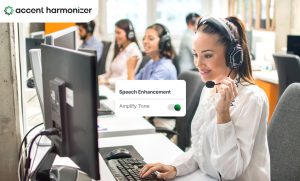
Here are some of the reasons call centers are moving to speech intelligibility with AI-based Accent Harmonizers:
Intelligibility Prioritizes Meaning Over Mimicry
Modern evaluation frameworks focus less on how close speech sounds to a reference accent and more on how reliably meaning is transmitted.
This includes:
- preserving native rhythm while correcting high-impact phonetic friction,
- supporting clarity without erasing identity.
Real-time Adaptation Matters More Than Static Profiles
Static accent profiles assume speech is consistent. Pronunciation shifts with stress, speed, and context. Tools that adapt in real time are better aligned with how conversations unfold.
Closing Perspective
Operations leaders are moving away from tools that “mask” audio, toward those that “harmonize.” The objective is to achieve a Human-AI Partnership where technology handles the heavy lifting while the human agent remains focused on empathy and resolution.
Systems like Accent Harmonizer by Omind represent this new standard. By prioritizing low-latency acoustic reinforcement over destructive voice replacement, these tools solve the 64% intelligibility breakpoint without sacrificing the agent’s identity or the natural rhythm of the conversation.
The Bottom Line
Accent neutralization was a solution for the era of analog offshore expansion. To hear how acoustic reinforcement stabilizes speech clarity without the “robotic” artifacts of traditional filters, you can listen to the real-time comparison here.