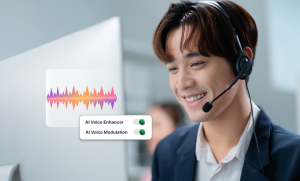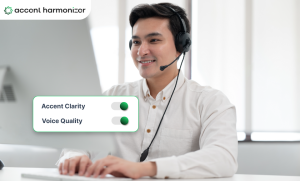
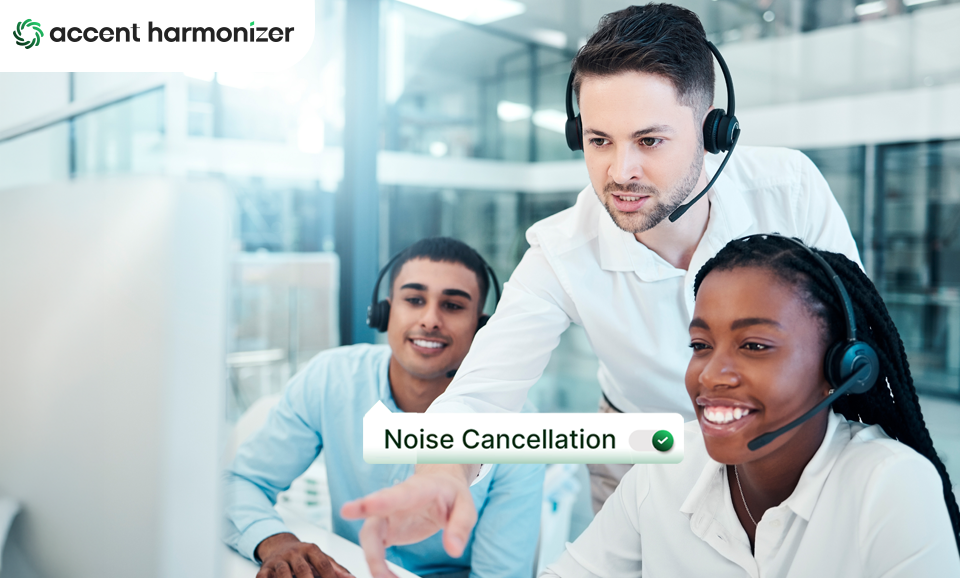
Most traditional accent neutralization training programs were designed for individuals. They do not support enterprise-scale customer conversations happening across offshore contact centers. Accent mismatch makes it difficult for customers to understand agents, causing communication gaps.
Modern AI accent harmonizer systems now adjust phoneme clarity in real time. Technology reduces clarity friction during the live call instead of waiting months for behavioral improvement.
What Is Accent Neutralization Training?
Global Business Process Outsourcing (BPOs) relied on a mix of disciplines to prepare offshore agents for Western customer bases:
- Accent Neutralization / Reduction: Systematic coaching to minimize regional phonetic traits, bringing speech closer to a generalized, “neutral” dialect (like General American English).
- Accent Modification: A clinically derived approach focused on altering speech patterns for individuals who speak English as a second language (ESL) or have distinct regional speech habits.
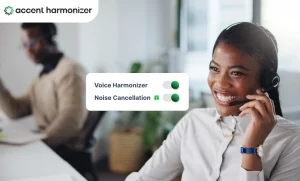
- Accent Harmonization: A modern, infrastructure-driven approach that adjusts specific speech sounds in real time during a live call, so the listener hears maximum clarity while the speaker maintains their natural identity.
Why Are Enterprises Re-Evaluating It?
Historically, these practices migrated from ESL classrooms, speech pathology clinics, and corporate communication coaching directly into call center onboarding.
Stage 1 Human Coaching → Stage 2 ESL & Speech Pathology → Stage 3 — Current Best Practice Real-Time AI Harmonization Layer |
Evolution of Accent Training
However, traditional programs frame accent training as an individual self-improvement journey. For a modern enterprise, this creates a massive infrastructure problem. When you are managing high-volume global conversations across diverse offshore teams, communication failures are rarely a reflection of an agent’s language proficiency. Instead, they are a structural issue of cross-accent communication fatigue. The goal of modern customer experience (CX) should be absolute intelligibility.
| “ Clear communication failures are usually comprehension failures, not language failures. ” |
Why Traditional Accent Neutralization Training Struggles in Modern Contact Centers?
Enterprise buyers have long suspected what the data shows: classroom-based speech coaching cannot keep pace with high-volume contact center operations. Traditional accent neutralization training for call centers requires agents to fight years of deeply ingrained muscle memory. It demands weeks—often months—of intense, daily repetition to see a measurable shift in live customer calls.
Furthermore, human speech habits degrade under stress, fatigue, or during a difficult customer escalation. An agent might maintain a perfectly neutralized accent during training but slip back into native phonetic habits during a grueling shift.
The Hidden Operational Cost of Accent Friction
When a customer struggles to process an unfamiliar accent, the financial leaks pile up across every live channel:
- Repeat explanations: “Can you say that again?” adds critical seconds to every interaction.
- Misheard values: Confusing “fourteen” with “forty” leads to immediate billing, tracking, and delivery errors.
- Compounded metrics: Higher Average Handle Time (AHT) directly increases operational costs, drives up escalations, triggering Quality Assurance (QA) penalties, and degrading overall Customer Satisfaction (CSAT) scores.
Why “Practice More” Is Not a Scalable Enterprise Strategy?
In a high-attrition BPO environment where annual turnover can hover between 30% and 70%, a training ramp-up period of 6 to 12 weeks means a significant portion of your workforce departs just as their speech training takes hold. Expecting constant repetition practice to outpace enterprise attrition is operationally unrealistic.
Real-Time AI Accent Harmonization Changes the Equation
Rather than trying to rebuild human speech habits over months, real-time AI accent harmonization inserts a digital clarity layer directly into the audio stream.
This technology relies on phoneme-level processing. A phoneme is the smallest unit of sound in speech (such as the difference between the /b/ in “bat” and the /p/ in “pat”). The AI performs real-time audio analysis of the agent’s incoming speech, identifies phonemes that cause listener friction and subtly adapts them for the output audio.
Unlike older voice changers or synthetic voice cloning tools, true accent reduction software preserves the speaker’s voice. It simply eliminates the phonetic mismatches that trigger cognitive strain.
What Happens During a Live Call?
1. Audio Capture: Sub-millisecond ingest.
The agent speaks into their headset. The local or cloud-based real-time accent harmonizer intercepts the uncompressed raw audio stream.
2. Phoneme Detection & Analysis: Deep neural networks.
Advanced speech-to-text models map the incoming acoustic characteristics, isolating regional phonetic markers.
3.Real-Time Harmonization: Ultra-low latency.
The software modifies problematic phonemes, smoothing out vowel durations and consonant boundaries to align with the listener’s native speech expectations.
4.Customer-Side Output: <50ms total delivery.
The optimized audio is injected back into the SIP/WebRTC stream. The customer hears the agent clearly, with zero conversational lag or synthetic distortion.
| Accent Harmonization vs. Accent Neutralization | ||
|---|---|---|
| Attribute | Traditional Accent Training | Real-Time AI Harmonization |
| Core Mechanism | Behavioral coaching & human memory | Real-Time algorithmic audio adaptation |
| Time-to-Value | Weeks or months of active classroom ramp | Instant deployment upon software activation |
| Scalability | Human-dependent; relies on 1:1 or small group coaching | Infrastructure-driven; instantly scales across thousands of seats |
| Consistency | Highly inconsistent; degrades under agent fatigue | Standardized, predictable voice clarity 24/7 |
Why does Phoneme Mismatch Creates Listening Fatigue?
When a customer converses with an agent who has an unfamiliar accent, the customer’s brain must work harder. In cognitive science, this is known as an elevated listening load.
When a phoneme mismatch occurs, the brain cannot automatically decode the word. It must temporarily pause, analyze the surrounding sentence structure, and retroactively infer the meaning and creates cognitive friction. If a call lasts ten minutes, this constant micro-decoding builds up fatigue. Once a customer experiences fatigue, their tolerance for errors drops, and their perception of the brand’s service quality deteriorates.
| Real Call Examples of Phoneme-Level Misunderstanding | ||
|---|---|---|
| What the Agent Says | What the Customer Hears | Downstream Business Impact |
| “Your total is fifteen dollars.” | “Your total is fifty dollars.” | Overcharge disputes, immediate billing escalations, and QA penalties. |
| “The departure is at fourteen hundred.” | “The departure is at forty hundred.” | Customer confusion, missed transport, and costly re-booking fees. |
| “Please verify your code.” | “Please verify your cold.” | Friction during critical identity verification steps, leading to longer AHT. |
Which Industries Benefit Most from Accent Harmonization?
Any enterprise running high-volume voice operations can see immediate optimization by switching from human-only training to an infrastructure-based voice clarity layer.
- BPO Support & Global Sales Teams: Maximizes conversion rates and customer satisfaction scores while driving down onboarding costs.
- Healthcare Scheduling & Technical Support: Eliminates dangerous data logging errors regarding patient notes, medical codes, or complex software troubleshooting steps.
- Banking, Finance & Collections: Ensures absolute precision during compliance readouts, interest rate explanations, and payment collection terms.
Conclusion
The traditional mandate for offshore contact centers—forcing international agents to completely rewrite their natural speech patterns over months of classroom drilling—is an outdated approach to a modern operational problem. It treats a scalable infrastructure challenge as an individual performance flaw.
The future of global customer experience belongs to adaptive, listener-centric speech intelligence. By deploying real-time harmonization, enterprise operations can protect critical metrics like AHT and CSAT, shield their bottom line from costly phonemic misunderstandings, and respect their workforce’s linguistic identity. Success in 2026 isn’t about erasing an agent’s background; it is about ensuring absolute, effortless comprehension the exact second a call connects.
Next Steps for Your Operation
Hear live before-and-after conversations with Omind Accent Harmonizer.