
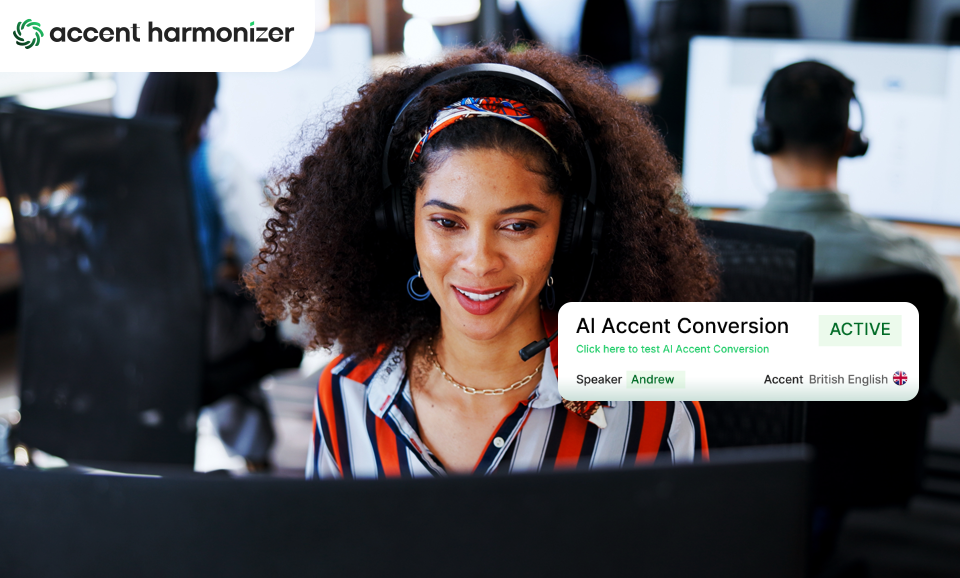
Global contact centers operate across regions, accents, and languages. For enterprises, the challenge is no longer whether accents exist, but whether customers can clearly understand agents on a scale. This is where accent translation for contact centers and broader voice clarity technology for enterprises enter procurement discussions.
As vendors introduce different approaches, often labeled as accent neutralization or accent harmonization—enterprise buyers are forced to evaluate not just outcomes, but how those outcomes are achieved. The distinction matters more than marketing terminology suggests.
This article examines how enterprises compare these approaches, focusing on decision logic rather than vendor claims.
“Enterprises don’t buy accent technology to remove identity—they buy it to reduce friction in understanding.”
What Do Enterprises Mean by Accent Processing?
In procurement and IT evaluations, “accent processing” is an umbrella term. It generally refers to technologies designed to improve accent clarity in contact centers without requiring agent retraining or customer-side adaptation.
Enterprises typically evaluate accent processing through three lenses:
- Customer comprehension and call resolution quality
- Consistency of voice output across regions
- Risk to brand perception and cultural sensitivity
The confusion arises because vendors describe similar goals using different labels—often without explaining the technical or experiential trade-offs involved.
How Is Accent Neutralization Commonly Positioned?
Accent neutralization is typically presented as an approach that modifies speech patterns to align more closely with a standardized or “neutral” accent model.
From an enterprise evaluation standpoint, this approach is usually positioned around:
- Reducing perceived accent variation
- Improving immediate intelligibility
- Standardizing speech output across agents
However, procurement teams often probe deeper during evaluations.
Enterprise Considerations with Neutralization
- Speech Naturalness: Over-modification can lead to mechanical or flattened speech.
- Cultural Sensitivity: Removing accent characteristics may conflict with diversity and inclusion commitments.
- Operational Risk: Overprocessing can impact real-time performance in high-volume environments.
These considerations do not disqualify neutralization outright, but they do limit where it is strategically deployed.
Academic research on voice interfaces has found that increased voice naturalness is associated with higher levels of user trust and compliance, without necessarily leading to over-reliance on automated systems. This suggests that natural-sounding speech can improve interaction quality while maintaining appropriate user judgment.
Accent Harmonization: A Different Design Philosophy
Real-time accent harmonization in live calls approaches the problem from a different direction. Instead of replacing an accent, it focuses on improving intelligibility while preserving the speaker’s natural vocal identity.
In enterprise contexts, harmonization is typically evaluated based on:
- Phonetic alignment rather than accent replacement
- Preservation of speech rhythm and tone
- Compatibility with real-time contact center workflows
This design philosophy aligns closely with enterprise demand for voice clarity technology for enterprises that improves customer understanding without introducing perceptual or cultural risk.
What Enterprises Actually Compare During Evaluation
When enterprises assess accent processing solutions, they do not compare labels. They compare outcomes, risks, and operational fit.
- Speech Naturalness: Procurement teams assess whether processed speech sounds conversational or artificial, particularly during longer calls.
- Customer Comprehension: Evaluation focuses on whether clarity improves consistently across accents, regions, and call types—not just in demos.
- Brand and Cultural Risk: Enterprises increasingly consider whether voice modification aligns with brand values and global workforce policies.
- Real-Time Performance: Latency, processing overhead, and call flow stability are critical for high-volume contact centers.
- Integration with Existing Systems: Solutions must be integrated with existing voice infrastructure, recording systems, and analytics platforms.
These criteria drive real purchasing decisions more than feature lists.
Neutralization vs Harmonization: Enterprise Comparison Snapshot
| Accent Neutralization vs Harmonization – Enterprise Evaluation Criteria | ||
|---|---|---|
| Evaluation Criteria | Neutralization | Harmonization |
| Speech Naturalness | Can vary based on processing depth | Typically preserved |
| Accent Identity | Reduced or removed | Retained |
| Cultural Sensitivity | Requires careful governance | Lower inherent risk |
| Real-Time Scalability | Depends on processing model | Designed for live environments |
| Enterprise CX Fit | Context-dependent | Broadly applicable |
Where Accent Harmonization Fits in Enterprise Voice Strategy?
For organizations prioritizing accent clarity in contact centers without altering agent identity, harmonization aligns well with modern CX strategies.
It is often considered in environments where:
- Contact centers operate across multiple geographies
- Brand consistency matters as much as comprehension
- Agent experience and inclusion are strategic priorities
Within this context, Accent Harmonizer by Omind is positioned as a solution designed to support clarity-first voice processing for enterprise-scale operations, focusing on intelligibility without aggressive speech modification.
Procurement Takeaways for Enterprise Buyers
Before selecting any accent processing solution, enterprises should validate:
- How clarity improvements are measured in real deployments
- Whether speech remains natural under peak loads
- What governance controls exist for cultural and brand alignment
- How the solution integrates into existing contact center stacks
The right choice is not defined by terminology, but by how well the approach aligns with operational, CX, and brand priorities.
Choosing the Right Approach, Not Just the Right Tool
Accent technology decisions reflect broader enterprise values. Whether evaluating accent neutralization or harmonization, buyers must assess trade-offs between clarity, naturalness, and risk.
As accent translation for contact centers continues to evolve, enterprises that prioritize intelligibility without overcorrection are better positioned to scale global customer engagement while preserving authentic human interaction.
Explore how Accent Harmonizer supports enterprise voice clarity without aggressive speech modification.