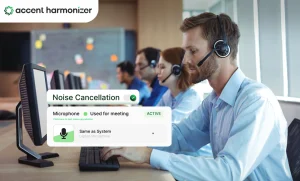

In global contact centers, customers not understanding agents is prime reason for conversation gap. Accent friction quietly drives up handle time and inflates repeat-call rates, before reaching a resolution.
Accent optimization AI for CX teams reframes this challenge. By enhancing voice clarity in the moment, without altering an agent’s identity. Here’s what it is, how it works, and why it’s becoming a standard part of the modern contact center stack.
Why Accent Clarity Is Now a Business-Critical CX Lever?
Miscommunication during interactions isn’t random. The cognitive load customers experience when processing unfamiliar phonetic patterns. The downstream effects are measurable:
- more repetition requests,
- longer average handle time (AHT),
- lower first-call resolution (FCR), and
- CSAT scores that trend down despite agent competence
Accent neutralization training programs, hiring constraints, BPO location shifts are traditional responses to this problem. However, these measures are slow, expensive, and inconsistent. For instance, real-time accent conversion training often takes weeks to deliver results, and hiring native speakers for every regional market isn’t financially viable at scale.
Real-time accent conversion training takes weeks to deliver results. Also, hiring native speakers for every regional market isn’t financially viable on scale. And neither approach addresses the core issue in real time, when the conversation is happening.
What Accent Optimization AI Actually Is?
Category confusion is common here, so it’s worth being precise. Accent optimization AI is not translation software, not voice synthesis, and not noise cancellation—though it often gets conflated with all three.
- Accent optimization makes speech more phonetically intelligible to the listener in real time. It adjusts specific phoneme patterns while preserving the natural rhythm, tone, and personality of the speaker’s voice. The agent still sounds like themselves—just clearer.
- Accent translation (a different, much harder problem) would attempt to convert one accent entirely into another. That’s not what production-grade accent harmonizer software does.
- Voice synthesis replaces the agent’s voice with a generated one. Accent optimization works with the existing voice.
- Noise cancellation removes background audio artifacts. Accent optimization works on the speech signal itself.
Understanding the difference between accent optimization and voice synthesis is critical for CX leaders who want to maintain “Human-to-Human” trust.
How Real-Time AI Accent Solutions for BPO Works?
The technical pipeline is more elegant than it sounds. When an agent speaks, the system captures the audio stream and performs phoneme-level analysis in near real time—identifying specific patterns that are likely to create friction for a given listener profile or regional context.
An accent normalization layer then applies targeted adjustments, reconstructing the audio output within a latency window of typically under 300–500 milliseconds. This speed ensures that neither the agent nor the customer perceives a gap in the natural conversation flow.
Modern systems are built to handle the complexities of live calls, including:
- Code-switching: Agents moving between two languages mid-conversation.
- Regional Dialects: Handling nuances that generic tools miss.
- Continuous Learning: Improving accuracy by learning from real-world call data without manual retraining.
Real-time Accent Harmonizer Delivers the Biggest CX Impact
Accent optimization AI isn’t a one-size-fits-all tool. Its impact is highest in specific call contexts:
- Customer support is the clearest use case. Clarity-driven misunderstandings inflate AHT through repetition loops. AI accent solutions for call centers reduce phonetic friction, with measurable effects on both handle time and first-call resolution.
- Sales calls benefit because clarity drives confidence. Sales teams use accent harmonization to build customer trust. When a prospect doesn’t have to strain to follow a pitch, they can focus on the value proposition.
- Collections & Compliance: In regulated industries, miscommunication creates liability. Ensuring clarity in Financial Services helps customers understand payment terms accurately, protecting the business and the consumer.
Accent Optimization vs. Hiring Native Agents vs. Training
When CX leaders evaluate accent optimization AI tools to address communication friction, three options are usually available.
| Scaling Accent Clarity: Approach Comparison | ||||
|---|---|---|---|---|
| Approach | Time to Scale | Consistency | Cost | CX Impact |
| Hire native-accent agents | Months | High | Very high | High, but limited geography |
| Accent training programs | Weeks–months | Variable | Moderate | Inconsistent |
| AI accent optimization | Days | Very high | Lower per-seat | High, globally scalable |
Key Features to Evaluate Voice Harmonization Tools for Contact Center
If you are currently evaluating accent improvement software, prioritize these non-negotiable features:
- Latency under 500ms — non-negotiable for natural conversation flow
- Identity preservation — Agents should sound like themselves, not a filtered version
- Multi-accent and dialect coverage — Especially important for operations spanning multiple source markets
- Native integration with your CCaaS, CRM, and dialer stack — Bolt-on tools that require workarounds create adoption friction
- Continuous learning — AI accent solutions for call centers that improve from call data outperform static models over time
- Analytics layer — Visibility into clarity metrics, not just technical performance
The Bottom Line
Accent friction is a solvable problem. It doesn’t require replacing agents, retraining workforces, or restructuring offshore operations. It requires deploying the right AI layer at the right point in the conversation pipeline.
The best way to evaluate whether accent optimization AI is right for your operation is to hear the difference on your own calls. A real-time accent harmonizer using your actual use cases is worth more than any benchmark report.
Want to see how real-time accent optimization AI for CX teams works? A short demo session is the fastest path to a clear answer.