Global contact centers depend on spoken communication more than any other operational function. Yet as customer support becomes increasingly distributed across regions, accents have emerged as an often-overlooked source of friction.
When customers struggle to understand an agent—despite accurate information being delivered—the interaction slows down. Repeated clarifications, longer call durations, and mounting frustration can follow. Over time, this communication friction affects customer satisfaction, operational efficiency, and agent morale.
Accent translation AI has emerged as an approach to addressing this challenge. Rather than retraining agents or enforcing speech standards, the technology focuses on improving clarity during live conversations.
What Is Accent Translation AI?
Accent translation AI refers to real-time speech technology that adjusts pronunciation patterns to improve listener comprehension while preserving the speaker’s natural voice.
Unlike traditional “accent neutralization” approaches—which implied flattening speech toward a single standard—modern systems aim for accent harmonization. The goal is not to remove identity, but to reduce misunderstanding.
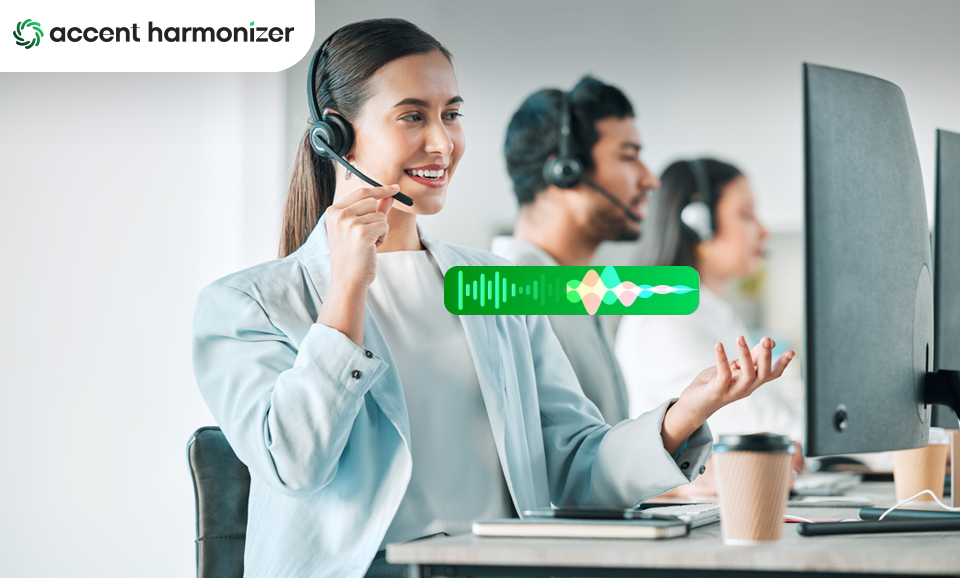
Accent Harmonizer use AI models to enhance clarity without altering emotion, tone, or conversational flow.
Why Accent-related Friction Persists in Contact Centers?
Accent friction in call center does not typically stem from agent capability. It arises from how human listeners process unfamiliar speech patterns under time pressure.
Common consequences include:
- Customers asking agents to repeat information
- Misheard names, numbers, or instructions
- Longer average handling time (AHT)
- Lower first-call resolution (FCR)
- Reduced CSAT despite correct issue resolution
In high-volume global contact centers, even minor communication delays compound quickly.
How Accent Translation AI Reduces Customer Friction?
AI-based accent translation tools for contact center assist in following ways:
- Improved Speech Clarity: By smoothing pronunciation inconsistencies, accent translation AI can make speech easier to follow on the first listening, reducing repeat requests during calls.
- Faster Call Flow: Clearer communication supports more natural conversations, helping reduce unnecessary pauses and re-explanations.
- Lower Cognitive Load: Both customers and agents expend mental effort when struggling to understand each other. AI-assisted clarity allows agents to focus on problem-solving rather than articulation.
- More Inclusive Hiring Models: AI tools with real-time speech refinement enables organizations to hire based on skill and experience rather than perceived accent compatibility—supporting broader talent access.
- Potential Metric Improvements: Some vendors report improvements in AHT, CSAT, and FCR after deployment. These outcomes are vendor-reported and environment-dependent, not industry-wide benchmarks.
Where Accent Translation AI Fits in the Contact Center Stack?
Voice clarity in customer service call typically operates alongside other voice technologies, including:
- Noise cancellation for contact centers
- Call monitoring and quality management systems
- Contact center analytics platforms
Together, these tools aim to improve call clarity, consistency, and measurable CX outcomes.
Benefits and Concerns of AI Voice Technology
Accent translation AI has gained traction, but it is not without controversy. Industry discussion focuses less on technical capability and more on social and ethical implications.
Arguments in Favor
Supporters argue that accent translation AI:
- Reduces unconscious accent bias during customer interactions
- Improves customer comprehension without retraining agents
- Enables fairer global workforce participation
- Addresses communication friction pragmatically
From this view, technology acts as a bridge between speakers, not a replacement for human identity.
Criticisms and Risks
Critics raise concerns including:
- Reinforcing dominant language norms rather than adapting listeners
- Risk of normalizing the idea that some accents are “less acceptable”
- Cultural sensitivity and identity implications
- Potential misuse if imposed without agent consent
These concerns highlight that implementation matters as much as technology.
Responsible Use of Accent Translation AI
Organizations exploring accent translation AI should evaluate:
- Whether agents retain control and visibility
- How performance claims are validated internally
- Whether diverse speech data is represented in training models
- How technology aligns with DEI principles
Used transparently, accent translation AI can support inclusion. Used carelessly, it can undermine it.
Final Perspective
Accent translation AI addresses a real operational challenge in global contact centers: communication friction that affects experience on both sides of the call.
When applied responsibly, it can support clearer conversations, smoother interactions, and more equitable access to global talent—without requiring agents to change who they are.
At the same time, organizations must acknowledge the broader debate surrounding accent technology rather than ignoring it. Clarity should never come at the cost of dignity or identity.
For contact centers operating across borders and time zones, accent translation AI is not a universal solution—but it is a meaningful tool when used with intent, transparency, and restraint.
Seeing Accent Translation AI in Practice
For teams evaluating whether accent translation AI fits their contact center environment, seeing how the technology works in live conditions can be more useful than reading specifications alone.
Accent Harmonizer offers a product walkthrough that demonstrates how real-time accent harmonization functions during customer conversations—without requiring changes to agent behavior or workflows. Let’s book a product demo now!!