
In financial services, a single misheard syllable is a liability. Whether it’s a KYC data point, a high-stakes risk disclosure, or a debt resolution call, the gap between what an agent says and what a customer hears is where compliance failures and reputational erosion live.
Most institutions attempt to solve “accent gap” issues through grueling accent neutralization training—an outdated, slow, and often culturally insensitive approach. Yet, even with training, phonetic friction remains the primary driver of high Average Handle Times (AHT) and “Failure to Understand” complaints.
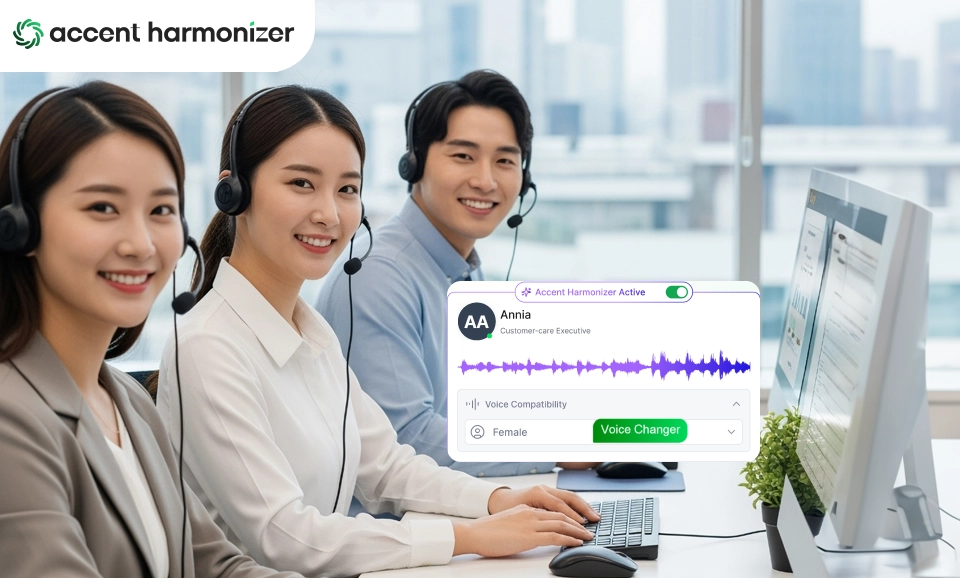
Real-time accent harmonization represents a shift from training the human to optimizing the audio. By using AI to align phonetic delivery with the listener’s expectations in real-time, banks can finally decouple an agent’s cultural identity from their intelligibility. This isn’t about making everyone “sound the same”; it’s about ensuring the regulatory message is received with zero ambiguity.
Accent Clarity Creates Measurable Value
Financial institutions handle complex terminology that must be understood the first time it is delivered. Any misunderstanding leads to callbacks, escalations, or UDAAP (Unfair, Deceptive, or Abusive Acts or Practices) risks.
| Compliance Comparison | ||
|---|---|---|
| Feature | Without Accent Harmonization | With Accent Harmonization |
| Disclosure Delivery | Agent repeats terms 2-3x; risk of “rushed” second readings. | High-precision first-pass delivery; consistent phonetic clarity. |
| AHT (Average Handle Time) | High “Clarification Loops” (e.g., “Can you repeat that?”). | 12-18% reduction in “repetition time” per high-stakes call. |
| Compliance Audit | QA must manually verify if a “misheard” word was a script violation. | Standardized audio baseline leads to 98% Auto-QA accuracy. |
| Regulatory Risk | Vulnerable to claims of “Inadequate Understanding.” | Stronger defense: Technical proof of optimized intelligibility. |
Accent Clarity Adds Measurable Value in Financial Conversations
AI voice clarity solutions for banks and other financial institutions manages conversation in the following ways:
Reducing Misunderstanding in Mandatory Disclosures
Compliance scripts often contain similar-sounding terms, legal concepts, or technical vocabulary. AI clarity tools help customers distinguish phrasing more easily, reducing the chance of a disclosure being misheard. This helps agents deliver information in a way that aligns with regulatory requirements.
Streamlining KYC and Identity Verification Calls
KYC involves precise information: names, dates, identification numbers, and verification steps. Misheard details can extend the process or require callbacks. Clearer pronunciation assists both sides of the exchange—agents delivering prompts and customers responding with key information.
Supporting Multilingual Clients and Global Customer Bases
Financial services serve diverse communities where English may not be the first language. Accent clarity tools can enhance intelligibility without removing the speaker’s natural voice characteristics. This reduces communication anxiety for customers and frontline teams.
Strengthening Client Trust in Sensitive Financial Discussions
Loan counseling, repayment plans, collections, dispute resolutions, and investment risk conversations can be emotional. Clarity helps stabilize the tone, reduces the need for repeated explanations, and supports a sense of transparency.
Improving Understanding in Fraud and Security Alerts
Fraud escalations require fast, accurate communication. Enhanced clarity can make instructions easier to follow and reduce confusion during high-stress moments.
How Real-Time Accent Harmonization Operates in Real Time?
Real-time Accent Harmonization functions as a precision filter. It operates at the edge of the audio stream to bridge the gap between a speaker’s native phonology and a listener’s auditory expectations:
- Latent Phonetic Alignment: The system identifies specific phonemes prone to regional variance (e.g., the “r” coloration or “th” centralization) and subtly shifts their acoustic properties toward a standardized intelligible baseline. This happens with sub-50ms latency, ensuring no disruption to natural conversational flow.
- Acoustic Feature Preservation: To maintain trust, the AI isolates and preserves “Prosodic Fingerprints” the speaker’s unique pitch, cadence, and emotional inflection. We are not replacing the voice; we are removing the “acoustic friction” that hinders rapid comprehension.
- Dynamic Noise Suppression & Gain Normalization: Financial calls often suffer from VoIP jitter or background office noise. The harmonization engine works in tandem with spectral subtraction to ensure the “signal” (the disclosure) is never lost to the “noise” (the environment).
- Zero-State Architecture: The processing is stateless. Audio is analyzed, harmonized, and passed through in real time without being cached or stored in an unencrypted state, meeting the strict ephemeral processing requirements of modern CCaaS environments.
Crucially, the Harmonizer maintains Biometric Integrity. Because the system operates on the phonetic ‘surface’ and not the underlying vocal tract frequency, it does not interfere with voice-based identity authentication systems. Your security layer remains intact while your communication layer is optimized.
Operational and Experience Benefits for Financial Institutions
Here are some examples of operational and experience benefits for financial institutions:
- Fewer Repetitions and Clarification Loops
When a customer clearly hears instructions or disclosures, conversations move forward with fewer interruptions. This can contribute to smoother call flow and a more positive experience.
- More Consistent Communication Across Distributed Teams
Teams in different geographic regions or outsourcing environments may have diverse speech patterns. Accent clarity tools promote consistency across operations, helping institutions maintain unified communication quality.
- Improved QA Alignment and Script Delivery
Clarity can support better adherence to required phrasing and help reduce deviations caused by miscommunication. This may assist QA teams in identifying true script gaps versus comprehension issues.
- Enhanced Customer Confidence and Perceived Transparency
Customers often equate clarity with honesty. When communication feels smoother and easier to understand, customers may feel more assured in their interactions with financial representatives.
- Accessibility for Customers with Hearing or Processing Difficulties
Clearer speech benefits individuals who may struggle with fast, accented, or jargon-heavy conversations. This aligns with broader accessibility priorities.
Clearer Conversations as a Standard for Financial CX
As financial institutions deepen their commitment to customer-centric operations, clear communication is becoming more central to compliance, trust, and competitive differentiation. AI-powered accent clarity aligns with broader industry trends around accessibility, fairness, and responsible communication. While technology alone cannot resolve every challenge in financial conversations, it provides a practical layer of support that strengthens advisor performance and simplifies customer understanding.
Institutions that elevate clarity—alongside personalization, efficiency, and compliance—create interactions that feel fair, transparent, and reliable. In a sector where trust defines long-term relationships, this creates meaningful advantage.
Ready to Make Every Financial Conversation Clearer?
The “standard” for financial customer experience is no longer just about speed; it is about precision. As global banking teams become more distributed and customer bases more diverse, the institutions that rely on “hope” as a communication strategy will see a rise in UDAAP complaints and operational drag.
Investing in accent clarity is a direct investment in the integrity of your disclosures and the efficiency of your front line. It moves communication from a variable risk to a controlled asset.
Accent Harmonizer provides the technical infrastructure to ensure that every conversation—regardless of geography—meets the highest standard of clarity. In a sector where trust is the primary product, being understood isn’t a “nice-to-have.” It is the baseline for doing business.
Book a Demo — empower your teams with clearer conversations today.