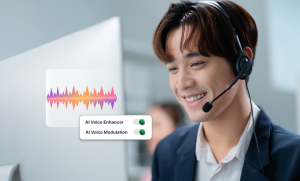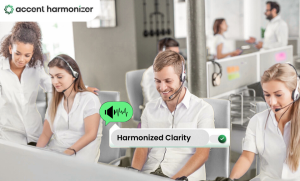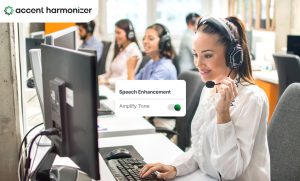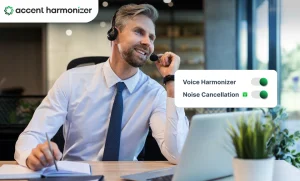
Poor audio quality in contact centers doesn’t just frustrate customers—it erodes trust, tanks satisfaction scores, and drives up repeat-call rates. When agents sound muffled, distorted, or drowned out by background noise, even the best service recovery falls flat. Traditional audio cleaning methods are too slow and inconsistent for high-volume operations.
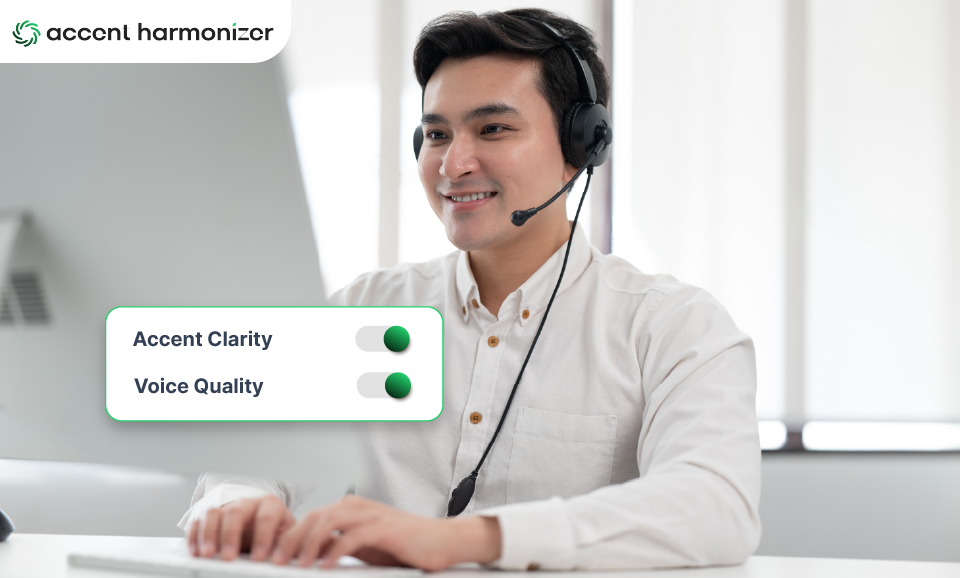
AI accent harmonizer tool for call center removes noise, sharpens clarity, and can even soften accents to improve comprehension. It is an intelligent audio optimization built for enterprise-level voice operations.
Why Contact Centers Need AI Speech Enhancement?
Modern contact centers face a perfect storm of audio challenges. Agents work from home offices with barking dogs, busy coffee shops, or crowded co-working spaces. Microphone quality varies wildly. Accents span continents. VoIP compression adds artifacts. The result? Inconsistent audio that forces customers to ask, “Can you repeat that?” multiple times per call.
Traditional audio engineering solutions require manual processing, expensive equipment, and specialized expertise. They don’t scale when you’re handling thousands of simultaneous calls. AI speech enhancement solves this by using deep learning models that “understand” speech patterns. These systems distinguish human voice from background noise in real-time, performing denoising, dereverberation, and voice isolation automatically. The AI doesn’t just suppress all sound—it intelligently preserves speech while removing interference. Tools like ai-coustics offer SDK solutions with latency under 50 milliseconds, making enhancement invisible to both agents and customers.
Key Use Cases for Enterprises
- Real-time call centers benefit most from AI speech enhancement. By integrating enhancement SDKs directly into voice pipelines, every call gets studio-quality audio processing instantly. An agent working from a noisy floor sounds as clear. This levels the playing field for remote and hybrid teams.
- Post-call processing represents another critical use case. Enhanced recordings improve training quality, making it easier for supervisors to review calls and for speech analytics tools to extract accurate insights. When audio is crisp, sentiment analysis and keyword detection perform better.
- Voice bots and AI agents need clear, natural-sounding voices to build customer trust. Enhancement ensures synthesized speech maintains professional quality across all interactions, reducing the “uncanny valley” effect that makes some voice AI feel robotic.
- For remote and hybrid workforces, AI speech enhancement is a game-changer. It removes the audio quality lottery that comes with distributed teams, ensuring every agent—regardless of their home setup—delivers consistent, professional sound.
Accent Softening: Clarity Without Losing Identity
Accent softening is where AI speech enhancement becomes truly transformative for global contact centers. This technology smooths phonetic irregularities that cause comprehension challenges—not to erase cultural identity, but to reduce friction in customer conversations.
When customers understand agents more easily, resolution happens faster. Repeat calls due to miscommunication drop. Agent confidence rises, especially for team members from diverse linguistic backgrounds who may have faced bias over their accents.
The technology works by detecting accent-specific patterns—like retroflex pronunciations, glottal stops, or vowel shifts—and making subtle adjustments without creating a robotic monotone. The goal is intelligibility, not homogenization. Agents retain their natural voice identity and emotional expressiveness while becoming easier to understand across different customer demographics.
This approach matters from an ethics standpoint. Accent softening for enterprise should enhance communication, not pressure agents to sound like they’re from a specific region. When implemented thoughtfully, it’s an inclusive tool that helps diverse teams succeed.
Comparing Top AI Speech Enhancement Tools
Choosing the right solution depends on your specific needs:
- Accent Harmonizer by Omind is purpose-built for contact centers that need both speech enhancement and intelligent accent softening in one solution. It processes calls in real-time, helping global teams deliver consistent audio quality while preserving agent authenticity.
- ai-coustics delivers enterprise-grade enhancement through API and SDK integration. Their models support real-time processing with studio-quality output, making them ideal for large-scale contact center deployments where low latency is critical.
- Voice.ai offers a free online audio enhancer that removes noise from MP3, WAV, and FLAC files through a simple web interface. It’s perfect for quick one-off enhancements or testing the technology before committing to an enterprise solution.
- Descript provides Studio Sound for content creators and podcasters, supporting MP3, WAV, and AAC formats. It isolates voice and removes distortion with a generous free usage tier, though it’s designed for post-production rather than real-time calls.
When evaluating tools, consider whether you need real-time processing or can batch-process recordings, what integration methods you require (API, SDK, web UI), how the solution scales with concurrent users, and what the pricing model looks like for your call volume.
Implementation Best Practices
Start with a pilot project. Select a subset of agents or a specific call type to test enhancement quality and gather feedback. This controlled approach lets you measure impact before rolling out broadly.
Track meaningful metrics: call clarity scores, customer satisfaction ratings, first-call resolution rates, and average handle time. These numbers tell you whether the investment delivers ROI.
Watch for over-processing. While enhancement dramatically improves clarity, excessive processing can strip out emotional nuance that helps agents build rapport. A/B test enhanced versus raw audio with sample customers to find the right balance.
Prioritize privacy. Voice data is sensitive. Choose vendors with SOC 2 certification, GDPR compliance, and options for on-premises deployment if your security requirements demand it.
Transform Your Contact Center Audio Today
Don’t let poor audio quality cost you customers. AI speech enhancement with intelligent accent softening isn’t a luxury—it’s a competitive advantage that directly impacts your bottom line through higher CSAT scores, faster resolutions, and lower agent turnover.
Ready to hear the difference? Omind’s Accent Harmonizer is specifically designed for enterprise contact centers that need real-time speech enhancement and accent clarity at scale. Our solution integrates seamlessly with your existing voice infrastructure, requires no special hardware, and delivers measurable improvements in call quality within days.
Schedule a demo to hear before-and-after audio samples from contact centers like yours.