Most global contact centers don’t struggle with agent capability. They struggle with how that capability is perceived.
When a customer says, “Sorry, could you repeat that?”, the issue isn’t knowledge—it’s clarity. That moment triggers longer calls, lower trust, and sometimes lost revenue. Multiply that across thousands of interactions, and accent friction becomes an operational bottleneck.
AI accent harmonizers promise to solve this. But to make the right decision, you need to understand not just what they claim—but how they work, where they fit, and when they deliver real ROI.
Why Do Your Call Center Needs an AI Accent Harmonizer?
Accent diversity is a natural outcome of global scaling. But in voice-based CX, it creates a hidden performance gap.
- Higher AHT: Repetition loops increase call duration
- Lower FCR: Misunderstandings delay resolution
- Reduced conversions: Trust drops when communication feels strained
And perception directly impacts:
- Customer satisfaction (CSAT)
- Agent confidence
- Revenue outcomes
Accent Translation vs Conversion vs Harmonization: What Are You Actually Buying?
The market is full of overlapping terms and that confusion shows up in how buyers search. Here’s what they really mean:
- Accent Translation: Often misunderstood. Suggests changing how someone speaks entirely (closer to language translation than clarity improvement). It’s important to note that language neutralization is not the same as accent removal.
- Accent Conversion: Implies transforming one accent into another—what many users think AI does.
- Accent Neutralization: Traditional training approach—flattening accents over time.
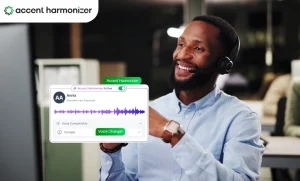
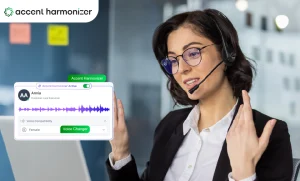
- Accent Harmonization: Real-time adjustment that improves how speech is heard, without changing the speaker’s identity.
Harmonization doesn’t force agents to change. It adapts the output so customers can understand them effortlessly.
How AI Accent Harmonizer Call Center Software Works in Real Time?
Here’s what happens during a live interaction:
Step 1: Voice Input Capture
The agent speaks naturally into their existing system (softphone, headset, CCaaS platform).
Step 2: Real-Time Speech Analysis
AI models analyze:
- Phonetics (how sounds are formed)
- Acoustic patterns (tone, pitch, cadence)
Step 3: Harmonization Layer
The system subtly adjusts specific speech elements:
- Softens unfamiliar phonemes
- Aligns pacing with listener expectations
Step 4: Output to Customer
The customer hears a clearer version of the same voice.
Key Performance Factors:
- Latency: Typically, under ~200 milliseconds to maintain natural flow
- Integration: Works within existing VoIP/CCaaS stacks
- Network dependency: Performance can vary with connectivity
From Accent Neutralization to AI Harmonization: Why Training Alone Doesn’t Scale
For years, call centers relied on accent training programs. But these approaches come with limitations:
- Weeks or months of onboarding
- Inconsistent results across agents
- No adaptability during live calls
AI changes the model entirely. Instead of forcing agents to adapt, it adapts the communication layer in real time.
Beyond Accents: The Full Voice Clarity Stack
Accent is only one part of the problem.
True voice clarity in call centers depends on three layers:
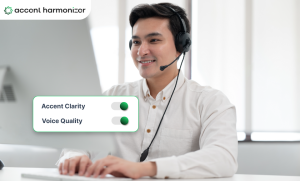
- Accent Harmonization: Improves speech intelligibility across accents
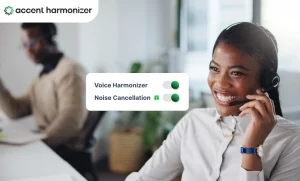
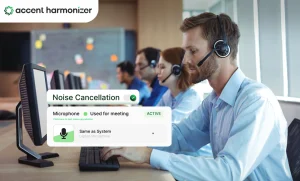
- Noise Cancellation: Removes background distractions from agent environments
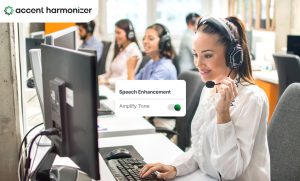
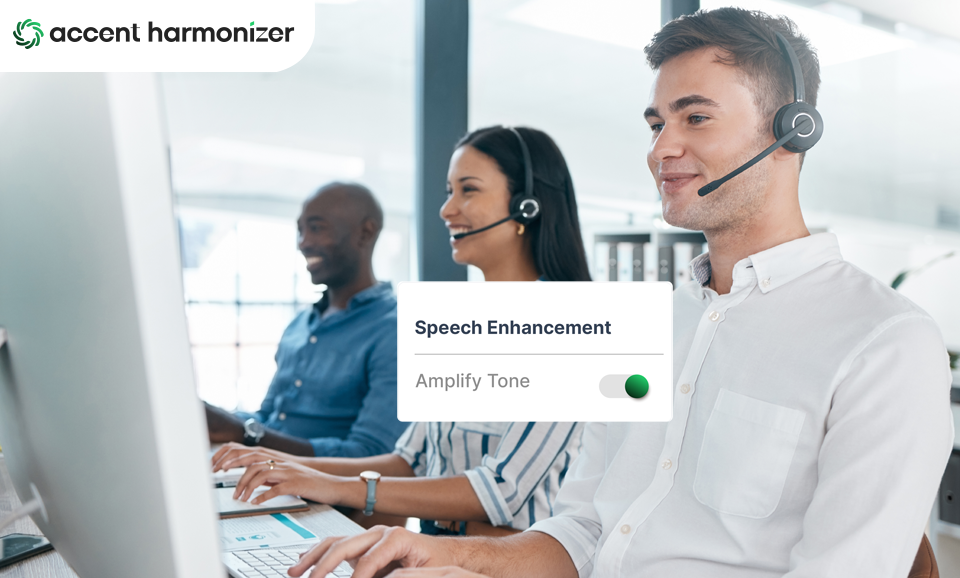
- Speech Enhancement: Optimizes overall voice quality and signal clarity
Most solutions treat these separately. High-performing CX operations combine them.
Measuring ROI: AHT and CSAT Gains from Voice Harmonization
The value of clarity is measurable—but only if you connect the dots. Here’s how it plays out:
- Fewer repetitions → Lower AHT
- Better understanding → Higher FCR
- Improved trust → Higher conversions
Instead of isolated metrics, think in chains: Clarity → Efficiency → Experience → Revenue
Use-case impact:
- Support: Faster resolution, fewer escalations
- Sales: Higher conversion rates through clearer communication. International sales teams use harmonization to build trust faster.
- Collections: Reduced friction in sensitive conversations
Final Takeaway
Accent harmonization is a performance layer that directly impacts:
- Efficiency
- Experience
- Revenue
And like any performance layer, its value depends on:
- Where it’s deployed
- How it’s configured
- What outcomes you’re optimizing for
If clarity is impacting your call metrics, it’s time to treat it as a strategic investment. Book a demo and see how AI accent harmonization works in your real call environment.