
Most enterprises are losing customers because of conversation friction. Accent differences, background noise, and real-time comprehension gaps increase call times, erode trust, and break deals.
The blog tries to answer how AI-based accent correction software for enterprises ensures every word is instantly understood, across any accent, in real time.
Accent Is Not the Real Problem — Clarity Is
Enterprises have spent years chasing accent ‘correction’ as the fix for communication breakdowns in contact centers. But framing the problem as an accent issue misses the bigger picture. The actual failure point is the misalignment between speaker and listener — and that’s a systems problem, not a linguistics one.
Research consistently shows that listeners process unfamiliar accents up to 30% more slowly than familiar ones. This processing delay has direct, measurable consequences for call center performance:
- Average Handle Time (AHT) increases as agents repeat, rephrase, and clarify
- First Call Resolution (FCR) rates drop when intent is misunderstood on the first pass
- Conversion rates in sales calls fall when customer confidence is undermined by communication friction
Clarity = Accent + Audio Quality + Listener Context + Real-Time Adaptation
What Is AI Accent Harmonizer Software?
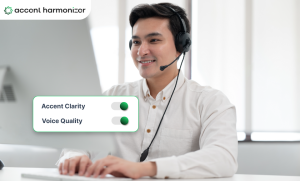
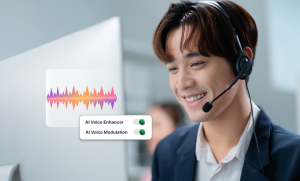
AI Accent Harmonizer Software is a real-time speech-to-speech technology designed to improve communication clarity in global contact centers. The platform preserves agent’s natural speech patterns, while enhancing listener’s experience.
How Accent Harmonization in Contact Centers is Different from Correction or Translation?
The market uses several terms interchangeably, but they describe meaningfully different approaches
| Accent Correction vs Neutralization vs Harmonization | |||
|---|---|---|---|
| Approach | Accent Correction | Accent Neutralization | Accent Harmonization |
| Output | Forces target accent | Removes regional traits | Preserves voice, enhances clarity |
| Authenticity Impact | Low — feels unnatural | Medium — flattened voice | High — speaker identity is retained |
| Real-Time Capable | No | Partial | Yes |
| Best Use Case | Scripted training | Legacy neutralization | Live CX & sales calls |
How Real-Time Accent Harmonization Works in Live Calls?
The pipeline behind real-time speech enhancement platform involves five core stages, executed in milliseconds:
- Speech Capture – platform intercepts live audio at the source
- Phonetic Mapping — the system analyzes phoneme patterns specific to the speaker’s accent
- Context-Aware Adjustment — platform processes audio in context of meaning and intent
- Voice Preservation — retains the speaker’s natural tone, pacing, and personality
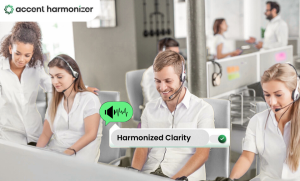
- Bi-Directional Clarity — clarity is delivered for both the agent and the customer in real time
‘Real-Time’ Means — Latency, Processing, and Accuracy
In live call environments, ‘real-time’ means nothing unless it meets functional latency thresholds. For contact center use, the acceptable window is under 200 milliseconds — anything beyond that introduces a perceptible delay that disrupts natural conversation flow.
Enterprise-grade harmonization systems navigate meaningful trade-offs: higher accuracy models require more processing cycles, while speed-optimized models must still clear accuracy bars for intelligibility. The best implementations adapt dynamically — accounting for multilingual switching mid-call, variable acoustic environments, and heavy regional accents — without defaulting to a generic target dialect.
Do You Need Noise Cancellation + Accent AI Together?
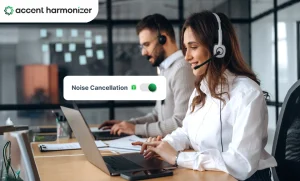
Consider two scenarios: an agent on a Manila floor during a peak shift, handling a complex healthcare enrollment call — or a LATAM-based sales rep on a mobile connection navigating a pricing objection. In both cases, acoustic noise compounds accent unfamiliarity. Solving one without the other leaves the customer experience incomplete.
Real-World Use Cases Across Global Contact Centers
Real-time accent harmonizer delivers compounding value across the highest-stakes interaction types in global BPO operations:
- Offshore CX Teams: Reduces listener processing friction for North American and European customers without requiring accent training investment
- Healthcare Enrollment Calls: Where misunderstood plan details or eligibility questions carry regulatory and financial consequences
- Outbound Sales: Where the first 30 seconds of perceived credibility determines whether the call continues
- Technical Support: Where instruction clarity directly impacts resolution speed and repeats call rates
How to Evaluate Accent Harmonizer Software: 2026 Buyer’s Checklist
This checklist gives enterprises and CX leaders essential checklist for evaluating Accent translation AI:
- Real-Time Latency: Does the system operate under 200ms? Does it maintain accuracy on a scale?
- Voice Preservation: Does the agent’s natural voice and identity survive processing? Review live demos carefully.
- Bi-Directional Clarity: Does the system enhance comprehension for both agent and customer?
- Dialer & QA Integration: Can it connect natively with your existing telephony stack, WFM, and QA tooling?
- Security & Compliance: Is audio processing HIPAA-compliant? SOC 2 certified?
- Accent Coverage: Does it support the specific accent pairs relevant to your delivery geography and customer base?
- Scalability Architecture: Can it handle concurrent sessions at enterprise call volumes without degradation?
A vendor who cannot address each of these dimensions with specificity is not ready for enterprise deployment. Use this checklist as both a procurement tool and a vendor accountability framework.
Conclusion
As AI QA systems become standard — analyzing every call for quality, compliance, and coaching signals — accent harmonization data feeds directly into performance analytics. Which agents benefit most from real-time adaptation? Which call types carry the highest clarity risk? The answers to these questions become strategic inputs, not just operational fixes.
Omind’s Accent Harmonizer integrates this roadmap in mind. The platform provides real-time agent assistance to create a unified clarity layer across the enterprise.
Experience Real-Time Voice Clarity Across Global Accents