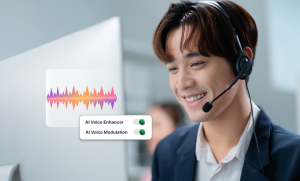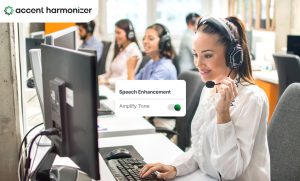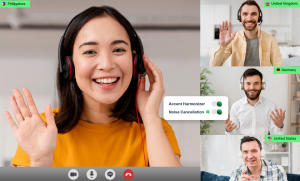

Accent issues don’t just affect how people sound — they affect how quickly they’re understood. In global contact centers, every second a customer spends trying to process an unfamiliar accent adds friction, repetition, and cost. AI accent improvement software changes this by reducing listener effort in real time, so conversations flow naturally on the first attempt — not the third.
What Is AI Accent Improvement Software?
AI accent improvement software is a real-time speech clarity layer embedded in live call infrastructure. It doesn’t train agents to sound different, clone voices, or evaluate speech quality after a call. It operates during the conversation — identifying phonetic friction points and adapting them in real time so the listener processes speech with less effort.
‘Improvement’ in this context has a precise meaning. It isn’t about making someone sound more neutral or more ‘standard.’ It means:
- Faster listener comprehension — fewer cognitive cycles spent decoding unfamiliar phonemes
- Reduced repetition — the listener understands correctly on the first pass
- Lower listener effort — the conversation flows without the friction of constant reprocessing
“Clarity is not pronunciation — it’s comprehension speed. A speaker can be perfectly articulate and still create friction if the listener’s brain has to work to keep up.” — CX Expert
Why Cross-Accent Conversations Break in Live Calls?
Most operations leaders understand that miscommunication costs money. Fewer can pinpoint exactly where the breakdown happens. There are three compounding failure mechanisms at work:
- Phoneme mismatch: Specific sound patterns in one accent don’t map cleanly to the listener’s internal phoneme library. Isolated words — account numbers, product names, dosage instructions — are the most vulnerable.
- Accent unfamiliarity and cognitive load: When a listener is exposed to an unfamiliar accent, the brain allocates additional processing resources to decode speech. Over the course of a call, this fatigue accumulates — customers disengage, agents lose confidence, and call outcomes deteriorate.
- Repetition loops: A single misheard word can trigger a repetition request. That repetition extends the call, disrupts flow, and subtly signals to the customer that communication has broken down. Multiple loops in a single interaction can critically damage satisfaction scores.
The downstream metric impact is direct:
| How Accent Friction Creates Business Risk | |
|---|---|
| Failure Point | Business Impact |
| Repetition loops from phonetic mismatch | ↑ AHT by 15–30% on cross-accent segments |
| Misunderstood instructions or details | ↓ First Call Resolution (FCR) |
| Listener cognitive fatigue | ↓ CSAT; customers disengage faster |
| Accent-driven trust gap on sales calls | ↓ Conversion rates; longer deal cycles |
| Missed compliance-critical information | ↑ Risk exposure in finance and healthcare |
Accent Training vs. Neutralization vs. AI Accent Improvement Software
Enterprises typically encounter three approaches when addressing accent-related communication challenges. Understanding what each one delivers — and where each one fails — is essential to making the right infrastructure decision.
| Accent Improvement Approaches – Performance Comparison | ||||
|---|---|---|---|---|
| Approach | Speed | Real-Time | Listener Effort | Scalability |
| Accent Training | Slow (weeks) | No | Medium — inconsistent | Low |
| Accent Neutralization | Medium | Limited | Inconsistent | Medium |
| AI Accent Improvement | Instant | Yes | Low — by design | High |
Accent training asks agents to modify their natural speech patterns over weeks of coaching. Improvements are inconsistent, degrade under stress, and disappear with staff turnover. Accent neutralization applies targeted corrections — but most implementations are either pre-call (too slow) or post-call (too late). Neither operates now that matters: during the live conversation.
AI accent improvement software is the only approach that intervenes in real time, on every call, without requiring agents to change how they speak or think.
How AI Accent Improvement Software Works in Real Time?
The real-time pipeline operates in five stages, completing the full cycle in under 150 milliseconds — below the threshold of perceptible conversation delay:
- Audio capture: The agent’s live voice is captured at the audio layer before transmission.
- Phoneme-level detection: AI models analyze the acoustic signal, identifying the specific phoneme patterns associated with the agent’s accent profile.
- Targeted adaptation: Only the phonemes creating listener friction are adjusted — the system leaves tone, pitch, pacing, and emotional register entirely intact.
- Real-time synthesis: The adapted audio is reconstructed and prepared for delivery.
- Listener delivery: The modified signal reaches the listener with no perceptible lag.
The Key Shift: From Speech Clarity to Listener Effort Reduction
Most software in this category frames its value around ‘clarity’ — making speech cleaner, crisper, or more standard. This framing misses the actual mechanism behind CX outcomes.
What drives AHT, FCR, and CSAT is not clarity in isolation. It is listener effort — the cognitive work required to understand speech. A customer dealing with a high-effort conversation experiences fatigue, frustration, and reduced trust, even when the agent is knowledgeable and professional. A low-effort conversation feels natural, builds confidence, and resolves faster.
High listener effort is invisible on call recordings. It only shows up in your metrics — as handle time, as repeat calls, as satisfaction scores that can’t be explained by agent quality alone.
AI accent improvement software’s core value proposition is effort reduction, not accent erasure. The distinction matters: you are not standardizing voices. You are lowering the cognitive barrier to comprehension.
Where AI Accent Improvement Software Delivers Maximum Value?
While technology applies broadly, four enterprise contexts demonstrate the strongest ROI:
- BPO and offshore contact centers: The highest concentration of cross-accent call volume. Listener effort reduction directly addresses the core operational challenge — quality at scale across diverse agent populations.
- Financial services: Account numbers, transaction details, and compliance disclosures cannot tolerate mishearing. A single misunderstood digit can create regulatory exposure and customer harm.
- Healthcare: Medication names, dosage instructions, and appointment details are safety critical. Miscommunication in this context carries consequences beyond customer satisfaction.
- Sales: Accent friction introduces hesitation in prospective conversations. When buyers can clearly process a value proposition, close rates improve and deal cycles shorten.
Real-Time vs. Post-Processing vs. Training: What Actually Works?
The timing of intervention is the most overlooked variable in accent improvement strategy. Here is why it determines everything:
- Training (pre-call): Effective overtime for willing agents in stable environments. But it takes weeks to yield results, deteriorates under call volume pressure, and must be re-administered with every new hire cohort.
- Post-call processing: Useful for quality analysis, transcription accuracy, and compliance review. It has zero impact on the customer experience that already occurred.
- Real-time AI adaptation: The only intervention that acts now the listener is processing speech. This is the only timing that can reduce AHT, improve FCR, and raise CSAT on the call that is happening right now.
Live conversations require live solutions. Every other approach addresses the problem after it has already cost you.
What to Look for in AI Accent Improvement Software?
Use this checklist when evaluating enterprise solutions. It separates genuine capability from polished demos:
- Real-time processing with sub-150ms latency — higher introduces perceptible lag that disrupts conversation flow
- Accent-pair coverage across your specific operational regions (Philippines, LATAM, Eastern Europe, South Africa)
- Voice identity preservation — tone, pitch, emotion, and speaking cadence must remain the agent’s own
- Native integration with your CCaaS or UCaaS stack (Genesys, Five9, Avaya, Zoom Phone, Microsoft Teams)
- Compliance readiness — data handling and audio processing must meet GDPR, HIPAA, and PCI-DSS requirements
- QA integration — clarity improvement metrics should feed directly into existing quality assurance workflows
Ask every vendor for deployment performance data from production environments, not demo recordings. The delta between a compelling proof of concept and enterprise-grade infrastructure is consistency under real call volume.
From Pilot to Enterprise Scale: Implementation Reality
Successful deployments follow a structured model — and the organizations that move fastest understand the common friction points before they hit them:
- Pilot phase (Weeks 1–4): Deploy with a defined agent cohort on the highest-volume cross-accent call segments. Establish pre-intervention baselines for AHT, FCR, and CSAT. Track repetition loop frequency as a leading clarity indicator.
- Common pitfalls to anticipate: Latency spikes in specific CCaaS integration configurations; dialect gaps in accent-pair coverage for regional sub-accents; agent resistance rooted in the misperception that the tool changes how they sound to themselves.
- Scale phase (Weeks 5–16): Expand by region using pilot data to set calibration benchmarks. Build a continuous monitoring dashboard tracking listener effort proxies — repetition rate, handle time by accent pair, CSAT by agent cohort.
The Future of AI Accent Improvement Software
The current generation of real-time accent improvement is the foundation of a more sophisticated infrastructure that is already in development:
- Bi-directional clarity: Systems that simultaneously reduce listener effort for both the agent and the customer, adapting speech in both directions during a live call.
- Emotion-aware adaptation: AI detects stress or frustration in the speaker’s voice and adjusts clarity parameters to de-escalate — rather than simply maintaining neutrality.
- QA and analytics integration: Clarity improvement metrics surfaced directly in quality assurance workflows, connecting listener effort scores to agent coaching and CSAT outcomes.
- Cross-language layering: Extending phoneme adaptation beyond accent pairs into multi-language environments, enabling global enterprises to maintain consistent communication quality regardless of the language pair.
Test Accent Improvement on Your Own Calls
Don’t evaluate this on a demo recording. Hear it on a real call scenario from your industry. Our team will run a live session using actual cross-accent call segments so you can measure listener effort reduction firsthand.
Book a Live Demo