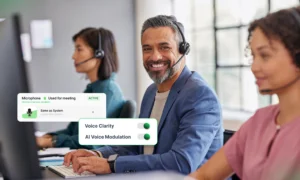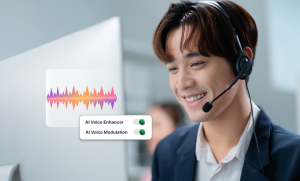

AI accent modification software is often misunderstood because the term itself suggests altering how a person speaks. In modern systems, that is not what happens.
The software does not train agents, coach pronunciation, or require behavioral change. It operates entirely on the audio signal transmitted during a conversation. The speaker remains unchanged. This distinction is central to how current accent technologies are designed and evaluated in contact center environments.
Why Speech Intelligibility Becomes a Challenge at Scale?
Global contact centers rely on voice communication delivered through compressed audio channels, variable network conditions, and background noise. Under these conditions, even minor pronunciation differences can affect how easily speech is understood.
The issue is not language proficiency or agent capability. It is how speech is perceived when transmitted digitally and processed in real time by listeners unfamiliar with certain speech patterns.
As call volumes increase, these small comprehension delays can accumulate into longer conversations, repeated clarifications, and inconsistent customer experience.
What AI Accent Modification Software Actually Does?
Modern accent translation platform for contact center works at the audio-processing level.
During a live call, the system analyzes speech in real time and applies subtle adjustments that improve intelligibility for the listener. These adjustments are designed to preserve the speaker’s natural voice characteristics, including tone, rhythm, and emotional expression.
The intent is not to standardize speech, but to make spoken audio easier to interpret across different listening contexts.
From an implementation perspective, the software functions as part of the voice infrastructure rather than as a training or performance tool.
What the Software Does Not Do?
To avoid misinterpretation, it is equally important to state what modern systems do not do.
Accent and speech clarity software does not:
- change how agents speak
- instruct agents to modify pronunciation
- evaluate or score accents
- replace or clone voices
- alter language choice or vocabulary
All processing occurs on the transmitted audio, not on the individual. This boundary defines the difference between audio enhancement and behavioral modification.
How It Fits Within the Contact Center Stack?
Accent translation technology is typically deployed alongside existing voice systems such as:
- noise cancellation
- call recording and monitoring
- quality management tools
- analytics platforms
It operates passively in the background, without requiring agents to adopt new workflows or speaking patterns.
Because the software does not introduce decision logic or customer-facing automation, its role is limited to improving clarity during human-to-human conversations.
Where Products Like Accent Harmonizer Are Used?
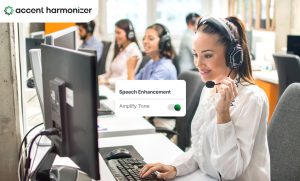
Accent Harmonizer supports real-time speech intelligibility in customer conversations by applying AI-based accent harmonization at the audio layer. The system is intended to function without changing agent behavior or identity, and without introducing delays into live calls.
Its role is narrowly defined: reduce misunderstanding caused by audio transmission rather than address broader CX or performance issues.
Conclusion
AI accent modification software modifies how speech is transmitted and perceived during live conversations. By operating at the audio level, these tools aim to improve conversations. When deployed correctly, this technology can help reduce communication friction and interaction flow in contact centers.
For teams assessing accent translation platform with AI for their contact center environment, Accent Harmonizer offers a product walkthrough. The platform demonstrates how real-time accent harmonization operates. Book a demo now to know more!!