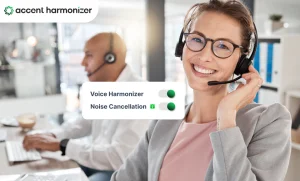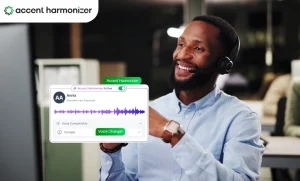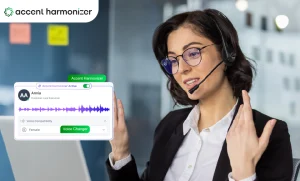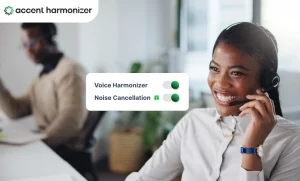

Accent modification software uses speech-processing technology to make spoken communication easier to understand without requiring people to change how they naturally speak.
In contact centers, modern AI-based systems can process an agent’s voice during a live conversation, adjust selected acoustic or pronunciation-related characteristics, and transmit the processed speech to the customer in real time. The objective is not to replace the speaker’s identity or create a different voice. It is to reduce communication friction when accent differences, unfamiliar speech patterns, audio compression, or other call conditions make conversations harder to follow.
What Is Accent Modification Software?
Accent modification software is technology designed to adjust selected characteristics of spoken audio to make speech easier for a listener to understand. The term is used for two different types of solutions:
- Traditional accent modification tools focus on the speaker. They typically use pronunciation exercises, speech assessments, coaching, and repeated practice to help someone change particular speaking habits over time.
- Real-time AI accent modification software focuses on the audio signal. Instead of teaching the speaker to pronounce words differently, it processes speech during the conversation.
An agent using a real-time system does not need to remember pronunciation rules while resolving a customer issue. The agent continues speaking naturally while the software operates within the voice-processing layer. That changes accent modification from a training exercise into an operational technology.
How Does Real-Time Accent Modification Software Work?
Real-time accent modification requires several processing steps to happen quickly enough that the conversation still feels natural. At a simplified level, the workflow looks like this:
| Real-Time Voice Processing Pipeline |
|---|
Step 1 Agent Speaks → Step 2 Speech Signal Analyzed → Step 3 Characteristics Adjusted → Step 4 Processed Audio Transmitted → Outcome Customer Hears Agent |
The underlying implementation varies between vendors, but modern systems may analyze phonetic, acoustic, and contextual characteristics of speech before making selective adjustments.
The important word is selective. Effective accent modification should not rebuild every element of a person’s voice. It should focus on speech characteristics that may affect intelligibility while preserving the characteristics that make the speaker sound like themselves.
For contact centers, the system must also operate with very low latency. Even technically accurate speech processing becomes impractical if it creates noticeable delays between speakers. Real-time voice processing becomes a part of the broader contact center infrastructure rather than as a standalone speech feature.
What Does Accent Modification Software Change—and What Should It Preserve?
One of the biggest misconceptions surrounding accent modification is that the goal is to erase an accent or replace a voice. That should not be the operating principle of modern contact-center systems. A well-designed system should make limited adjustments while preserving the speaker’s identity and conversational expression.
| Real-Time Voice Processing: Parameter Modification Boundaries | |
|---|---|
| Parameters Dynamic AI May Adjust | Core Elements System Must Preserve |
| Selected pronunciation characteristics | Speaker identity |
| Certain phonetic patterns | Emotional tone |
| Speech clarity cues | Natural rhythm |
| Selected acoustic characteristics | Meaning and vocabulary |
| Features affecting listener comprehension | Conversational intent |
The exact characteristics processed depend on the technology. Contact center buyers should verify what a vendor actually modifies rather than relying on broad claims about “neutralizing” or “changing” accents. The distinction also separates real-time accent modification from voice cloning or entertainment-oriented voice changing.
Accent Modification Software vs. Accent Training
Accent training and accent modification software can both address speech intelligibility, but they approach the problem from opposite directions.
| Accent Modification Software vs. Traditional Accent Training | ||
|---|---|---|
| Evaluation Vector | Accent Modification Software | Traditional Accent Training |
| Execution Timing | Processes speech dynamically during live customer conversations (sub-150ms). | Occurs weeks or months prior to entering live production calls. |
| Core Mechanism | Real-time AI signal processing modifies transmitted audio output. | Manual behavioral coaching forces the speaker to modify physical articulation. |
| Behavioral Dependency | Zero dependency on long-term habit changes; works while the agent speaks naturally. | Requires months of active practice, ongoing coaching, and deliberate self-monitoring. |
| Primary Purpose | Designed for rapid, enterprise-wide operational deployment to slash AHT. | Designed for individual skill development and gradual phonetic neutralization. |
| Scalability & Reach | Deploys instantly across thousands of distributed or offshore agents (e.g., PH/LATAM). | Scales poorly; outcomes vary heavily based on individual aptitude and coaching quality. |
Traditional training may still be appropriate where employees specifically want to improve pronunciation or communication skills. Real-time software addresses a different operational problem: reducing communication friction during the conversation itself. The distinction is particularly relevant for large contact centers where continually retraining hundreds or thousands of agents may be difficult to scale.
Accent Modification vs. Neutralization, Harmonization, Voice Changing, and Noise Cancellation
The terminology surrounding AI speech processing is often inconsistent. Several technologies may appear similar even though they solve different problems.
| Primary Purpose of Voice & Accent Technologies | |
|---|---|
| Technology | Primary Purpose |
| Accent modification | Adjust selected characteristics of accented speech |
| Accent neutralization | Reduce accent-specific pronunciation differences |
| Accent Harmonizer | Improve cross-accent intelligibility while preserving speaker identity |
| Voice changer | Transform how the speaker’s voice is perceived |
| Noise cancellation | Remove environmental or background noise |
| Speech enhancement | Improve broader audio quality or intelligibility |
These categories may overlap technically, but they should not be treated as interchangeable. For example, noise cancellation can remove keyboard sounds or office chatter, but it does not necessarily resolve comprehension difficulties caused by unfamiliar pronunciation patterns.
Likewise, a consumer voice changer may significantly transform someone’s vocal characteristics without being designed to improve customer understanding. Understanding the difference between accent neutralization and accent harmonization is especially important when the objective is to improve clarity without unnecessarily standardizing how agents sound.
When Should a Contact Center Consider Accent Modification Software?
Accent modification technology should not be deployed simply because agents and customers have different accents. Different accents are a normal part of global communication. The stronger business case appears when measurable comprehension friction begins affecting customer interactions.
Contact centers may want to investigate accent modification software when they see patterns such as:
- customers frequently asking agents to repeat themselves
- repeated clarification increasing average handle time
- comprehension complaints despite strong language proficiency
- offshore agents regularly serving customers from different linguistic regions
- inconsistent understanding across geographically distributed customer bases
- agents slowing down or overexplaining because they anticipate misunderstanding
- good network and microphone quality but persistent speech-comprehension problems
The goal is not to remove linguistic diversity. The goal is to identify whether a recurring communication barrier is creating unnecessary effort for both the customer and the agent. The distinction matters because many call-quality problems originate elsewhere. Poor microphones, background noise, packet loss, scripting problems, and inadequate product knowledge require different solutions.
What Should Buyers Evaluate Before Choosing Accent Modification Software?
The quality of an accent modification system cannot be judged solely by how different the processed voice sounds. In fact, dramatic transformation may be the wrong outcome. Contact center leaders should evaluate whether the system improves understanding while keeping conversations natural and operationally usable.
| Real-Time Voice Processing Evaluation Framework | |
|---|---|
| Evaluation Area | What to Ask |
| Latency | Does processing create a noticeable delay in conversation? |
| Naturalness | Does the speaker still sound like themselves? |
| Intelligibility | Does processing reduce unnecessary clarification? |
| Identity Preservation | Are tone and recognizable voice characteristics retained? |
| Integration | Can it work with the existing telephony environment? |
| Scalability | Can it support production call volumes consistently? |
| Speech Coverage | Which accents, speech patterns, and languages are supported? |
| Noise Performance | How does it behave when calls contain background noise or compression? |
| Measurement | Can teams compare processed and unprocessed outcomes? |
| Privacy & Security | How is live voice data handled and protected? |
Buyers should also test the technology with actual production-like conversations rather than relying only on carefully recorded demonstrations. Call-center audio is rarely pristine. Real conversations contain interruptions, fast speech, emotion, background noise, telephony compression, and changes in pacing. A system needs to perform under those conditions.
What Accent Modification Software Cannot Fix
Accent modification is an audio-layer intervention, not a universal customer-experience solution.
It cannot compensate for:
- weak language proficiency
- incorrect information
- poor listening skills
- ineffective scripts
- broken call routing
- severe network degradation
- poor agent knowledge
- every form of cross-cultural misunderstanding
It should therefore be evaluated as one part of a broader voice-quality strategy.
If customers:
- cannot hear agents because of background noise, noise cancellation may be the first problem to solve.
- can hear every word clearly but agents are providing incorrect answers, accent processing will not improve the outcome.
And if the underlying issue is poor conversational behavior, coaching or QA intervention may still be necessary. The useful role of accent modification software is much narrower: reducing avoidable comprehension friction where speech characteristics contribute to misunderstanding.
Where Accent Harmonizer Fits
Accent Harmonizer is designed for real-time human-to-human conversations in contact center environments.
Rather than requiring agents to change the way they speak through continuous accent coaching, the platform applies AI-based accent harmonization to transmitted speech while the call is taking place.
The approach is designed around several operational requirements:
- real-time speech processing
- preservation of the agent’s voice identity
- natural conversational delivery
- no change to the agent’s vocabulary or intent
- no continuous pronunciation retraining
- compatibility with live customer conversations
- reduced communication friction across different accent patterns
This positions Accent Harmonizer differently from both traditional accent coaching platforms and consumer voice-changing applications. The objective is not to make every agent sound identical. It is to make communication easier to follow while allowing agents to continue sounding like themselves.
For contact centers evaluating this category, that distinction should be part of the buying criteria alongside latency, integration, scalability, voice naturalness, and measurable improvements in customer understanding.
Conclusion
Accent modification software is evolving from traditional pronunciation training into a real-time voice-processing category for global contact centers.
The most useful systems do not attempt to erase linguistic identity or completely reconstruct the speaker’s voice. Instead, they selectively process speech to make conversations easier to understand while preserving tone, intent, rhythm, and recognizable vocal characteristics.
Accent Harmonizer is designed to work in real time during customer conversations without requiring agents to change how they naturally speak. If your team is evaluating accent modification software for live contact center conversations, book an Accent Harmonizer demo to experience how real-time harmonization works in practice.