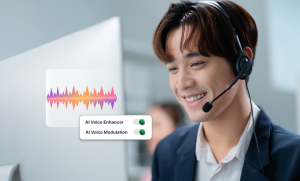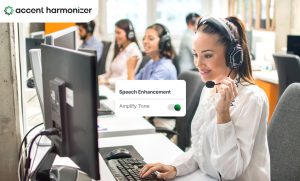

Most AI accent neutralization software promises clearer calls. Few explain what happens to tone, latency, emotional nuance, or system performance once it’s deployed at scale. For global BPOs running thousands of concurrent conversations, clarity isn’t enough — it must be real-time, identity-preserving, and infrastructure-ready.
Why AI Accent Neutralization Software Became Essential for Global BPOs?
Accent friction is one of the most underdiagnosed drivers of KPI drag in contact center operations. When customers ask agents to repeat themselves, every additional exchange adds to Average Handle Time (AHT), reduces First Contact Resolution (FCR), and quietly chips away at CSAT scores. In voice-based sales environments, that friction can become direct deal leakage.
Global BPOs face a compounding version of this problem. Subcontractor voice variance — teams spanning multiple regions with divergent phonetic patterns — makes consistent intelligibility nearly impossible to manage through training alone. This is why contact centers are adopting accent harmonizer instead of training programs which take months and often fail to scale.
The distinction that matters operationally is between perception bias and intelligibility load. Perception bias is a listener preference — often unconscious and cultural. Intelligibility load is measurable: it’s the cognitive effort a listener expends to decode what an agent is saying. AI accent neutralization software, properly built, targets the latter without trying to erase the former, helping to reduce communication friction in enterprise training and onboarding.
Voice Replacement vs. Accent Conversion vs. Phoneme-Level Harmonization
There are three distinct approaches in the market, and the differences are consequential.
- Voice replacement overlays a synthetic voice on the agent’s speech — it solves the accent problem by eliminating the agent’s voice entirely, introducing artificiality and destroying the relational quality of the call.
- Accent conversion maps one accent profile to another, often producing distorted output.
- Phoneme-level harmonization takes a minimal-intervention approach. Rather than replacing or converting, it identifies only the specific phonetic patterns that reduce intelligibility and adjusts those selectively. It is critical to understand accent harmonizer differs from generic voice changers to maintain brand trust.
The Hidden Risk of Over-Processing
Over-processed audio creates its own set of problems. Tone flattening strips the warmth from a reassuring agent voice. Emotional dampening makes de-escalation harder. Customers begin to perceive the call as automated even when it isn’t — triggering the very disengagement that high-quality CX is designed to prevent. The goal of real-time accent harmonization is surgical precision, not wholesale transformation.
How Real-Time Accent Harmonization Actually Works?
It Operates as a Lightweight Middleware Layer
Accent harmonization is not a voice replacement system. It functions as a real-time layer between live audio capture and downstream systems.
At a high level:
- Audio is captured from the agent.
- Background noise is filtered.
- Phonetic patterns are analyzed for accent variance.
- Select phonemes are adjusted for clarity.
- Pitch and emotional tone are preserved.
- The harmonized audio flows into STT, QA, analytics, and CRM systems unchanged.
The result: improved intelligibility without altering the speaker’s natural identity.
It Must Operate Within Real-Time Constraints
In live conversations, latency matters.
- Conversations begin to feel unnatural beyond ~200 milliseconds of delay.
- Enterprise systems must stay below that threshold.
- Compatibility with WebRTC and SIP infrastructure is essential in modern contact centers.
If harmonization introduces lag, it defeats its purpose — clarity cannot come at the expense of conversational flow. It Preserves Emotion — It Does Not Synthesize Voice
There is a critical distinction between harmonization and voice synthesis.
- Synthesis recreates voice and often flattens emotional nuance.
- Harmonization adjusts phonemes only.
- Pitch, tone, urgency, empathy, and hesitation remain intact.
This is what protects agent authenticity while improving clarity.
It Integrates Into Existing CX Infrastructure
Enterprise BPO environments are layered systems:
Telephony → Middleware → Agent Interface → STT → QA → Analytics → CRM
Harmonization must fit cleanly into this architecture.
Poorly engineered systems create:
- Softphone compatibility issues
- SIP integration gaps
- QA and analytics disruptions
- Long-term technical debt
Scalability is equally critical.
- Performance at 100 calls is not proof of enterprise readiness.
- Systems must maintain quality at 5,000–10,000+ concurrent calls.
- Load balancing, routing, and failover protocols are baseline requirements.
How to Evaluate AI Accent Neutralization Software: A Buyer Framework
Procurement teams evaluating this category need criteria that go beyond vendor claims. Seven dimensions matter most:
- Tone preservation scoring — does the system measure what it leaves intact, not just what it modifies?
- Measured intelligibility improvement — verified through controlled listener tests, not subjective demos.
- Latency benchmarking — confirmed sub-200ms performance under peak concurrency loads.
- Agent perception surveys — do agents feel their voice identity is preserved?
- CSAT A/B testing — pilot data showing measurable improvement in customer satisfaction scores.
- Overprocessing safeguards — what limits prevent the system from modifying beyond intelligibility thresholds?
- Consent and transparency controls — does the system support clear disclosure protocols for agents and customers?
Why AI Voicebots Still Struggle Without Accent Harmonization?
LLM-powered voicebots are improving fast. But they depend on accurate transcription.
When speech-to-text (STT) mishears accented input:
- Intent classification drops
- Routing errors increase
- Knowledge retrieval fails
- Escalations rise
Transcription error cascades through the entire automation pipeline, causing AI CX stacks to break quietly.
Accent harmonization acts as a pre-processing layer. It improves input quality before speech reaches STT and LLM systems.
Without it:
- Automation rates stall
- Repeat-call loops increase
- Escalations erode ROI
With it:
- STT accuracy improves
- LLM responses align better with intent
- Downstream analytics become more reliable
The difference is not cosmetic — it directly affects automation performance and revenue retention.
Governance Is Not Optional
Any voice-processing technology must meet enterprise governance standards.
Three areas matter most:
- Agent Consent: Agents must understand how their voice is processed and agree to it. Transparency is foundational.
- Identity Preservation: Systems should assist clarity — not replace identity. When agents feel “synthetically altered,” engagement can decline.
- Deployment Controls: Organizations should evaluate:
- Bias mitigation in accent modeling
- Customer transparency standards
- Defined use-case boundaries
- Formal compliance documentation
Serious vendors should provide both technical documentation and governance briefs.
The Future of AI Accent Neutralization Software
“Accent neutralization” implies erasure, a homogenization of voice that trades identity for uniformity. Real-time harmonization is a different proposition: targeted, minimal, identity-preserving, and infrastructure-grade.
The contact centers that will lead on CX in the next five years won’t just be the ones with better AI. They’ll be the ones with better voice infrastructure — systems that treat speech clarity as a foundational layer, not a cosmetic feature. Harmonization, not neutralization, is where that evolution leads.
Ready to see what this looks like in a live-call environment?
Request demo to see real-time harmonization, tone preservation, and integration in action.