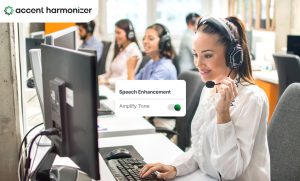

Global contact centers operate across dozens of regions, languages, and accents — yet customers still expect instant clarity during a support call. Traditional accent training programs attempt to “fix” this problem through weeks of coaching. However, modern AI accent reduction technology is changing the equation entirely: instead of forcing agents to change how they speak, AI accent reduction technology can adapt speech in real time while preserving the agent’s natural voice.
Why Accent Clarity Still Matters in Global Call Centers?
Geographic diversity spanning across Philippines and Latin America is a massive win for talent and cost. However, it introduces a comprehension friction.
When a caller struggles with an agent’s pronunciation, the conversation slows down and eventually breaks. This creates a “repetition loop” that ripples through your entire P&L.
Failure of Traditional Training
For decades, CX leaders relied on manual accent coaching, but the model is fundamentally broken for modern scale:
- Slow Time-to-Value: Coaching takes weeks, not hours.
- High Variance: Results are inconsistent across different agent cohorts.
- The “Pressure” Fade: Under high call volumes, agents often revert to native speech patterns, erasing training gains.
How AI Accent Reduction for Call Centers Works
AI accent reduction is the process of automatically adjusting the phonetic output of a speaker’s voice so that the listener experiences greater clarity — without altering the speaker’s natural tone, cadence, or personality.
It helps to distinguish three related but distinct concepts:
- Accent neutralizationtargets pronunciation patterns and shifts them toward a neutral or standard dialect.
- Language neutralizationoperates at the vocabulary and grammar level, adapting regional phrasing.
- Accent harmonization— the most sophisticated approach — improves clarity while preserving the agent’s voice identity.
At the technical core, these systems analyze incoming speech in real time, identify phoneme-level patterns that differ from a target clarity model, and apply targeted adjustments to the audio output stream. The customer hears clearer speech. The agent speaks naturally.
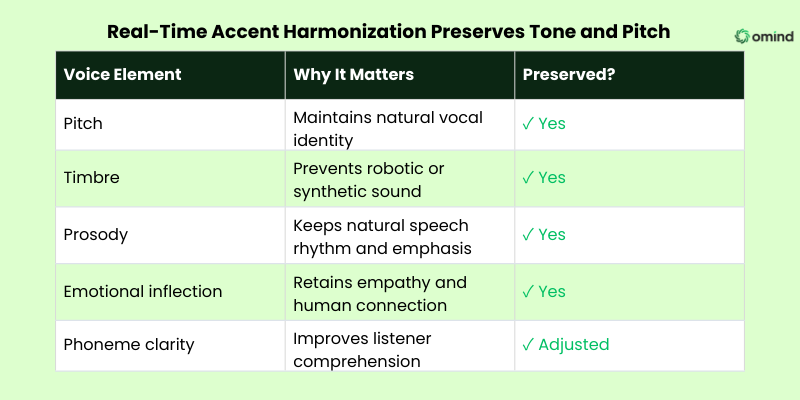
How Real-Time Accent Harmonization Preserves Tone and Pitch
One of the most common concerns about accent processing is whether it makes agents sound robotic or artificial. Modern AI voice modulation handles audio identity separately from phonetic clarity to maintain warmth and confidence.
Customers respond not just to the words they hear, but to the emotional texture of a voice: its warmth, its rhythm, its confidence. Accent harmonization systems are engineered to leave these layers intact.
Does Accent Processing Increase Voice AI Latency?
Latency is one of the most practical concerns when evaluating any real-time speech processing system. If accent adjustment introduces perceptible delay, it degrades the conversational experience rather than improving it.
The good news: modern accent harmonization is engineered for streaming pipelines, meaning processing occurs on small audio segments in parallel rather than waiting for a complete utterance. The latency contribution of accent adjustment is typically low enough to fall within the existing latency budget of a standard VoIP call.
Conversations remain natural. Agents and customers do not experience the characteristic “lag” associated with older synthesis approaches. For enterprise deployments where call quality is non-negotiable, this is a critical technical requirement that modern systems are built to meet.
Accent Neutralization vs. Language Neutralization vs Accent Harmonization
These two terms are frequently used interchangeably, but they describe fundamentally different layers of the communication stack. Conflating them leads to misaligned technology choices.
Most enterprise deployments benefit from accent harmonization rather than full neutralization. The goal is comprehension — not erasing the richness of regional speech. Organizations that understand this distinction make better technology decisions and set more realistic expectations for outcomes.
Noise Cancellation vs. Accent Harmonization — Two Different Problems
It’s equally important not to conflate environmental audio quality with linguistic clarity. These are separate problems requiring separate solutions — and often, both are needed simultaneously.
Operational Benefits of AI Accent Reduction in Contact Centers
Technology needs to justify itself in business terms. Contact center leaders should expect accent harmonization to influence several key operational metrics.
- Average Handle Time typically decreases when comprehension improves. Fewer repetitions mean shorter calls for the same issue resolved.
- First Call Resolution improves when customers fully understand the information provided on the first attempt.
- CSAT scores rise when interactions feel effortless rather than effortful.
The impact on agents is equally significant. Accent harmonization reduces the cognitive burden of accent self-monitoring during high-volume calls. It accelerates onboarding for agents in offshore and nearshore locations, replacing weeks of accent coaching with real-time assistance from day one. Agents who feel understood report higher confidence and lower fatigue — which in an industry with chronic attrition challenges, matters enormously.
Clear Conversations Without Changing the Agent
Accent clarity remains one of the most consequential factors in global contact center performance. Traditional training is slow, inconsistent, and places the entire burden on the agent. AI accent translation shifts that burden to the technology layer, enabling real-time clarity improvements that scale across thousands of agents simultaneously.
The best implementations do this without sacrificing what makes a human agent irreplaceable: tone, warmth, empathy, and personality.
See How AI Accent Harmonization Works in Real Time
Explore how Accent Harmonizer improves cross-accent clarity without changing the agent’s natural voice.