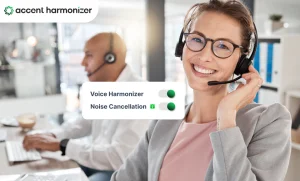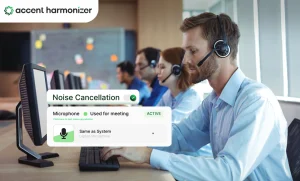

In customer service, the problem isn’t what your agents say — it’s how quickly customers can understand it. When accent friction slows a call, every downstream metric pays the price. However, AI accent reduction in customer service fixes these gaps. The automated system bridges what a speaker says and what a listener perceives in real time.
This is sometimes called perception-layer optimization or selective enhancement of phonetic clarity rather than wholesale voice replacement. The speaker’s tone, rhythm, and natural expressiveness stay intact. Only the moments of potential misinterpretation are softened, in milliseconds, before the audio reaches the customer’s ear.
“Intelligibility and accent are distinct dimensions of speech. You can have a strong regional accent and be perfectly intelligible — and vice versa. AI tools that conflate the two-cause harm. Tools that separate them create real value.”
Impact of Accent Friction on Customer Service Performance
Customer service leaders tend to frame communication breakdowns as soft problems — difficult to measure, difficult to fix. The data tells a different story.
When a customer struggles to understand an agent, a predictable chain reaction follows. They ask for repetition, and the accent variability leads to decision delays for the customer. By the time the call ends, average handle time (AHT) has climbed, and FCR (First-Call Resolution) has dipped. The customer’s CSAT score reflects not the quality of the answer, but the effort it took to get there.
How Real-time AI Accent Reduction Actually Works?
The engineering challenge is not modest: audio must be captured, analyzed, adjusted, and re-delivered in under 200 milliseconds. Modern systems, like ultra-low latency voice AI, clear this bar with room to spare.
The process unfolds in following steps:
- First, the agent’s audio is captured and fed into a phonetic analysis engine that maps each sound against expected listener-side reception patterns.
- Next, the model identifies specific phonemes where perception risk is elevated and adjusts them. The rest is passed through untouched. The result reaches the customer with no perceptible lag and, crucially, with the agent’s voice still recognizable as theirs.
Reduction, Neutralization, Harmonization — What’s The Difference?
The industry uses these three terms loosely, which causes real confusion during vendor evaluations. Understanding the difference between neutralization and harmonization is key for procurement:
| Strategic Comparison: Accent Improvement Methodologies | ||
|---|---|---|
| Approach | What it does | Best for |
| Accent Reduction | Minimizes deviations from a target phoneme set to achieve a specific regional sound. | Teams with a highly consistent, single-region listener base. |
| Accent Neutralization | Standardizes toward a clarity baseline without targeting a specific regional accent. | Multilingual agents |
| Accent Harmonization | Adapts speaker output dynamically toward the listener’s expected phonetic patterns in real-time. | Global BPOs with diverse, multi-regional customer bases. |
Most enterprise deployments today lean toward harmonization, since it avoids encoding a specific “correct” accent as the benchmark — a move that carries both ethical and practical advantages.
Why Modern BPOs Prefer AI Over Traditional Accent Training?
Accent harmonization vs. training is a major debate for BPO leadership. While training programs are useful for coaching, they have structural limitations:
- they are slow to produce results,
- they create uneven outcomes across individual agents, and
- they place heavy cognitive load on speakers
AI operates differently. It is consistent across every agent, every shift, every call. Real-time accent harmonizer software improves immediately rather than over months. And it removes the burden from the speaker entirely, allowing agents to focus on what matters — listening, problem-solving, and resolution.
Deploying Responsibly: The Ethical Frame
The ethics here are real and worth taking seriously. Any technology that modifies a voice requires clear communication governance. Responsible deployment involves transparency with agents, regular bias auditing, and ensuring cultural identity is preserved while reducing miscommunication.
AI accent modification software removes the acoustic gap between speaker and listener. It helps agents maintain expertise and empathy can land without interference.
Where This Fits in Your CX Tech Stack?
AI accent reduction is a real-time layer, not a post-call tool. It sits upstream of everything: QA platforms, analytics dashboards, and coaching systems all work better when the underlying call data reflects clear, resolved communication rather than friction-laden audio. Think of it as infrastructure — the kind that makes every other investment in the stack perform closer to its potential.
Ready to see measurable clarity improvements across your call center operations?