
In global contact centers, the problem isn’t just accents — it’s when clarity breaks mid-conversation and deals, resolutions, or trust break with it. Most solutions promise better CX metrics, but few explain how clarity changes a live call. Here’s the operational breakdown.
The Real Problem: Why Voice Clarity Breaks Performance
It’s tempting to frame this as an accent problem. It isn’t. Plenty of agents with strong regional accents are perfectly intelligible; plenty of technically “neutral” voices still cause comprehension failures. However, low clarity degrades a call.
At the call-flow level, clarity failures have a predictable shape: a repetition loop early in the call inflates handle time, misinterpretation of a key detail (account number, name, date) forces a correction mid-resolution, and by the closing phase the customer is re-confirming instructions they only half-understood. None of this shows up as “accent problem” in your reporting. It shows up as AHT creep, repeat calls, and CSAT dips that feel impossible to trace.
Key Distinction
Accent and clarity are not the same variable. AI accent solutions address the specific points where pronunciation patterns disrupt comprehension — not an agent’s identity or regional character.
Accent Translation, Conversion, Harmonization: What These Terms Actually Mean
Vendors use these terms loosely, which creates real confusion when you’re evaluating solutions. Here’s a working distinction:
| Accent Technologies – Translation vs Conversion vs Harmonization | |||
|---|---|---|---|
| Term | What It Means | When It Applies | BPO Use Case |
| Accent Translation | Converting speech across language boundaries while preserving meaning | Cross-language scenarios (e.g., Spanish agent, English customer) | Multilingual support desks |
| Accent Conversion | Transforming one accent profile into another (e.g., Philippine English → General American) | Same-language, different regional pronunciation norms | Offshore-to-US/UK customer calls |
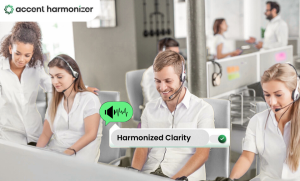
| Accent Harmonization | Adapting speech in real time to reduce friction without wholesale conversion | High-volume live calls where latency matters most | Sales, collections, tier-1 support |
“Accent translation” is frequently misapplied in BPO contexts to describe what is harmonization. The distinction matters when scoping solutions: buying translation tooling for a clarity problem is like buying a noise-canceling headset to fix pronunciation.
What “Real-Time” Actually Means in a Live Call?
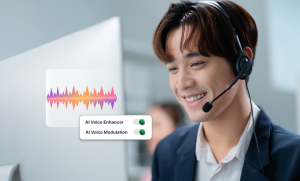
Real-time is another term vendors stretch. True real-time accent harmonization operates at the millisecond level — the adaptation happens before the audio reaches the customer’s ear, with no perceptible delay in conversation flow. This is architecturally different from post-processing, where audio is adjusted after the fact (useful for transcription quality, useless for live calls).
In practice, latency tolerance is tighter than most people assume. A 200ms processing delay is below the threshold of conscious notice. Anything approaching 400–500ms begins to feel like a satellite call, which destroys rapport faster than any accent would. When evaluating solutions, latency benchmarks matter more than accuracy scores in isolation — an 98%-accurate system that adds 350ms of lag will hurt more than it helps.
Where AI Accent Solutions Actually Reduce AHT
The AHT story is most persuasive when you trace it through the call stages rather than citing an aggregate number:
- Opening (0–60 seconds):Fewer repeat-yourself moments during authentication and intent capture. Even shaving one repetition loop here cuts 20–30 seconds per call at scale.
- Problem identification:Faster comprehension of issue details means agents spend less time verifying what they heard. Misheard account numbers or product codes are a significant hidden cost in support queues.
- Resolution explanation:Instructions delivered with high clarity require less re-confirmation at the close. This is where long calls often stall — the agent has solved the problem, but the customer isn’t confident they understood the fix.
- Closing:A call that hasn’t accumulated confusion doesn’t need a lengthy recap. Clean closings are a downstream consequence of clarity maintained throughout.
AI Accent Solutions vs. Noise Cancellation vs. Speech Enhancement
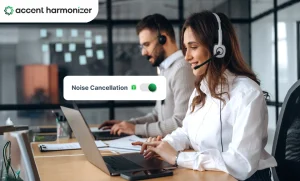
These three categories are frequently conflated, and buying the wrong one is an expensive mistake. Noise cancellation addresses environmental audio quality — background call center noise, HVAC hum, keyboard clatter. Speech enhancement improves the fidelity of the audio signal itself. Accent harmonization addresses pronunciation-level clarity in the speech content.
They solve different layers of the same stack. A center with excellent noise cancellation but no accent AI still has clarity problems; a center with accent harmonization but poor signal quality will underperform both tools’ potential. The practical recommendation: audit which layer is causing your comprehension failures before buying.
AI Accent Localization: Beyond Neutralization
The next capability evolution for accent translation software is audio adaptation. Where neutralization strips regional character toward a generic standard, localization goes further: dynamically shifting speech patterns to match regional customer expectations.
A US-Southeast customer and a US-Northeast customer have different perceptual baselines for what sounds authoritative and trustworthy. An Australian enterprise customer responds differently than a UK one.
This matters most in sales and collections, where trust signals are loading bearing. The emerging capability is dynamic adaptation — a system that reads caller origin signals and adjusts in the first 30 seconds of the call without any manual configuration.
When Should a BPO Invest in AI Accent Solutions?
The clearest signals are operational, not philosophical:
- Repeat call rate above 15% with no clear technical cause
- AHT trending up despite agent coaching investment
- CSAT scores flat or declining despite process improvements
- Offshore scaling creating new customer escalation patterns
- Sales conversion rates underperforming onshore benchmarks by 10%+
- Agent onboarding time for clarity standards exceeding 6 weeks
Maturity stage matters too. Early-stage offshore operations often benefit most from harmonization as a bridge while coaching programs develop. Scaled operations use it to protect consistency across large agent populations where individual coaching is impractical.
Will It Sound Natural? The Authenticity Question
This is the concern most BPO buyers have and fewest vendors address directly. The short answer: well-implemented harmonization is transparent to customers. The goal isn’t to make every agent sound identical — it’s to remove the specific phonemic patterns that cause comprehension failures while preserving the agent’s natural voice character.
The ethical frame matters here. Real-time accent localization software works as enhancement. Agents retain their accent what changes is the subset of sounds that reliably cause confusion for a specific customer population.
The Business Impact: Clarity as a Revenue Variable
The case for accent AI becomes most compelling when you stop measuring it against CX benchmarks and start measuring it against revenue outcomes. In sales environments, comprehension failures late in a call — during pricing explanation, terms confirmation, or upsell offers — are where conversion drops. A customer who isn’t sure what they just agreed to do agree to anything.
BPOs running outbound sales programs on offshore teams consistently report that clarity improvements correlate more strongly with conversion uplift than script optimization or objection-handling training. The message was always good. The delivery chain was the constraint.
See how clarity gaps are showing up in your calls