For global contact centers, diversity is an asset. It allows them 24/7 coverage and access to a worldwide talent pool. Yet, accent clarity often persists as a hidden friction point. It is known in the industry for spiking cognitive load for both the agent and the customer, leading to frustration and confusion.
When a customer struggles to interpret unfamiliar speech patterns, research from the University of Southern California shows they subconsciously rate the speaker as less credible. Every clarification across thousands of calls compounds into lost operational efficiency and poorer customer experience.
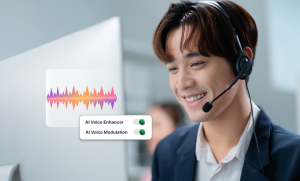
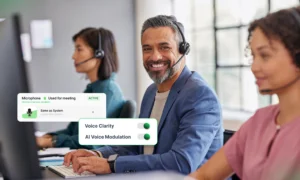
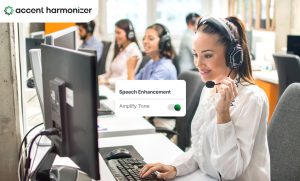
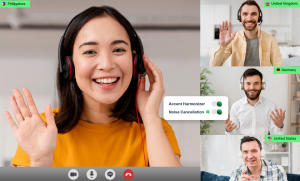
AI accent solutions for call centers like AI Accent Harmonization by Omind solves this communication barrier. It is a real-time technology designed to enhance clarity, ensuring that agent expertise becomes the focus of every conversation.
What Makes a Solution Enterprise-Grade?
The market is currently flooded with adjacent speech technologies. However, top AI accent solutions work on two areas: technical execution and ethical governances.
The Technology Behind Fixing Latency Barrier
AI-based agent communication improvement tools operate in real-time. For a human conversation to feel natural and un-delayed, the total processing latency (from when the agent speaks to when the customer hears the enhanced speech) must be minimal. The industry standard for acceptable communication delay is sub-300 milliseconds.
Accent Harmonizer is engineered with optimized computing capabilities to ensure an average latency of 100-200ms.
Enhancement vs. Erasure
A key driver of agent adoption and customer trust is the product’s ethical stance on identity. Our approach is founded on the principle of Harmonization, which is distinctly different from Neutralization.
- Neutralization (Avoid): Attempts to completely strip the voice of its unique regional, cultural, or personal character, resulting in a robotic or generic sound that compromises agent authenticity.
- Harmonization (Our Approach): Uses AI to selectively modify only the specific phonemes (speech sounds) that statistically cause listener confusion. The agent’s natural tone, rhythm, pitch, and personal expression are preserved.
Integration and Compliance AI Accent Solutions for Call Centers
A sophisticated AI solution is only valuable if it can be deployed seamlessly and trusted implicitly. It minimizes workflow disruption and maximizes data security.
Implementation Roadmap for Contact Center
A successful rollout is deliberate, focusing first on high-impact areas to validate the ROI before full-scale deployment.
- Step 1: Accent Audit & Baseline Measurement: Identify specific call queues or agent populations where friction is highest (e.g., agents with specific regional accents, or high-volume support lines). Establish the pre-implementation baseline for AHT, FCR, and customer feedback.
- Step 2: Change Management & Agent Buy-In: The technology must be introduced as an empowering “clarity support tool,” not a corrective measure. Teams should be trained on how the Harmonizer works and how it improves their confidence.
- Step 3: Pilot Program (The High-Friction Queue): Implement the solution with a small, focused group for 4-6 weeks. Closely monitor the delta in KPIs and collect qualitative agent feedback.
- Step 4: Tech Stack Integration: Deploy the solution seamlessly within the existing infrastructure.
- Step 5: Continuous Monitoring & Refinement: Use the solution’s native analytics (repetition frequency, call smoothness) alongside your existing Speech Analytics Platform to ensure consistency and refine the AI’s models over time.
Integration into Existing Tech Stack
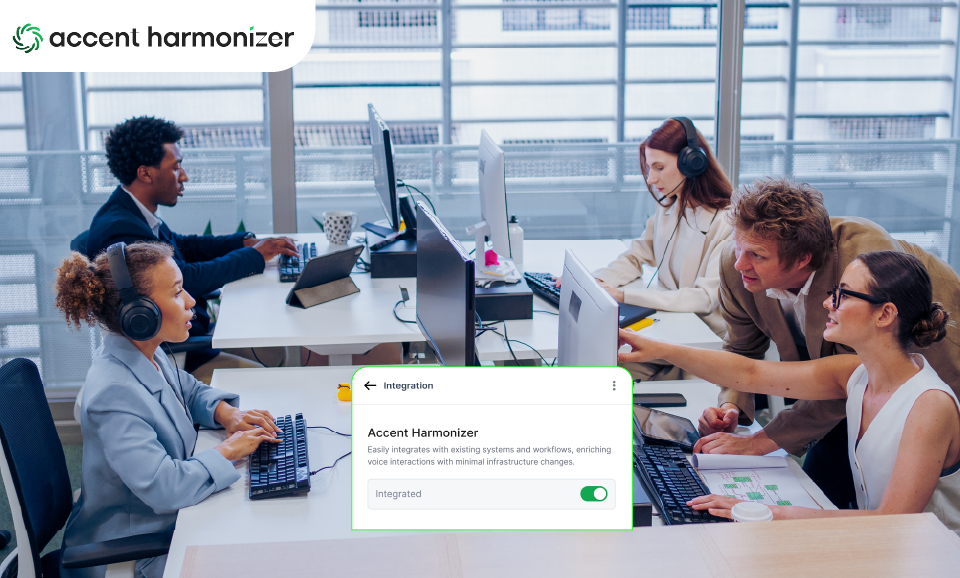
Accent Harmonizer is designed to fit directly into the existing voice pathway using a lightweight software layer.
| Integration Point | Benefit |
|---|---|
| CCaaS/Telephony Layer | Deploys as a simple SIP trunk-level proxy or integrated application, compatible with major platforms like Genesys, Cisco, and Five9. |
| Softphones & Dialers | Runs as a local service or plug-in, ensuring the agent’s experience remains intuitive. |
| Speech Analytics Platforms | Critical: Sends the enhanced, clear audio to your platform (e.g., Verint, NICE), dramatically improving the accuracy of transcription, keyword spotting, and sentiment analysis for QA teams. |
Security & Compliance Processing Sensitive Voice Data
Because technology processes live, sensitive voice data, stringent adherence to global data privacy and security standards is mandatory for Trustworthiness.
- Data Minimization: Accent Harmonizer does not permanently store the full, raw voice stream; it processes it momentarily for enhancement.
- Compliance: The platform must adhere to key global and industry-specific regulations, including:
-> GDPR/CCPA: Compliance with regional data privacy laws regarding voice biometrics (where applicable).
-> HIPAA & PCI-DSS: Ensures secure handling of health and payment data, even with enhanced audio.
Conclusion
As contact centers continue their global expansion, they need talent who communicate with maximum efficiency and confidence. Real-time AI accent enhancer and harmonizer can bridge linguistic diversity and universal service quality.
The AI accent solutions for call centers move beyond a simple CX fix and operational lever:
- Agent Retention Tool: By removing communication anxiety, it improves the daily experience of agents, transforming retention rates and protecting the organization’s investment in its global workforce.
- Predictable Quality: It delivers consistent, high-clarity communication regardless of the agent’s location or background, guaranteeing a unified, professional brand experience for every customer.
- Data Accuracy: By cleaning up audio streams, it makes existing speech analytics and quality assurance platforms more accurate and effective, enhancing your overall data strategy.
Ready to Quantify Your Clarity ROI?
AI Accent Harmonization by Omind (powered by Sanas) delivers AHT reduction and lift in FCR. Request your personalized demo to project measurable savings and CX gains with your Accent Harmonizer.