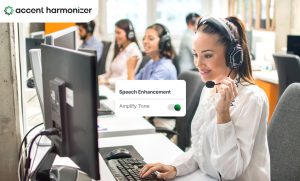

Modern businesses operate across borders. Customer support agents may be in the Philippines or Latin America while customers call from the United States, Europe, or Australia.
Yet many conversations break down not because of poor service—but because of accent friction. Many organizations are now looking for advanced accent translation tolls designed to make speech easier to understand across different accents and dialects.
What Is an Accent Translation Tool?
An accent translation tool uses artificial intelligence to modify or harmonize spoken audio so that it becomes easier for listeners from different regions to understand.
Unlike traditional translation systems that convert one language into another, accent translation focuses on clarity within the same language.
For example:
- A Filipino English accent may be subtly adjusted for a U.S. listener
- An Indian accent may be optimized for global call center conversations
- A regional dialect may be smoothed for clearer speech perception
The goal is not to change the speaker’s identity.
Instead, the technology helps reduce pronunciation friction so communication flows naturally.
Modern AI-driven systems perform this processing during live calls, making the experience seamless for both the agent and the customer.
Why Accent Differences Create Communication Friction?
Global contact centers depend on multilingual and multicultural teams. While this diversity enables 24/7 support, it also introduces challenges related to speech perception.
Research in linguistics and speech science shows that listeners are more likely to misinterpret words when accents differ significantly from their own.
In customer interactions, this can lead to:
Repeated Clarification: Customers may ask agents to repeat information several times, slowing down the conversation.
Misheard Information: Numbers, dates, and product names are especially vulnerable to misunderstanding. These errors directly contribute to inflated Average Handle Time (AHT) and higher error rates in post-call processing.
Reduced Customer Confidence: When communication feels unclear, customers may perceive the service experience as lower quality—even if the agent is highly skilled.
How an Accent Translation Tool Works?
Modern accent translation systems rely on several layers of speech processing technology.
While implementations differ across platforms, most systems follow a similar pipeline.
- Real-Time Speech Analysis: AI models analyze the speaker’s voice characteristics, phonetics, and pronunciation patterns during the conversation. This step identifies where certain sounds may be difficult for listeners from other regions.
- Phonetic Adjustment: The system modifies specific speech elements—such as vowel sounds or syllable stress—to improve clarity. These adjustments are subtle and designed to maintain the natural tone of the speaker.
- Audio Reconstruction: The processed speech is then reconstructed and delivered to the listener almost instantly.
In modern voice AI systems, this entire process can occur with extremely low latency, ensuring that conversations remain fluid.
Accent Translation vs Traditional Accent Training
For decades, companies attempted to address accent barriers through training programs.
Agents were asked to practice pronunciation, memorize scripts, and attend accent coaching sessions.
While training can help in some situations, it also has limitations:
| Traditional Approaches & Their Limitations | |
|---|---|
| Approach | Limitation |
| Accent training | Requires months of practice |
| Script standardization | Reduces natural conversation |
| Hiring restrictions | Limits talent pools |
AI-driven accent translation tools take a different approach.
Instead of asking agents to change how they speak, the technology optimizes the audio signal itself. Also, removing the need for strict accent-based hiring requirements, companies can significantly expand their contact center talent pools to find the best-skilled agents regardless of geography
This allows agents to communicate naturally while still being clearly understood by customers worldwide.
Where Accent Translation Tools Deliver the Most Value?
Organizations exploring accent translation technology often share similar communication challenges.
Several environments benefit particularly from these systems.
- Global Contact Centers: Customer support teams often handle calls from multiple regions. Accent translation tools help ensure that agents are understood regardless of where customers are located.
- Offshore BPO Operations: Business process outsourcing providers rely on international teams. Clear communication improves customer satisfaction and operational efficiency.
- Sales and Revenue Teams: In sales conversations, clarity is critical. Even minor misunderstandings can disrupt the flow of a deal. Global sales teams use accent harmonization to build trust faster with international prospects.
- Technical Support: Support engineers often explain complex instructions. Clear speech helps reduce confusion and repeat calls.
Across these scenarios, improved speech clarity can contribute to better communication outcomes.
Real-Time Accent Harmonization in Action
One example of this technology is Accent Harmonizer, an AI-driven solution designed to improve voice clarity during live conversations.
The platform focuses on real-time accent harmonization, meaning that it adjusts speech dynamically without requiring post-processing. Key capabilities include:
- Real-time accent adjustment during calls
- Preservation of the speaker’s natural voice identity
- Compatibility with contact center platforms
- Low-latency audio processing for seamless conversations
Instead of forcing agents to change their speech patterns, the system works in the background to ensure that conversations remain clear.
The Technical Challenges Behind Accent Translation
Developing an effective accent translation tool involves several complex technical challenges.
- Maintaining Natural Speech: Overprocessing audio can make voices sound robotic or unnatural. Advanced systems must balance clarity with authenticity. The technology refines speech without robotic distortion, ensuring a natural human connection.
- Low Latency: Any noticeable delay can disrupt conversation flow. Real-time systems must process speech within milliseconds.
- Accent Diversity: English alone contains hundreds of regional accents and dialects. AI models must be trained in diverse voice data to perform effectively.
Because of these challenges, real-time accent harmonization requires sophisticated speech processing infrastructure.
The Future of AI-Powered Accent Translation
As voice AI continues to evolve, accent translation tools are likely to play an increasing role in global communication.
Several trends are emerging:
- AI models trained on larger multilingual datasets
- Improved phonetic modeling for dialect variation
- Integration with contact center platforms and voice assistants
For global enterprises, the goal is simple: remove communication barriers so conversations remain focused on solving customer problems.
Accent translation technology represents one step toward that future.
Clearer Conversations Without Changing Your Voice
Accent diversity is a natural part of global communication. But in high-stakes environments like customer support and sales, clarity matters.
AI-powered accent translation tools are helping organizations bridge the gap between diverse speech patterns and listener expectations.
By enhancing pronunciation clarity in real time, solutions such as Accent Harmonizer aim to ensure that conversations remain natural, efficient, and easy to understand.
Real-time Accent Harmonization Transforming Global Conversations
Experience how Accent Harmonizer improves speech clarity while preserving the natural voice of your agents.