
Most contact centers don’t struggle with language—they struggle with clarity in the moment of conversation.
When a customer asks an agent to repeat themselves, the issue isn’t just a missed word. It’s a break in flow. That break introduces hesitation, increases cognitive load, and often leads to longer calls, repeat contacts, or lost trust. Over time, these micro-frictions compound into measurable operational drag—higher average handle time (AHT), lower first call resolution (FCR), and inconsistent customer satisfaction (CSAT). AI communication clarity tools for agents are changing the equation. Not by training agents before calls or analyzing them after—but by improving intelligibility while the conversation is still happening.
What Are AI Communication Clarity Tools for Agents?
AI communication clarity tools are systems designed to enhance speech intelligibility in real time. They ensure real-time accent enhancement tools for voice clarity enables what an agent says is clearly understood by the listener—without altering the agent’s identity or tone.
Unlike traditional approaches, these tools don’t rely on:
- Long-term accent training programs
- Script standardization
- Post-call transcription or QA analysis
Instead, they introduce a real-time clarity layer into live conversations. This layer works by identifying parts of speech that are most likely to cause misunderstandings and adjusting them dynamically during the call. The outcome is not a “neutralized” voice, but a more intelligible version of the same voice.
Why Agent Communication Breaks Down When Language Isn’t the Issue?
Communication failures in contact centers are often misdiagnosed as “accent problems.” They are multi-layered breakdowns in comprehension.
There are four primary contributors:
- Phonetic Mismatch: Different accents produce sound patterns that may not align with the listener’s expectations, making certain words harder to decode.
- Cognitive Load: When listeners must “work harder” to understand speech, their mental processing capacity is consumed faster leading to fatigue and reduced comprehension as the call progresses.
- Environmental Noise: Background noise or poor audio quality can distort speech signals, amplifying existing clarity challenges.
- Contextual Misinterpretation: Misheard names, numbers, or product details create downstream errors—even when the rest of the conversation is accurate.
These breakdowns are not evenly distributed. They tend to cluster at critical moments:
- Opening (0–60 seconds): Misheard details create early friction and skepticism
- Mid-call: Misinterpretation leads to incorrect resolutions or repeat explanations
- Closing: Lack of clarity affects confirmations, commitments, or conversions
Key Insight: Clarity is a system-level problem that directly impacts operational metrics.
Types of AI Communication Clarity Tools And Where They Fall Short
The market offers multiple approaches to improving communication. However, not all are designed to solve the same problem.
Accent Training
- Focuses on long-term phonetic improvement through coaching.
- Limitation: Slow, inconsistent, and difficult to scale across large teams.
Neutralization of Accent
- Attempts to standardize speech toward a “neutral” accent.
- Limitation: Can reduce authenticity and create unnatural speech patterns.
Accent Conversion
- Transforms speech into a different accent entirely.
- Limitation: Risk of synthetic or “processed” sound that impacts trust.
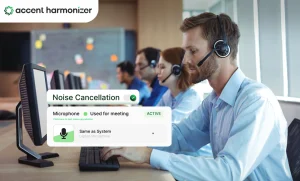
Noise Cancellation Tools
- Improve background audio quality.
- Limitation: Addresses only environmental factors, not speech clarity itself.
Post-Call AI (Transcription / QA)
- Analyzes conversations after they occur.
- Limitation: Does not prevent misunderstandings during live interactions.
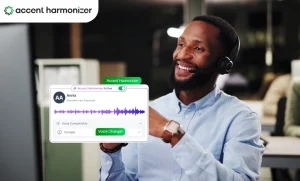
Real-Time Accent Harmonization
- Adjusts speech dynamically to improve intelligibility while preserving voice identity.
- Strength: Operates directly at the point of failure—during the call.
How Real-Time AI Communication Clarity Tools Work?
At a high level, real-time clarity systems process speech through a low-latency pipeline:
- Audio Capture – The agent’s voice is captured at the source
- Phoneme Detection – AI models identify speech elements likely to cause confusion
- Selective Adjustment – Only high-risk phonetic elements are modified
- Output Delivery – The adjusted audio is delivered to the listener in near real time
For this to work seamlessly, latency must remain extremely low. In most conversational systems, anything above ~200 milliseconds risks disrupting natural speech flow.
Equally important is what the system does not change:
- Voice identity
- Emotional tone
- Speech rhythm
The AI voice clarity software for agents modifies audio while preserving authenticity. When clarity improvement happens upstream in the voice stack, it enhances:
- Speech-to-text accuracy
- AI-driven analytics
- Quality monitoring output
The Business Impact: Why Clarity Tools Matter for Agent Performance
Improving communication clarity is not just a qualitative upgrade—it has measurable operational impact.
- Reduced Average Handle Time (AHT): Fewer repeat-confirm loops mean less time spent clarifying basic information.
- Improved First Call Resolution (FCR): When customers understand instructions clearly, they are less likely to call back.
- Higher Customer Satisfaction (CSAT): Smooth, uninterrupted conversations improve perceived service quality.
- Better Agent Experience: Agents experience less stress and cognitive load when they don’t need to repeat themselves.
- Lower Operational Costs: Time savings on a scale translate into significant cost efficiencies.
For example, even a modest reduction in repetition during calls can free up hundreds of agent hours per month in high-volume environments.
Key Takeaway: Clarity is more than communication improvement, rather an operational lever.
Why Do Training and QA Alone Solve the Problem?
Most contact centers rely on two primary levels:
- Training (before the call)
- Quality assurance (after the call)
Both are important—but neither addresses the moment when communication fails. Training programs often:
- Require months to show impact
- Struggle with consistency across agents
- Reset with attrition and new hiring cycles
QA systems:
- Identify issues after they occur
- Provide feedback too late to influence the live interaction
The moment of misunderstanding, the point where clarity matters most—remains unaddressed. This is why many contact centers are now adopting harmonization adopting accent harmonization over traditional training programs.
AI communication clarity tools fill this gap by operating in real time, where traditional approaches cannot.
What to Look for in AI Communication Clarity Tools?
For decision-makers evaluating solutions, the difference between a pilot success and production failure often comes down to technical and operational criteria. Key considerations for real-time accent enhancement AI include:
- Low latency under real-world conditions (not just lab performance)
- Voice identity preservation to maintain natural conversations
- Selective processing to avoid over-modification
- Adaptability to different accent pairings
- Seamless integration with existing telephony systems
- Measurement frameworks for A/B testing and ROI validation
- Governance controls for compliance and transparency
When Should You Invest in AI Clarity Tools?
Not every operation requires immediate adoption. The decision should be driven by clear signals.
Strong Indicators for Deployment
- Rising AHT despite ongoing training efforts
- High repeat call rates linked to misunderstanding
- Performance gaps between offshore and onshore teams
- CSAT inconsistencies across regions
Situations Where It May Not Be Urgent
- Small teams with manageable training cycles
- Stable performance metrics across key KPIs
- Lack of baseline measurement for communication issues
Understanding timing is critical.
Introducing new technology without diagnosing the problem can lead to unnecessary complexity.
The Future: From Accent Correction to Communication Infrastructure
The direction of the industry is shifting, the goal is no longer to “fix accents.” It is to optimize understanding at scale. Future AI-powered call quality monitoring systems are likely to:
- Adapt dynamically to listener preferences
- Integrate with real-time agent assist tools
- Feed directly into quality and analytics platforms
- Operate as a foundational layer in voice communication stacks
In this model, communication clarity becomes infrastructure, not a training outcome.
Conclusion
Contact centers have spent decades trying to standardize how agents speak. But standardization doesn’t guarantee understanding. The real issue is: Can the customer understand the agent clearly, the first time?
AI communication clarity tools shift the focus from long-term correction to real-time comprehension. And in doing so, they address one of the most persistent—and costly—frictions in customer experience.
Move from Analysis to Clarity
If communication friction is showing up in your AHT, CSAT, or repeat call rates, the next step is better visibility. Book a demo with Accent Harmonizer to analyze your calls for clarity breakdown patterns and identify where real-time intervention could make the biggest impact.