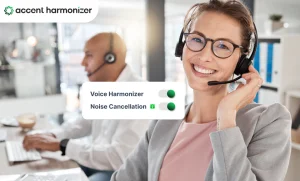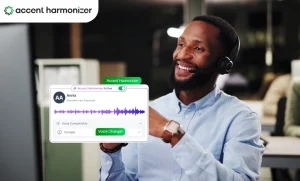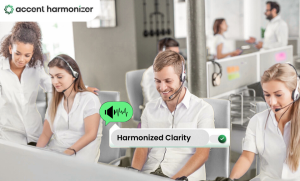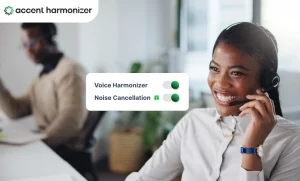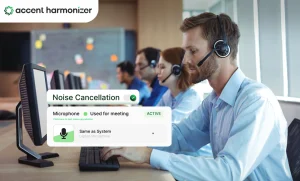

In high-volume contact centers, communication breakdowns don’t announce themselves. They happen in milliseconds — a misheard digit, a repeated question, a hesitant close. AI-powered accent clarity is changing how BPOs address this, but most teams still don’t know how to evaluate or deploy it effectively.
In a support call, clarity breakdown instead of accent is the problem. That distinction matters more than most BPO leaders realize. Conflating the two leads to misdiagnosed root causes, wasted training budgets, and metrics that keep creeping in the wrong direction.
This guide covers what real-time accent harmonization does, how it differs from legacy approaches, and what separates tools that perform at scale from tools that sound good in a demo.
Why is AI-powered Accent Clarity for BPOs the New CX Standard?
Clarity failures don’t show up cleanly in dashboards. They’re distributed across three moments in every call — and each carries a measurable cost that rarely gets attributed correctly.
In the opening phase, authentication loops stall the conversation before it begins. Mid-call, misheard data — a digit, a date, a name — triggers repetition that compounds handle time. At the close, agents lose confidence, re-confirming details customers thought were already settled.
One repetition loop removed equals roughly 15–25 seconds saved per call. Across
Neutralization vs. Conversion vs. Harmonization: Choosing the Right BPO Solution
These three terms are used interchangeably by most vendors. They describe meaningfully different approaches, and buying the wrong one has real consequences for agent experience and customer trust.
| Accent Management Approaches Compared | |||
|---|---|---|---|
| Approach | What It Does | Best For | Trade-off |
| Neutralization | Reduces regional accent features | High-volume Tier-1 support | Can feel inauthentic at scale |
| Conversion | Transforms into a target accent | Brand-specific voice matching | Highest latency risk, identity concerns |
| Harmonization | Reduces friction without removing identity | Sales, multilingual ops, long calls | Narrower vendor selection |
Harmonization is the emerging standard for enterprise BPOs because it preserves the agent’s voice while reducing the specific phoneme patterns that cause misunderstanding — without the uncanny effect that full conversion produces.
Evaluating Latency in AI-Powered Accent Clarity BPO Tools
Every vendor in this category claims real-time performance. Very few define what that means. Latency thresholds matter more than any other technical specification because once you cross the threshold where processing delay becomes perceptible, the tool actively degrades the conversation.
The processing pipeline needs to complete under 200ms to remain below the threshold of conscious perception. Post-processing solutions that work on recorded audio are not usable for live calls, regardless of output quality.
“Real-time in a demo environment and real-time under concurrent load are two different things. Ask for latency benchmarks at your expected call volume, not at 10 concurrent sessions.”
When Accent Clarity Works — And When It Doesn’t
Accent clarity AI performs best in high-volume Tier-1 support, outbound sales, and offshore-heavy operations where clarity friction is the primary driver of handle time and satisfaction gaps. Speech clarity software for contact centers delivers compounding returns in environments where calls are structured, and volume justifies the integration cost.
It does not fix broken scripting, compensate for agent knowledge gaps, or resolve process failures that cause calls to fail before clarity even becomes relevant. Deploying voice harmonization on top of poor call design is expensive and ineffective.
The buyers who get the most from these tools are the ones who have already diagnosed their clarity gaps as structural — not the ones hoping AI will solve a problem they haven’t localized yet.
How to Evaluate Accent Harmonization Tools for Your Operation
When assessing vendors, the evaluation criteria that matter most are those that predict performance under real operating conditions:
- Latency benchmarks at your actual call volume (not synthetic load)
- Naturalness scores from blind listening panels, not vendor-run tests
- Integration with your existing CCaaS or VoIP stack
- Agent experience review — does it affect how agents hear themselves?
- Rollout model: API, SDK, or desktop layer, and what each requires from IT
- QA calibration support for post-deployment performance tuning
Red flags worth noting
- Vendors who cannot produce latency data under concurrent load,
- Tools that require a full call recording before processing, and
- Any solution that routes audio through a third-party data center without clear sla and compliance documentation
Measuring the ROI of Real-time Voice Clarity Infrastructure
“Accent reduction tool” undersells what these systems have become. In operations that have deployed them successfully, voice harmonization sits alongside top technology that manages every call.
As offshore scaling accelerates and global CX complexity increases, the operations that treat clarity as infrastructure will outperform those that treat it as a training variable. Compounding math includes: fewer repetition loops, lower handle time, fewer repeat calls, higher first-call resolution — all flowing from one intelligently applied layer of the call stack.
See where clarity gaps are costing you
Request a call analysis and get a tailored recommendation for your operation.