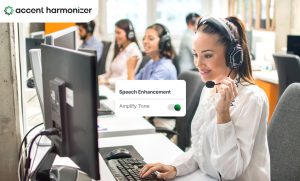

In global contact centers, communication challenges are rarely about language alone. Accent variability and audio clarity often introduce friction long before intent is misunderstood. The situations where customers struggle to understand agents even when the information shared is correct.
AI-powered accent neutralization has emerged as a system-level response to this problem. Rather than asking agents to modify how they speak, it modifies how speech is delivered—in real time, during live conversations.
This article explains what AI-powered accent neutralization does, how it fits into contact center operations, and how it contributes to agent communication improvement without relying on behavioral retraining.
Why Agent Communication Breaks Down in Cross-Accent Conversations
Contact centers serving global markets face structural realities:
- Agents and customers often do not share the same linguistic background
- Accent familiarity varies widely between callers
- Even minor pronunciation differences can slow comprehension
These issues typically surface like:
- Repetition and clarification loops
- Longer call handling times
- Frustration on both sides of the conversation
Traditional interventions—such as accent training or script standardization—address communication over time, but they do not resolve misunderstandings while a call is happening.
AI-powered accent neutralization focuses on that real-time gap.
What Is AI-Powered Accent Neutralization?
AI-powered accent neutralization is a real-time speech processing approach designed to reduce accent-related friction in voice conversations. It builds on broader voice harmonization principles, working on adjusting specific audio signals. The controlled acoustic and phonetic elements of voice, making it easier for a broader listener base.
What it is not:
- It does not replace the agent’s voice
- It does not generate synthetic speech
- It does not remove identity or individuality
Accent Neutralization Supports Agent Communication Improvement
Agent communication improvement is often treated as a coaching or training challenge. Accent neutralization approaches it differently. By treating clarity as a systems problem, not a human limitation.
From an operational perspective, this means:
- Agents continue speaking naturally
- No additional cognitive load is introduced
- Communication support is applied uniformly
This allows organizations to improve consistency in customer experience without increasing agent effort or extending onboarding cycles. In live environments, misunderstanding often appears in QA notes as “customers didn’t understand,” even when intent was clear.
How AI-Powered Accent Neutralization Works in Practice
While implementations vary, most accent harmonizing systems follow a similar processing flow.
Live Audio Intake
The agent’s speech is captured directly from the active call. This can occur at the headset, softphone, or telephony stream level.
Latency control is critical at this stage, as conversational flow must remain uninterrupted.
Acoustic and Phonetic Processing
The system analyzes speech characteristics associated with accent-driven comprehension challenges. This analysis focuses on how words are pronounced, not what is being said.
No intent interpretation or semantic rewriting occurs at this stage.
Real-Time Accent Harmonization
Rather than enforcing a standardized accent, the system applies incremental adjustments to improve intelligibility. These may include subtle corrections to articulation or timing while preserving the speaker’s natural tone.
Audio Reconstruction and Delivery
The processed audio is reconstructed and delivered to the listener in near real time. The quality of this step determines whether the solution feels seamless or intrusive.
Accent Neutralization vs Accent Training
Both approaches address communication, but they operate on different timelines and assumptions.
Accent training:
- Requires sustained effort from agents
- Produces variable outcomes
- Does not address immediate call issues
AI-powered accent neutralization:
- Operates instantly
- Applies consistently across teams
- Supports agents without behavior change
For organizations managing scale and consistency, this distinction is operationally significant.
Conclusion
AI-powered accent neutralization reframes agent communication improvement as an infrastructure challenge rather than a human one. By addressing how speech is delivered, not how agents speak—it supports clarity without imposing behavioral change.
It is not a universal solution, nor does it replace training or quality programs. Instead, it functions as a real-time clarity layer, designed to reduce friction where human communication already works—but still falls short across accents.
Used with clear expectations and proper evaluation, it becomes a practical component of modern contact center architecture.
Evaluate Accent Neutralization for Your Live Conversations
If you’re exploring AI-powered accent neutralization for real-time customer conversations, the most important step is understanding how it behaves in live environments—not in demos. A structured evaluation helps teams assess clarity impact, latency tolerance, and deployment fit before any rollout.
Request a demo to know more