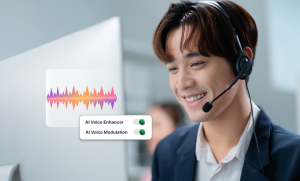

Imagine a customer desperately needing help, trapped on a call where repeated questions echo endlessly: “I’m sorry, can you say that again?” This scenario plays out too often in contact centers worldwide. It leads to frustration and fatigue for both customers and agents. The communication gap can become evident, undermining other customer experience investments. AI voice clarity software changes the approach by making audio an adaptable part of the customer experience rather than just a basic channel.
Imagine a frustrated caller who struggles to make themselves understood, feeling the weight of each repeated word. Suddenly, AI voice clarity transforms the call. Every word is clear, and the frustration melts into relief and gratitude for the support they’ve received.
Why Customer Effort Escalates in Global Voice-based Support?
The conversation begins with an accent handicap for both sides. When a native English-speaking customer calls a support center in South Asian countries, regional pronunciation patterns and dialectical differences create comprehension challenges for both parties.
Network audio compression, background noise, and other phone-system limitations make communication even harder. Every time someone says, “I’m sorry, can you repeat that?” it adds time to the call, frustrates customers, and increases agents’ mental load.
Problems with voice clarity can hurt the customer experience even before customers say anything. They might not mention an agent’s accent or a bad connection, but they may say the call was “harder than it should have been” or give a neutral rating instead of a positive one. Such neutral ratings could be linked to a measurable increase in churn probability, suggesting that this unvoiced dissatisfaction translates into loyalty risk. A recent Forbes survey shows that 88% of customers report frustration from accent barriers. These problems lead to longer calls, more back-and-forth, and tired agents.
What AI Voice Clarity Software Actually Means for Contact Centers?
There is a distinct difference between AI voice clarity software built for contact centers and tools designed for content creators. Podcast editing software, video conferencing enhancers, and post-production tools operate in environments where latency is not a concern. Here, audio processing is available post-recording, and the communication flow is one-way.
Contact centers need real-time, two-way audio improvement with delays measured in milliseconds, not seconds. For context, a human blink takes roughly 300 milliseconds. Also, one cannot pause calls for processing. Uptime requirements are as strict as those for critical systems, not for standard consumer software.
Core functional layers of real-time voice clarity
At the technical level, AI voice clarity software for contact centers operates across a memorable ‘clarity ladder’ of integrated layers. This three-step process can be easily recalled with the mnemonic ‘Mute-Tune-Harmonize’:
- ‘Mute‘ represents noise suppression. It reduces environmental interference to enhance focus and understanding.
- ‘Tune’ involves isolating and optimizing speech, providing the foundation for clear communication across diverse backgrounds.
- ‘Harmonize’ focuses on accent normalization. It adjusts pronunciation to improve intelligibility while maintaining the speaker’s natural identity.
These processes run throughout live calls, using models trained on phone audio instead of studio recordings. The result should sound natural, as if sitting nearby, keep the speaker’s emotion, and match the flow of conversation, all while working within the tight timing needed for real-time calls.
How Real-time Voice Clarity Directly Reduces Customer Effort?
The most significant benefit of better voice clarity is less repetition. When customers don’t have to repeat questions or spell out account numbers, calls move faster. Agents can focus more on solving the customer’s problem instead of asking for clarification. Reducing repetition by just a few seconds per call can add up to significant savings. For example, if each call was reduced by 10 seconds due to improved clarity, and a contact center handles 1,000 calls per day, that would save over 100,000 seconds, or nearly 28 hours of operation, every month. This reduction translates into both time savings and cost efficiencies, potentially saving thousands of dollars annually, depending on the cost per minute of agent time.
This improvement in dialogue flow has a compounding effect:
- Faster intent recognition leads to quicker routing to the right resource
- More accurate documentation leads to better record-keeping and easier access to information
- Fewer instances of the customer having to re-explain the context lead to higher satisfaction and greater efficiency in issue resolution
How does voice AI for call quality influence AHT and FCR directionally?
Voice AI for call quality addresses communication friction, impacting AHT and FCR. When agents can immediately understand customer requests and customers can clearly hear agent guidance, conversations naturally become more efficient. Typically, contact centers observe an average handling time (AHT) reduction of 5-12% when implementing such technologies, though this can vary.
The impact is likely but not guaranteed. Contact centers may see shorter call times and better first-call resolution because instructions are clear the first time. How much things improve depends on the starting audio quality, the agent’s training, and the complexity of the issues. Still, more transparent communication helps solve problems faster.
Noise Cancellation vs Accent Harmonization at the Global Scale
Many contact centers rely on noise cancellation to improve the agent’s audio quality. However, it makes accurate mutual understanding a significant challenge. This is because clear audio and intelligible speech are two fundamentally different problems.
- Clear Audio (Noise Cancellation): This technology effectively reduces static, fan noise, keyboard clicks, and other background distractions.
- The Result: The agent speaks loudly, and the audio is “clean.”
- The Limitation: Clean audio addresses the environment but does not modify the speech itself. An agent’s pronunciation, speech rhythm, pitch variations, or accent can still make the speech unfamiliar and challenging to process for some customers.
- Intelligible Speech (Accent Harmonization): This technology directly addresses the challenges posed by unfamiliar speech patterns.
- The Goal: To bridge the perceptual distance between the agent’s natural speaking style and the customer’s listening preferences.
- The Value: While noise suppression ensures an agent is heard, Accent Harmonization ensures an agent is understood, making unfamiliar speech patterns easier to process and reducing friction in critical customer interactions.
| Feature | Noise Cancellation | Accent Harmonization |
|---|---|---|
| Primary Target | Environment (Static, sirens, fans) | Phonetics (Cadence, vowel sounds) |
| Technology | Spectral subtraction / AI filters | Real-time generative AI / Resynthesis |
| User Benefit | Less auditory distraction | Reduced cognitive effort & higher FCR |
Where Call Center Voice Optimization Software Delivers the Most Value?
Voice optimization technologies, such as Accent Harmonizer by Omind, deliver critical ROI by directly addressing friction points in global and high-stakes customer interactions.
1. International Customer Service and Support (Global Scale)
This is the most critical case, focusing on the sheer volume and diversity of cross-border interactions.
| Core Challenge | The Problem (Without Voice Optimization) | The Value of Clarity (The Solution) |
|---|---|---|
| Cognitive Load & Trust | Unfamiliar accents require the customer to expend mental energy on interpretation rather than listening, leading to immediate frustration and reduced trust in the agent. | Frictionless Engagement: The customer focuses entirely on the solution. Clarity fosters trust, leading to immediate improvements in CSAT, NPS, and overall customer loyalty. |
| Efficiency & Repetition | High rates of agent repetition and customer confusion inflate Average Handle Time (AHT) and depress First Call Resolution (FCR) rates. | Accelerated Resolution: Reduces the need for agents to repeat instructions or details. The outcome is a measurable decrease in AHT and a lift in FCR, boosting operational efficiency. |
| Agent Experience | Agents experience stress, burnout, and high attrition when customers frequently struggle to understand them, which undermines their morale and perceived effectiveness. | Agent Empowerment: Confident agents who know their message is universally clear experience less stress and higher job satisfaction, leading to better retention and service quality. |
2. High-Stakes Interactions (Financial Outcomes)
Here, clarity is critical because every conversation has a measurable financial impact (e.g., revenue, debt, or contract terms).
| Core Challenge | The Problem (Without Voice Optimization) | The Value of Clarity (The Solution) |
|---|---|---|
| Global Sales Conversion | Miscommunication of pricing, product features, or contract terms due to unclear speech causes hesitation, confusion, and stalled deals. | Persuasion & Agreement: Ensures complex, high-value information is understood the first time perfectly, removing barriers to commitment and leading to higher conversion rates and average order value. |
| Collections and Debt Recovery | Difficulty understanding payment instructions or options increases customer stress, making an already tense conversation more hostile and less productive. | De-escalation & Compliance: Clear, unambiguous communication reduces tension, ensuring successful negotiations and a clear understanding of repayment plans, resulting in improved debt recovery rates. |
3. Regulated and Compliance-Driven Communication (Risk Mitigation)
Clarity here is not just about service; it’s about legal and financial safety.
| Core Challenge | The Problem (Without Voice Optimization) | The Value of Clarity (The Solution) |
|---|---|---|
| Compliance & Legal Risk | In regulated fields (finance, healthcare), verbal consent, disclosures, and agreements must be unambiguously understood by both parties to be legally valid. | Safety & Audit Trail: Voice clarity serves as a critical layer of risk mitigation. It ensures every recorded agreement is defensible and minimizes the risk of legal challenges or costly regulatory penalties. |
Why Do Generic AI Audio Tools Fall Short in Contact Centers?
Many companies first try AI audio tools made for creators, remote workers, or podcasters. These tools are effective for cleaning up recordings after they’re made or improving one-way audio on video calls. But they’re not built for the special needs of contact center voice systems.
The main difference is timing. Contact centers need AI voice tools that work in real time, handle two-way conversations, integrate with phone systems, and manage thousands of calls simultaneously without causing delays or issues.
Why Do Latency, Security, and Uptime Change Everything?
Consumer AI audio tools are fundamentally unsuitable for contact center environments because they fail on three critical enterprise requirements:
1. Latency
- Consumer Latency: Consumer AI audio tools often introduce delays of 200 to 500 milliseconds (ms), as they process audio on personal devices or generic cloud infrastructure.
- Contact Center Requirement: Call centers cannot tolerate delays over 150 ms, as longer latencies actively disrupt the natural rhythm and flow of conversation, degrading the customer experience. This difference in acceptable delays is the primary barrier.
2. Security and Compliance
- Consumer Tools: These tools typically lack the necessary data protection, access controls, and auditing capabilities.
- Contact Center Requirement: Audio data in call centers is highly sensitive. Enterprise solutions must meet strict data standards, including encryption, access controls, and robust data governance. It helps manage risk and maintain regulatory compliance.
3. Uptime and Integration
- Consumer Tools: Designed for individual use with standard consumer reliability.
- Contact Center Requirement: Contact centers require business-grade systems with guaranteed high uptime and seamless integration with leading communication platforms and management tools to ensure reliability and scalability across thousands of agents.
Accent Harmonizer by Omind and AI Voice Clarity
Accent Harmonizer by Omind is a dependable AI voice enhancement for call centers. It fills the gap between general audio tools and the critical, real-time needs of global contact centers. The deliberate design choice ensures that the technology prioritizes understanding over mere audio quality, thereby fundamentally solving cross-cultural communication problems.
| Differentiating Design Principle | General Audio Tools (The Old Way) | Accent Harmonizer (The New Way) |
|---|---|---|
| Starts With | Podcast editing or noise-reduction technology. | Live phone calls and accent modeling technology. |
| Primary Goal | Treats accent differences as secondary to the goal of removing background noise (clear audio). | Focuses first on intelligibility, treating cross-cultural communication as the primary problem. |
Supporting Global CX Consistency Through AI Voice Clarity
For large contact center operations that span different countries and geographies, Accent Harmonizer functions as a crucial consistency tool by delivering three core benefits:
- Standardized Comprehension: The technology doesn’t require every agent to sound the same, but it ensures every customer can understand any agent, regardless of which team takes the call. This creates a reliable, predictable customer experience (CX).
- Boosted Agent Confidence: Increased comprehension significantly improves agent morale and job satisfaction. Knowing they are clearly understood reduces after-call stress, increases customer trust, and reduces attrition.
- Improved Efficiency & CX: Confident agents are more efficient and engaged, delivering superior customer experience. This consistency positively impacts all key contact center performance indicators and overall success.
Voice Clarity as a CX Infrastructure Layer
The global contact center is defined by complexity: managing diverse customer needs, multiple agent locations, and the constant pressure to maximize efficiency. Our analysis reveals that, in this environment, the seemingly small friction of poor voice clarity is the single most critical driver of customer effort, agent stress, and operational costs.
Global contact centers need to choose between clear audio and intelligible speech. Voice optimization software like Accent Harmonizer represents the final, non-negotiable step in the evolution of customer service. It cleans up the line, bridges the human gap, and ensures every agent feels confident during each interaction.
Stop Losing Customers to Communication Friction
Don’t let the “Can you repeat that?” loop define your customer experience. It’s time to move beyond basic noise suppression and achieve true global intelligibility.
Request a demo of Accent Harmonizer by Omind and see the clarity difference in a real-time environment.