
Customer expectations for clear, efficient service interactions have never been higher. Yet contact centers face a persistent challenge: communication clarity gaps that force customers to repeat themselves, lead to misdiagnosed issues, and ultimately drive-up repeat call rates. For organizations managing remote or offshore teams, these comprehension challenges directly impact first-call resolution (FCR) metrics.
The equation is straightforward. Better clarity leads to more accurate issue identification, which enables faster resolutions. This is where AI voice enhancers are transforming the contact center technology stack.
What AI Voice Enhancers Actually Do?
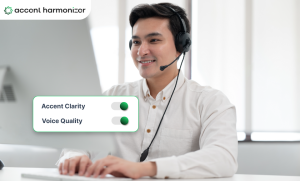
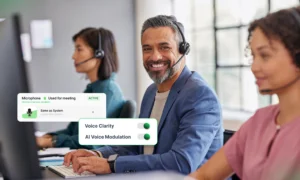
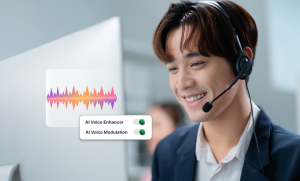
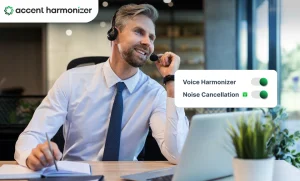
An AI voice enhancer is not simply a noise suppression tool. While traditional filters remove background sounds, modern speech clarity AI actively processes and reconstructs audio in real time to boost intelligibility. These systems analyze vocal patterns, enhance frequency ranges critical for comprehension, and optimize audio quality across varying network conditions.
It’s important to distinguish AI voice enhancers from AI voice generators or voice cloning technologies. Voice enhancers preserve the speaker’s natural voice while making it clearer. They don’t replace or synthesize speech—they refine it.
The Missing Layer: Accent Harmonization
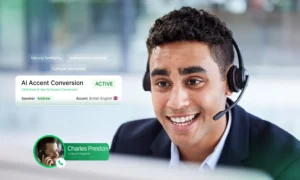
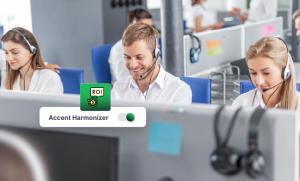
Beyond basic clarity enhancement, accent harmonization represents the next evolution in speech clarity AI. This technology doesn’t eliminate accents but adjusts pronunciation patterns in real time to improve mutual intelligibility during multi-accent interactions. For global contact centers, this capability addresses one of the most common sources of communication friction.
Connection Between Speech Clarity and First-call Resolution
When agents and customers struggle to understand each other, several cascading problems emerge. Agents may misdiagnose the issue, leading to incorrect solutions. Customers repeat information multiple times, extending average handle time (AHT). Scripts become harder to follow when constant clarification interrupts the flow. Each comprehension gap increases the likelihood that the customer will need to call back.
Speech Clarity AI as a Diagnostic Tool
By ensuring both parties hear each other accurately from the first exchange, speech clarity AI prevents these comprehension failures before they compound. Clearer communication means fewer errors in issue identification, more accurate first responses, and ultimately higher FCR rates.
Accent Harmonizer Use Cases That Directly Improve FCR
Here are some of the most common Accent Harmonizer use cases:
Offshore and Global Contact Center Teams
Organizations with geographically distributed teams frequently encounter accent-related comprehension challenges. Accent harmonizers use cases in these environments show measurable improvements in understanding between agents and customers from different regions.
Technical Support Desks
Technical terminology is difficult enough to communicate without adding accent variables. Mispronounced product names, model numbers, or technical terms can derail troubleshooting processes entirely.
Sales and Collection Calls
In high-stakes conversations where clarity directly impacts outcomes, repeated clarifications damage rapport and reduce conversion rates.
Healthcare, Insurance, and Finance Support
These sectors involve complex information exchanges where misunderstandings can have serious consequences. Enhanced clarity becomes a compliance and accuracy imperative.
How AI Voice Enhancers Work in Real-time Interactions?
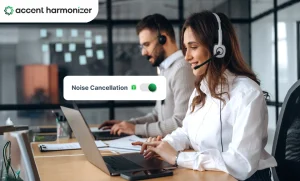
Modern AI voice enhancers operate bidirectionally with minimal latency. On the agent side, they remove audio distortions and boost clarity, so customers receive clean, intelligible speech. On the customer side, they enhance incoming audio to help agents accurately understand customer inputs despite background noise, poor connections, or unfamiliar accents.
The real-time processing requirement is critical. Any noticeable delay would disrupt natural conversation flow, so low-latency enhancement is table stakes for contact center deployment.
Why Accent Harmonization by Omind Is the Missing Layer for Higher FCR?
Accent harmonization by Omind specifically addresses repetition reduction. When agents and customers understand each other on the first attempt, conversations move forward productively. This improved accuracy in issue identification means agents can diagnose problems correctly from the start, reducing misrouting and unnecessary escalations.
For diverse contact center operations, bidirectional accent support ensures that clarity improvements benefit both sides of every conversation.
Final Thoughts
The clarity-to-resolution-to-efficiency pipeline is becoming impossible to ignore. As speech clarity AI and accent harmonization technologies mature, they’re moving from competitive advantages to operational necessities. Contact centers serious about FCR optimization understand that audio quality is a strategic CX lever. It directly impacts their most important performance metrics.
Do you want to know more? You can schedule a demo and our team will get in touch.