
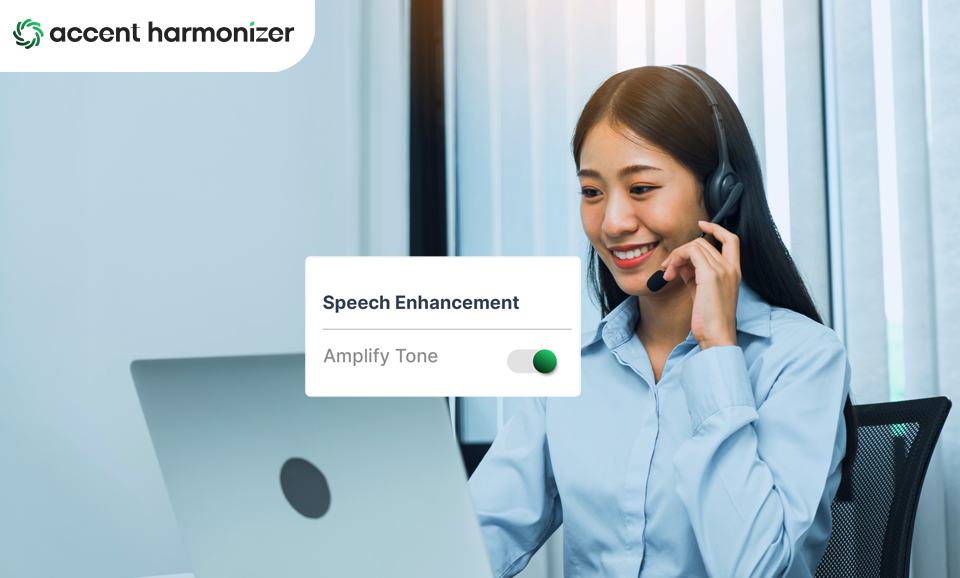
Most call center AHT reduction strategies for voice clarity assume the conversation layer is already working. However, they are.
In global contact centers, agents and customers often spend the first 30–60 seconds just trying to understand each other. That invisible friction quietly inflates handle time, drives repeat calls and erodes customer trust. If your AHT improvement efforts have plateaued, this is almost certainly why.
Why Traditional AHT Reduction Strategies Plateau?
The contact center industry has a well-worn playbook for cutting handle time: sharpen agent training, optimize call routing, streamline the knowledge base, refine scripts. These tactics work initially, then the numbers flatten.
The reason is a buried assumption, including:
- Conversation itself is functioning normally
- Agents and customers hear and understand each other clearly
- Only friction left to remove is process friction
However, assumption is wrong for a significant share of calls. When an agent based in Manila speaks with a customer in Manchester, or a customer in Lagos calls a team in Atlanta, there is a communication layer underneath the process layer. Most AHT strategies never touch it. This conversation friction layer eats up the handle time.
The Hidden Driver of High AHT: Conversation Friction
Conversation friction is the cumulative cost of imperfect real-time comprehension. It shows up in three forms:
- Mishearing and repetition. The customer says something, the agent doesn’t catch it and asks them to repeat. Even one repetition cycle adds 15–30 seconds. Two or three? You’re looking at 45–90 seconds of pure overhead — before any problem-solving begins.
- Accent interpretation delay. The agent hears the words but needs an extra half-second to process an unfamiliar accent pattern. Over a 6-minute call, these micro-delays compound into a measurable handle time inflation.
- Clarification loops. When comprehension is uncertain, agents hedge. They paraphrase back, ask confirming questions, re-read details. Each loop is a precaution against mishearing — and each one extends the call.
What Is AI Voice Clarity Software?
Before going further, it’s worth separating three terms that get conflated:
- Noise cancellation removes background sound — keyboard clicks, ambient office noise, traffic. It makes audio cleaner but does nothing for accent-driven comprehension gaps.
- Transcription enhancement improves the accuracy of speech-to-text output. Useful for analytics, but it operates after the conversation, not during it.
- AI voice clarity software — specifically, real-time accent harmonization — operates in the live audio stream. It identifies phoneme patterns that are likely to cause comprehension difficulty and selectively enhances them in real time, before the audio reaches the listener’s ear.
Why do Voice Clarity Solutions Matter for AHT?
The speech clarity solutions for contact centers are the new category layer in the CX stack. They don’t replace the existing CCaaS platform, QA tools, or coaching program. It sits beneath all of them, resolving friction when two people try to understand each other.
How Real-Time Accent Harmonization Works?
The term “real-time” is easy to drop into a feature list. Here is what it requires.
When an agent speaks, the audio stream enters the AI processing layer. The system identifies phoneme-level patterns — the specific sounds most likely to require extra interpretation effort from the listener — and applies selective enhancement. The output reaches the customer within milliseconds.
What is this not?
The AI accent solutions for call centers do not clone voices, nor do they act as voice transformation tools. These platforms keep the agent’s voice intact while enhancing clarity and understandability in real-time.
Accent Neutralization vs. Harmonization
The terminology in this space is genuinely confused, and that confusion has real consequences for the buyers evaluating solutions.
- Accent neutralization software attempts to strip regional or non-native speech patterns entirely, producing a flattened, “neutral” output. The problems with this approach are well-documented: the resulting voice often sounds robotic, agents resist using it because it erases their identity, and customers frequently find it unsettling.
- Accent harmonization takes a different approach. Rather than removing what makes a voice distinctive, it preserves the agent’s natural voice while clarifying the specific phoneme patterns most likely to cause comprehension friction. The agent sounds like themselves.
For contact centers, harmonization is the right model. It improves comprehension without creating the side effects that make neutralization compliance and morale liability.
The Direct Link Between Voice Clarity and AHT Reduction in BPOs
The causal chain is straightforward once you see it:
Greater clarity → faster first-pass comprehension → fewer repetition cycles → shorter calls.
A contact center processing 50,000 calls per month, where 20% involve at least two repetition cycles averaging 30 seconds each, is carrying roughly 5,000 minutes of pure repetition overhead monthly. A 40% reduction in that repetition frequency translates directly into handle time savings — no script changes, no routing adjustments, no additional training cycles required.
The downstream effects compound the ROI. Fewer repetitions mean lower call abandonment during extended handles. Clearer first interactions improve FCR, which reduces inbound volume from repeat callers. Higher comprehension quality produces better transcription accuracy, which improves QA insight and coaching relevance. Each of these outcomes has its own cost line.
Where Accent Harmonization Fits in the Contact Center Tech Stack?
Integration is typically the first technical question from enterprise buyers, and the answer is simpler than most expect.
Accent harmonization operates at the voice layer — the audio stream layer that precedes everything else. This means it integrates with your existing CCaaS platform and others support voice-layer integrations. Moreover, it requires no changes to your IVR logic, routing rules, agent desktop, or analytics stack.
In fact, deploying clarity at the voice layer improves the performance of tools downstream. Speech analytics engines are trained on relatively clean audio — when the input audio is clearer, transcription accuracy improves, which means sentiment analysis, topic detection, and compliance monitoring all get better data. A clarity layer isn’t a replacement for your stack; it’s infrastructure that makes the rest of your stack work better.
Implementation Framework for Full Real-Time Accent Conversion Software Deployment
A clarity-driven AHT reduction rollout follows five phases:
- Identify high-friction queues. Use existing AHT data and agent-customer pairing data to find the call types and agent groups where comprehension friction is most likely.
- Establish baselines. Measure AHT and — where your analytics allow — repetition frequency and clarification loop rates in the target queues.
- Run a controlled pilot. Deploy harmonization on a subset of agents in the target queues. Keep routing and scripts identical to isolate the clarity variable.
- Measure impact against clarity metrics. Look at AHT delta, repetition frequency, FCR rate, and CSAT scores. The goal is not just “did AHT go down” but “did comprehension improve, and did that drive the AHT change.”
- Scale with change management. Agent adoption is the most common friction point in rollout. Agents need to hear the before/after difference for themselves, and they need reassurance that harmonization preserves their voice and identity.
The pilot phase typically runs 4–6 weeks — long enough to accumulate statistical significance without delaying the business case.
Concusion
If contact center AHT metrics have stalled despite rigorous script optimization and process coaching, it is likely because they are treating a linguistic problem with a process solution. Process friction can be coached away, but conversation friction requires a technological bridge.
By integrating AI voice clarity software into the tech stack, BPOs aren’t just shortening calls. They are improving the fundamental quality of the human connection and empowering agents to speak with confidence.
In a global economy, accents are a sign of a diverse and talented workforce—not a barrier to be “removed” through accent neutralization software. With real-time accent harmonization, they preserve the identity of global talent while delivering the crystal-clear communication your customers expect.
Ready to see how much AHT you’re losing to conversation friction?
Let’s book a demo to hear the difference: before vs. after accent harmonization