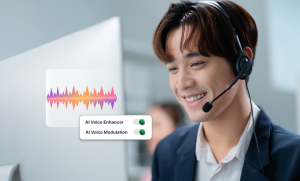

Call centers have spent decades trying to make offices quieter. Managers installed acoustic panels, spaced out desks, and issued better headsets. The goal was simple: to reduce background noise so agents and customers could hear each other clearly.
That approach breaks down in modern support environments. Remote working agents or customers take calls from cars, cafés, and busy homes. Noise enters calls from both sides, often outside the control of the contact center.
The problem is no longer just a noisy room. The real challenge is noise inside the audio stream itself. Modern noise cancelling software for call centers focuses on cleaning that audio in real time.
Why Traditional Noise Reduction in Call Centers Falls Short?
For years, contact centers treated noise as a workspace problem.
Common strategies included:
- installing acoustic panels and sound-absorbing materials
- increasing distance between agents
- issuing higher-quality headsets
- training agents to speak clearly and avoid typing while talking
These measures worked reasonably well in tightly controlled office environments.
But the structure of customer support has changed.
Today’s contact centers rely on:
- remote and hybrid agents
- global outsourcing teams
- cloud-based telephony systems
Once agents and customers operate in uncontrolled environments, physical noise control becomes unreliable.
A contact center may keep its own office quiet, but it cannot control a customer calling from a train station or a home filled with background noise.
The Real Problem: Noise Lives Inside the Call Stream
A customer support call is not simply a conversation between two people. It is an audio signal transmitted through several digital systems.
At each stage, unwanted sound can enter or distort the signal.
Common noise sources include:
- traffic or crowd noise from the customer’s environment
- laptop fan noise from remote agents
- cross-talk from busy contact center floors
- keyboard typing or equipment sounds
- audio compression artifacts from VoIP systems
Because the audio travels through multiple systems, the most reliable place to remove noise is inside the digital signal itself.
What Noise Cancelling Software Actually Does?
Noise cancelling software processes audio signals in real time.
Instead of trying to eliminate noise at the source, it focuses on separating speech from background sound within the call.
Most systems perform three basic steps:
- Speech detection: Algorithms analyze incoming audio to identify patterns associated with human speech.
- Noise suppression: Once speech patterns are identified, background noise is reduced or removed while preserving the voice signal.
- Audio reconstruction: The software outputs a cleaner version of the voice so the listener hears speech with less interference.
The result is a call where the speaker remains clear even if their environment is noisy.
Why Software Noise Cancellation Scales Better Than Workspace Fixes
Traditional noise reduction methods rely on controlling physical environments.
Software-based noise cancellation works differently. It operates on the audio signal itself, which allows it to handle a wider range of situations.
| Approach | What It Fixes | Limitations / Outcome |
|---|---|---|
| Acoustic Treatment | Reduces noise inside the office environment. | Ineffective for remote agents or background noise from the customer side. |
| High-End Headsets | Improves microphone clarity and isolation. | High hardware cost; cannot remove background sound originating from callers. |
| Agent Training | Improves speaking behavior and mic discipline. | Does not physically remove environmental noise; requires constant monitoring. |
| Noise Cancelling Software | Processes the audio signal directly at the source. | Scalable solution that works across all agent environments. |
How Real-Time Noise Cancelling Software Works in Call Centers?
Noise cancelling software typically operates as part of the call’s audio pipeline.
The process can be simplified into four stages.
- Audio Capture: Voice enters the system through microphones, telephony networks, or VoIP platforms.
- Signal Analysis: The system analyzes the incoming audio stream to detect speech patterns and distinguish them from background noise.
- Noise Suppression: Non-speech sounds are reduced using filtering techniques and machine learning models trained to recognize common noise patterns.
- Audio Reconstruction: The system outputs a cleaned version of the voice signal, which is then transmitted to the listener.
Operational Benefits of Noise Cancelling Software
Clearer audio affects how calls unfold. When background noise is reduced, agents and customers can understand each other more quickly. This leads to several operational improvements.
Common outcomes include:
- fewer requests to repeat information
- shorter average call duration
- clearer communication of instructions or account details
- improved quality of recorded calls used for training and auditing
- reduced listening fatigue for agents handling long shifts
These improvements occur because conversations become easier to follow when speech is not competing with background noise.
What to Look for in Call Center Noise Cancelling Software?
Not all noise cancellation tools are designed for real-time call environments. Contact centers evaluating solutions should focus on a few practical requirements.
Real-Time Processing
The system must filter noise during the call, not after it ends. Post-call audio cleanup helps with recordings but does not improve the live conversation.
Low Latency
Audio processing should happen fast enough that participants do not notice delays. Even small delays can disrupt natural conversation.
Platform Compatibility
Noise cancelling software should integrate with existing communication systems such as:
- VoIP platforms
- softphones
- contact center cloud systems
Scalability
Enterprise contact centers may handle thousands of simultaneous calls. The system must process large volumes of audio without performance issues.
Why Audio Clarity Is Becoming Part of Contact Center Infrastructure?
Modern contact centers rely heavily on voice-based technologies. Examples include:
- speech and accent analytics
- automated quality monitoring
- AI-powered voice assistants
- conversation intelligence platforms
If recordings contain heavy background noise, speech recognition and analysis systems struggle to interpret conversations correctly. For this reason, many organizations now treat audio clarity as part of their core communication infrastructure. Clean voice signals improve both live conversations and the downstream systems that analyze those conversations.
Conclusion
Contact centers once treated noise as a facility problem ans solution was to make offices quieter. That model no longer fits the way support teams operate today. Customers call from unpredictable environments, and agents increasingly work remotely. Noise now enters conversations from many different sources.
Instead of trying to control every environment, modern contact centers focus on the audio signal itself. Noise cancelling software processes voice in real time, reducing interference before the listener hears it. In practice, clearer calls depend less on quiet offices and more on clean audio processing within the communication pipeline.
Experience AI Accent Harmonization Live
Book a personalized demo and discover how AI can instantly localize accents and improve customer communication.