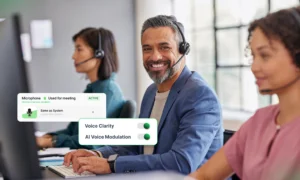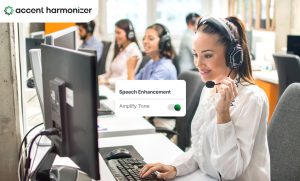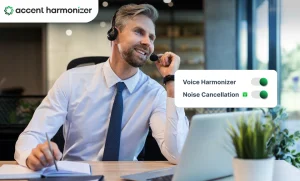
In global call-center environment, customer conversations often involve agents and callers who speak the same language but with very different accents. Often it creates real communication friction: slower comprehension, repeated phrases, frequent escalations, and customer frustration.
A real-time accent harmonizer addresses this challenge by improving clarity during live interactions, allowing both parties to understand each other more easily without altering their natural identity.
This blog focuses on how Omind’s Accent Harmonizer for call center works and the day-to-day impact it creates for agents, customers, and operational teams.
Why Call Centers Struggle With Accent Variability?
Accent variation is normal, but in a call-center environment driven by efficiency, it creates measurable issues. Agents often slow down their speech, over-enunciate, or repeat themselves to avoid misunderstandings. Callers may ask for clarifications more than once, even when the agent’s explanation is accurate.
These micro-breakdowns accumulate across thousands of calls:
- Longer time
- Higher confusion-based escalations
- Lower customer satisfaction
- Increased agent fatigue from managing communication strain
Search trends around terms like “accent translation,” “accent changer,” and “accent converter download” indicate that customers and agents are actively seeking ways to make conversations clearer. A real time accent harmonizer meets this need in a way general voice filters cannot focus on clarity, not artificial transformation.
What a Real Time Accent Harmonizer Does in Live Calls?
A real time accent harmonizer is an AI system designed to support live human-to-human conversations. Instead of replacing a voice or imposing a new accent, it lightly adjusts the acoustic patterns that create comprehension difficulty.
During a call, the pipeline typically works like this:
- The system captures the speaker’s voice in real time.
- It identifies accent-related phoneme variations and prosody patterns.
- It normalizes the relevant acoustic features without changing tone or emotional expression.
- It outputs a clearer, more standardized voice signal to the listener with minimal latency.
The agent still sounds like themselves—just easier to understand. This differs from downloadable tools that try to “convert” voices entirely.
How an AI Accent Harmonizer for Call Center Teams Improves Clarity?
One of the most direct impacts in a real call center is improved comprehension. When harmonization reduces accent-based friction, both callers and agents understand each other more quickly. This means fewer interruptions, fewer requests to repeat information, and a smoother conversational flow.
The outcome is practical: shorter average handle time, faster resolution, and fewer moments where the customer feels lost or unheard. When clarity improves consistency, call centers see a noticeable increase in first-call resolution.
Reduced Agent Stress and Burnout
Accent-related friction affects customers and agents alike. A real time accent harmonizer removes the need for agents to constantly modify their natural speech. They no longer must over-compensate for pronunciation differences or slow down unnaturally. When agents feel they can communicate freely without fear of misunderstanding, their cognitive load decreases.
This directly contributes to lower stress levels, smoother performance, and a more confident interaction style, particularly in multilingual queues where accent variety is high.
Better Performance Metrics for Call Centers
An AI accent harmonizer for call center contributes to real operational improvements. Several metrics tend to shift positively when clarity issues are reduced:
- Average handle time decreases because conversations are smoother.
- Escalations related to misunderstanding decline.
- QA scores become more consistent because communication clarity stabilizes.
- ASR-based analytics (transcription, sentiment detection, compliance checks) become more accurate when audio is harmonized.
Harmonization strengthens both the human side of the interaction and the AI systems processing those interactions.
Support for Multilingual Customer Bases and AI Systems
For call centers supporting multilingual customers, accent variation affects both human listeners and automated systems. A harmonized audio stream helps multilingual conversational AI tools—such as ASR, intent analysis, sentiment detection, and QA automation—perform with greater accuracy.
Even when language stays the same, accent differences can confuse AI models. Harmonization reduces this inconsistency and improves model reliability without requiring extensive retraining.
Integration Into Daily Call Center Tools
In a real call center setup, an accent harmonizer usually integrates between the agent’s microphone and the telephony system. Solutions such as the Accent Harmonizer by Omind are designed to slot directly into existing call-center infrastructure, connecting seamlessly with telephony systems, CRM platforms, ASR engines, and QA workflows. It can also feed harmonized audio into transcription engines, QA systems, speech analytics, and agent-assist platforms.
This ensures that not only the listener benefits, but every downstream AI system receives cleaner, more consistent audio.
Responsible Use and Human Considerations
Accent harmonization should not erase identity or flatten diversity. Ethical deployment includes transparency for agents, adjustable harmonization levels, and a focus on clarity rather than accent replacement.
Looking Ahead
Modern CX platforms such as Arya explore advanced voice-intelligence layers that improve both human conversations and AI accuracy. Accent harmonization is becoming one of the foundational components of this shift.
As call centers continue to globalize, accent clarity will no longer be optional. It will be a core operational requirement that helps agents perform better and customers feel heard. Omind’s Accent Harmonizer reflects this shift toward real-time clarity as a core layer of call-center performance.
If clarity is becoming a priority for your call center, exploring Omind’s Accent Harmonizer can help you. To build a more efficient, consistent, and customer-ready voice operation, let’s schedule a demo.