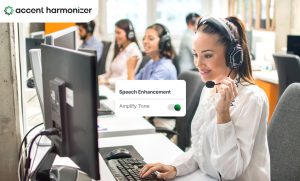

Imagine a contact center bustling with activity, where a simple misunderstanding caused by an unclear accent leads to a frustrated customer, a prolonged call, and ultimately a lost opportunity. Consider the story of Anna, a skilled agent with a regional accent, who spent 30% of her call time repeating herself because customers struggled to understand her. This not only affected her confidence but also impacted customer satisfaction scores by over 20%. Such scenarios underline the cost of inaction when it comes to addressing accent clarity.
Contact center accent clarity AI is changing voice interactions. Instead of removing accents or forcing everyone to sound the same, it helps make conversations clearer. This lets agents focus on connecting with customers instead of repeating themselves or worrying about how they sound.
Clear communication is essential for a great customer experience. In busy contact centers, where customers want quick, smooth, and caring interactions, clarity matters even more. It builds trust, boosts agent confidence, improves efficiency, and increases satisfaction. For instance, improved clarity can lead to a higher Net Promoter Score (NPS) as customers who receive clear communication are more likely to recommend the service. Additionally, enhanced clarity can reduce Average Handle Time (AHT) by minimizing the need for repetition, thus improving operational efficiency. Aligning these benefits with familiar metrics makes it easier for companies to measure the impact on their existing performance dashboards.
Where Miscommunication Hurts CX Operations?
Many conversations about voice quality focus on call metrics, but the real experience starts with the emotions in each conversation. When clarity is lost, agents feel it first. They end up repeating themselves, speaking more slowly than usual, or using a neutral tone that doesn’t match their natural style.
Over time, these habits lead to fatigue and hesitation. Agents start to doubt themselves, which hurts their confidence and connection with customers. Customers notice it too. When they have trouble understanding, they quickly get frustrated. Even simple requests can turn into long conversations. Studies in cognitive psychology show that when people struggle to hear clearly, it becomes harder for them to remember information and stay calm.
What Modern Accent Clarity AI Actually Solves?
Accent clarity problems are not caused by having different accents. They happen when accents mix with call quality issues, background noise, different speaking speeds, and how customers handle new speech patterns. That is why AI voice clarity solutions aim to make speech easier to understand, not to make everyone sound the same.
Key improvements include:
- Better pronunciation smoothness without altering natural voice identity
- Reduced friction caused by regional patterns or speaking speed
- More consistent clarity across different agents, shifts, and acoustic setups
- Greater intelligibility for customers experiencing high cognitive load or stress
AI accent harmonization helps agents keep their natural tone while making it easier for customers to understand them. The goal is not to remove identity, but to support clear conversations that feel smooth, respectful, and human.
As one agent noted, ‘Using the accent clarity tool made me feel heard and authentic in my interactions with customers. I no longer worry about losing my identity, but focus on meaningful communication.’ Personal experiences like this help reinforce that agents maintain their unique voices while enhancing clarity.
How do Real-time Accent Neutralization AI Support Agents?
Traditional training uses coaching, scripts, or long-term pronunciation practice. These methods help, but they do not solve problems during live calls. Modern real-time accent-neutralization AI works during the call, improving clarity as soon as a challenge arises.
The process is simple to grasp:
- The system listens to speech patterns, accent contours, phoneme shapes, and acoustic inconsistencies
- It gently adjusts certain sounds, making them easier to understand without making the voice sound robotic or artificial.
- It manages noise, sharpness, and distortions.
- The agent’s original tone remains intact
This means agents do not have to slow down, repeat themselves, or change their speech. The technology handles clarity, so agents can focus on the conversation.
Why Voice Clarity Boosts Agent Performance and Confidence?
When speech is clear, agents naturally feel more confident. Conversations go more smoothly. Agents stop worrying about being misunderstood or judged for their accent. They no longer need to over-enunciate or apologize for how they sound.
This change helps agents build better relationships with customers. They can focus on understanding, empathy, and problem-solving rather than worrying about pronunciation. Over time, this lowers stress and mental effort, making agents sound more relaxed and effective.
This human benefit is one of the biggest advantages of clarity AI. It improves calls, while supporting the people making them.
Fairness, Inclusivity & Reduced Accent Bias Inside the Contact Center
Many people see accents as a cultural strength, but research shows that ‘processing fluency’ strongly affects how customers judge competence and reliability. Accent bias, whether people realize it or not, shapes customer reactions, QA evaluations, and supervisor coaching. Even small pronunciation differences can change how customers see an agent’s competence or politeness. Quantitatively, a pilot study showed that after implementing accent clarity technology, there was a 15% increase in QA scores due to fewer politeness deductions. This data highlights the hidden costs of bias and the beneficial impact clarity tools can have on perceptions of agent professionalism.
- Reducing misheard words that lead to unnecessary escalations
- Supporting multilingual and regional-accented agents without forcing voice “correction”
- Making coaching more focused on customer outcomes rather than accent patterns
- Minimizing misunderstanding-driven penalties in QA evaluations
This change helps create a more inclusive workplace, where accent issues do not hide talent. Diversity stays a strength, not a barrier.
Use Cases Where Accent Harmonizer Supports Better Conversations
Here are some instances where platforms like Accent Harmonizer by Omind can help:
- Modern clarity systems let agents sound clear and natural without changing how they speak. Tools that gently shape speech, like Accent Harmonizer, make real-time conversations smoother, especially during stressful or complex discussions.
- Contact centers that use solutions like Accent Harmonizer often see smoother interactions among teams with different language backgrounds.
Operational Benefits Where Clarity Enhances CX and Compliance
Better clarity isn’t just about comfort. It influences measurable operations:
- Lower repeat queries because customers understand instructions the first time
- Shorter handle time due to fewer clarifications
- Better compliance adherence when disclaimers are heard clearly
- Reduced escalation volume because frustration levels dropped significantly
- Better FCR alignment, especially for service requests requiring detailed explanations
| Operational Impact of AI Voice Clarity Solutions on Contact Center KPIs | ||
|---|---|---|
| Feature Area | Without Accent Clarity | With Accent Harmonizer |
| Information Retention | Customer asks for 3+ repeats | Instructions understood first time |
| Business Impact (KPI) | Higher AHT | Lower AHT |
| Compliance | Disclaimers are muffled/unclear | Legal scripts are crisp & audible |
| Business Impact (KPI) | Higher Legal Risk | Reduced Legal Risk |
| Agent Sentiment | High fatigue / Emotional labor | Increased confidence / flow |
| Business Impact (KPI) | Higher Agent Attrition | Lower Agent Attrition |
| Problem Solving | Focused on “What did you say?” | Focused on “How can I help?” |
| Business Impact (KPI) | Lower FCR | Higher FCR |
Clarity removes small problems that can add up to bigger issues in operations. By removing these barriers, companies can lower their Customer Effort Score (CES), which Gartner says is a key indicator of long-term brand loyalty. When customers understand agents more quickly, it is easier to improve other metrics.
How Do Teams Onboard Accent Clarity AI Platforms for Smooth Adoption?
One of the biggest benefits of modern clarity technology is its ease of use. Agents usually do not need much retraining because the system works in the background. Their voice still sounds like themselves, just clearer.
A typical rollout includes:
- A brief orientation to explain how the enhancer supports the agent
- Silent activation during live calls
- Monitoring for naturalness and comfort
- Gradual scaling across teams once agents feel the improvement
Because the enhancer does not force agents to change how they speak, using it feels natural and supportive rather than corrective.
Conclusion
Clarity is more than a technical attribute—it’s an enabler of human connection. With AI tools for accent clarity in the contact center, conversations feel less strained, and agents feel more confident. Also, the customers experience smoother interactions.
Would you like to learn more? Our team can show you how Accent Harmonizer by Omind works. Talk to an expert to see how it can help your global team.