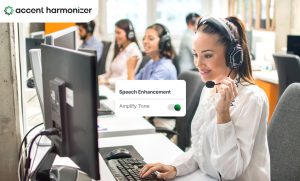

“Accent improvement software” has become a convenient umbrella term in enterprise conversations. But convenience comes at a cost. The label is used to describe tools with fundamentally different purposes, deployment models, and limitations. When those distinctions are ignored, organizations don’t just buy the wrong technology, they apply it to the wrong problem.
Enterprises rarely fail because people have accents. They fail because communication systems are misaligned with operational realities: live conversations treated like training problems, human factors ignored in favor of demos, and tooling expected to compensate for issues they were never designed to address.
This article is not a comparison of vendors or features. It is an evaluation guide intended to help enterprises distinguish between categories of tools, understand what each is actually designed to do, and assess fit based on real communication constraints—not labels.
What Enterprises Usually Mean by “Accent Improvement Software”?
In procurement discussions, the phrase “accent improvement software” is often applied to a broad range of tools that solve very different problems. Commonly, it refers to one or more of the following:
- Pronunciation training and ESL learning platforms
- Accent neutralization or conversion systems
- Real-time speech clarity or harmonization technologies
These tools are not interchangeable. They differ in time-to-impact, deployment context, human involvement, and technical architecture. Grouping them under a single label obscures those differences and creates confusion during evaluation.
The result is predictable: training tools are purchased to solve live communication issues, real-time systems are expected to teach skills, and accent modification is mistaken for comprehension improvement.
Enterprise Communication Problem These Tools Solve
When enterprises raise concerns about “accent,” the underlying issue is rarely accent itself. More often, it is a breakdown in understanding that manifests operationally as:
- Repetition loops during conversations
- Slower resolution times
- Listener fatigue and disengagement
- Increased handling effort for both parties
From an enterprise perspective, the concern is not linguistic purity or conformity. It is understanding at scale—across regions, agents, customers, and conditions.
This distinction matters. Accent is a characteristic of speech; communication breakdown is a system-level problem involving speakers, listeners, tools, context, and constraints. Treating one as a proxy for the other oversimplifies the issue and distorts evaluation criteria.
This section defines the problem space. It does not prescribe a solution.
“Accent Improvement” Tools Are Designed For
Clarity begins with categorization. The tools commonly grouped under “accent improvement” fall into three distinct categories, each optimized for a different context.
Training and Learning Tools
Purpose: long-term pronunciation and speech development
Context: education, coaching, self-improvement
These tools are designed to help individuals change how they speak over time. They rely on practice, feedback, repetition, and conscious effort. In learning environments, this approach is appropriate.
Limitation: training tools do not affect live conversations. They do not intervene during real-time interactions and cannot address immediate communication breakdowns at scale.
Accent Neutralization and Conversion Systems
Purpose: modify or replace accent patterns in spoken output
Context: standardized delivery environments
These systems alter how speech sounds to the listener, often producing a more uniform output. The speaker adapts indirectly, with the system acting as an intermediary.
Trade-offs include:
- Potential identity shift
- Listener dependence on modified output
- Reduced speaker agency
Real-time Speech Clarity and Harmonization Systems
Purpose: improve intelligibility during live conversations
Context: contact centers, real-time enterprise communication
These systems operate during live interactions, focusing on intelligibility rather than alteration.
Constraint: Accent Harmonizer platform built to operate during live enterprise conversations without altering speaker intent or content. It does not change intent, content, or communication skill. They address clarity within the limits of the underlying interaction.
What These Tools Are Actually Built For?
| Dimension | Training & Learning Tools | Accent Neutralization / Conversion | Real-Time Speech Clarity & Harmonization |
|---|---|---|---|
| Primary intent | Long-term speech change | Modify accent output | Improve live intelligibility |
| Time to impact | Weeks to months | Immediate | Immediate |
| Live conversation support | No | Yes | Yes |
| Who adapts | The speaker | The system | The system |
| Effect on speaker identity | Preserved | Potential shift | Preserved |
| Listener dependency | None | Yes | Yes |
| Enterprise scalability | Low | Medium | High |
| Typical use case | Training programs | Standardized delivery | Contact centers |
| Does not do | Affect live calls | Improve skills | Fix communication quality |
What an Enterprise-grade Evaluation Should Focus On?
Once categories are clear, evaluation should move away from terminology and toward operational alignment.
Deployment Context
Key questions include:
- Is the use case live or asynchronous?
- Is it customer-facing, internal, or both?
- What are peak volume and concurrency requirements?
A mismatch here invalidates most downstream evaluation.
Technical Fit
Evaluation should account for:
- Latency tolerance under real conditions
- Integration with existing CCaaS and voice stacks
- Performance consistency across regions
- Defined failure behavior
Demos rarely expose these constraints.
Human Impact
Enterprises should assess:
- Whether agents must consciously adapt mid-conversation
- Impact on cognitive load
- Preservation of speaker identity
- Variability across agents and accents
Human factors determine adoption durability.
Measurement and Governance
Enterprises should distinguish:
- Directly observable signals (e.g., repetition frequency)
- Outcomes influenced by multiple variables
Governance boundaries—what the system can and cannot infer—must be explicit.
Conclusion
Enterprise communication challenges are contextual and human, yet no single tool category addresses them universally. Success comes from matching tools to problems with discipline—evaluating for fitness, constraints, and boundaries rather than buying into labels.
See how real-time speech clarity systems work in real-life. Explore how Accent Harmonizer by Omind assists within this category. Schedule a demo to know more.