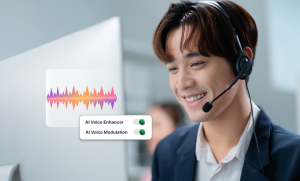

For too long, the contact center industry has operated under an unspoken rule: if a candidate’s accent or speech pattern doesn’t fit a specific profile, they are filtered out—regardless of their skill. Accent AI technology for contact centers offers an equitable alternative. Rather than forcing agents to adopt new speech patterns, the technology enhances real-time clarity while preserving the individual’s unique voice identity and natural rhythm.
Instead of accent bias in customer service requiring agents to change how they speak, it enhances clarity in real time while preserving individual voice identity. This allows contact centers to evaluate candidates on competence, empathy, and technical skills.
Operational Cost of Hiring for Accent Instead of Skill
When hiring criteria prioritize a specific accent over genuine competence, the consequences are felt directly on the balance sheet. Talent acquisition shifts from a search for skill to a search for conformity, resulting in higher expenses and compromised quality.
This filtering approach introduces several significant, often hidden, operational costs:
- Extended Time-to-Hire (TTH): Recruiters must apply narrow vocal criteria during screening, which dramatically lengthens the hiring cycle and delays critical capacity expansion across the contact center.
- Costly, Ineffective Training: Training budgets are inefficiently diverted to extensive, mandatory accent modification programs, pulling focus and resources away from essential product knowledge, service protocols, and technical skill development.
- Underutilized Talent Pools: Organizations fail to tap into highly motivated, service-oriented professionals in growing rural and Tier-2/3 markets. This practice artificially restricts the available labor pool, undermining efforts for rapid, cost-effective scaling.
This reliance on archaic filtering creates a significant risk of accent bias in customer service. The only way to sustainably eliminate them is through the deployment of advanced technology like AI voice modulation for enhanced clarity, regardless of the agent’s natural speech.
AI Voice Harmonization: How Real-time Clarity Unlocks Global Talent
Accent harmonization uses sophisticated speech processing to improve voice clarity. The AI voice modulation technology adjusts subtle pronunciation patterns in real-time without altering the agent’s unique voice.
For hiring teams, this shift removes accent as a screening barrier entirely. By ensuring universal intelligibility, call centers can evaluate candidates strictly on competence, empathy, and technical knowledge. It directly tackles the systemic issue where standard-accented candidates are consistently favored over non-standard-accented candidates in high-communication jobs.
The hiring funnel becomes deeper and more diverse, drawing from high-potential agents previously considered inaccessible due to speech. This strategy has been shown to increase eligible hiring pools by 20% to 37% in key offshore markets, validating their financial impact. This solution ensures valuable talent is never dismissed based on the way words are formed.
3 Ways Accent Harmonization Optimizes the Funnel
Integrating accent harmonization technology into your talent acquisition process creates immediate, measurable operational advantages for the contact center:
- Deeper and More Diverse Talent Pool: 64% of potential contact center agents who are disqualified during the hiring process due to their accent strength. Achieve significantly higher offer rates without compromising service quality. By removing accent as a clarity barrier, the pool of qualified applicants expands dramatically, ensuring recruiters can maintain or even raise standards based on skills that truly matter.
- Accelerated Onboarding & Reduced Training Costs (TTC): Drastically reduce the time and expense associated with training. Trainers can shift their focus from time-consuming pronunciation drills to critical areas like product expertise, empathy development, and workflow mastery. This accelerates agent readiness and directly lowers your Time-to-Competency (TTC) metric.
- Enhanced Agent Confidence and Faster Readiness: By fixing accent bias in customer service, new hires experience less anxiety and stress about how they sound to the customer. This enables them to focus all their attention on active listening and problem-solving.
Operational Advantages for CX Leaders
Beyond hiring, accent harmonization delivers measurable improvements in customer experience outcomes:
- More consistent CX across distributed teams: Whether agents are based in Mumbai, Manila, or rural Kentucky, harmonized clarity reduces miscommunication and creates smoother interactions across global customer bases.
- Better customer understanding without identity loss: Agents retain their authentic voice and personality while being easier to understand. This balance satisfies the customer’s need for clarity while reinforcing agent dignity and psychological safety, a key driver of loyalty.
- Stronger workforce stability: Reducing the pressure on agents to “sound different” decreases burnout, stress, and subsequently, agent turnover. Agents who feel genuinely accepted for whom they tend to stay longer and perform better, directly lowering recruiting costs.
Supporting Fair Hiring Practices
Traditional accent-neutralization training often creates internal conflict for agents. Being asked to suppress natural speech patterns can feel like an erasure of identity, leading to disengagement and attrition. Accent harmonization offers a more ethical alternative—it supports clarity without demanding conformity.
This approach aligns with skill-first hiring models that prioritize empathy, competence, and service quality over vocal homogeneity. It allows contact centers to build inclusive, values-driven workforces while maintaining high operational standards.
Practical Implementation Pathways
Accent AI for contact centers can deploy accent harmonization at multiple stages:
- Candidate Screening: Use the tool to assess true communication ability without bias against the candidate’s natural accent.
- Onboarding & Training: Integrate during training to immediately reduce pronunciation anxiety and accelerate Time-to-Competency (TTC).
- Live Interactions: Deploy in real-time to support distributed teams, ensuring consistent clarity across diverse domestic and international customer bases.
Conclusion
The future of CX leadership demands separating clarity from conformity. Accent AI for contact centers uses core technology for diverse, high-performing, and globally scalable teams without forcing agents to change who they are. By solving clarity technically rather than culturally, organizations immediately access broader talent pools, reduce costs, and create more humane, effective workplaces.
Ready to Optimize Your CX? Stop paying the high price of accent bias. Book a demo to see how Accent Harmonizer can reduce your AHT, increase FCR, and build a skill-first workforce.