Contact centers love clean audio. Vendors sell it as the first step toward better CX, better QA, better everything. Remove background noise, polish the waveform, and—problem solved.
Noise cancelling software for contact center environments solves a signal problem. Customers, agents, and supervisors are dealing with a comprehension problem. Those are not the same thing, and pretending they are is why so many “crystal-clear” calls still end in repeats, clarifications, and frustrated silences.
Let’s separate what these technologies do—and what they don’t.
What Noise Cancelling Software Actually Fixes?
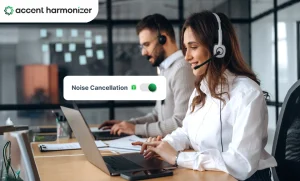
Noise cancelling software reduces non-speech interference: keyboard clatter, office chatter, traffic hum, fan noise. In a contact center, this matters. Poor audio quality raises cognitive load and increases listener fatigue. That part is not controversial.
Used correctly, noise cancelling software for contact center setups delivers three real benefits:
- Improved baseline audibility
Words are easier to hear because they are not competing with background noise. - Cleaner recordings for QA and analytics
Transcription accuracy improves when the signal is less polluted. - Lower immediate irritation
Customers are less annoyed when they don’t hear chaos behind the agent.
That’s the full list. Notice what’s missing: understanding. Noise cancellation makes speech audible. It does not make it easier to interpret.
How Clear Audio is Not Equal to Clear Communication?
Most buying decisions in this category rely on an unstated assumption: “If the customer can hear the agent clearly, they will understand them.”
That assumption fails every day in global contact centers. An agent can speak perfect English, with zero background noise, and still be hard to understand. Accent, pronunciation patterns, stress timing, and phoneme substitutions all affect comprehension. Noise cancelling software does not touch any of that.
This is where teams confuse acoustic clarity with linguistic clarity.
Accent Is Not Noise
Here’s the uncomfortable truth many vendors avoid: Accent-related comprehension issues are not caused by distortion. They are caused by mismatches.
Customers are processing unfamiliar sound patterns. Even when speech is technically “clear,” the brain works harder to map sounds to meaning. That extra effort shows up as:
- “Sorry, can you repeat that?”
- Longer call durations
- More agent interruptions
- Lower CSAT despite polite interactions
Noise cancelling software for contact center use cases does nothing here, because there is nothing to cancel. The signal is clean. The listener still struggles.
Calling this a “training issue” is a convenient dodge. Training helps, but it does not change how speech is perceived in real time under pressure.
What Accent Harmonization Actually Addresses?
Accent harmonization targets the speech signal itself, not the environment around it.
Instead of removing sound, it subtly adjusts pronunciation features—timing, stress, and phonetic emphasis—so spoken language aligns more closely with what the listener expects. The goal is not to erase accent. It’s to reduce friction.
When it works, the impact shows up differently:
- Fewer repetitions per call
- Smoother turn-taking in conversation
- Reduced cognitive load for the listener
- More consistent understanding across regions
This is not about making everyone sound the same. It’s about making speech easier to process at speed.
Noise cancellation improves what you hear while accent harmonization improves how quickly you understand it.
Accent Harmonizer focuses on real-time pronunciation alignment rather than noise suppression. Instead of stripping sound out of the call, it adjusts speech patterns, so accents are easier for listeners to process—without changing what the agent says or flattening their natural voice.
Why Contact Centers Keep Over-Buying Noise Cancellation?
If accent harmonization addresses a real problem, why does noise cancelling software dominate budgets?
Three reasons:
- It’s easy to demonstrate
Play a “before and after” clip. The difference is obvious. Comprehension problems are harder to demo in 10 seconds. - It feels objective
Noise is visible on a waveform. Accent friction is subjective, even when the operational impact is measurable. - It avoids uncomfortable conversations
Talking about noise is safe. Talking about accent makes leadership nervous, even when the intent is purely functional.
So, teams keep stacking audio cleanup tools and wondering why AHT and CSAT barely move.
The Operational Cost of Confusing the Two
When contact centers rely only on noise cancelling software for contact center optimization, the downstream costs show up quietly:
- QA flags call as “clear”, but customers still sound confused
- Coaching focuses on scripts instead of speech delivery
- Analytics misinterpret repeated questions as process issues
- Agents get blamed for “communication skills” problems that tech could reduce
None of this shows up in a vendor demo. It shows up in weekly ops reviews.
Where Noise Cancelling Still Matters?
To be clear, noise-claiming software is not useless. It is necessary but there are limitations of noise cancellation platforms making them insufficient.
Use noise cancellation to:
- Standardize audio quality
- Improve transcription accuracy
- Reduce environmental distractions
Do not expect it to:
- Improve comprehension across accents
- Reduce repetition caused by pronunciation mismatch
- Fix perceived fluency issues
Those expectations are misplaced, and they waste budget.
The Better Framing: Audibility vs Understandability
If contact centers reframed the problem honestly, buying decisions would look different.
- Audibility problem?
Use noise cancelling software for contact center environments. - Understandability problem?
Look at speech harmonization, pronunciation alignment, and real-time linguistic smoothing.
Most centers have both problems. Treating one as a substitute for the other is the mistake.
The Bottom Line
Clear audio is table stakes. It is not a differentiator, and it is not a proxy for understanding.
Noise cancelling software for contact center operations cleans the channel. It does not fix how humans process speech under time pressure. If your calls sound great and still require constant repetition, you don’t have an audio problem. You have a comprehension problem. Buying more noise cancellation won’t change that.
Want to see the difference in a real call?
If you’re evaluating why clear audio hasn’t translated into clearer conversations, you can see how accent harmonization works in practice.
Book a live demo for Accent Harmonizer