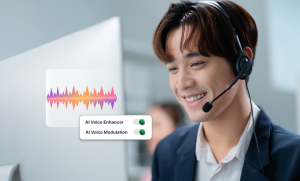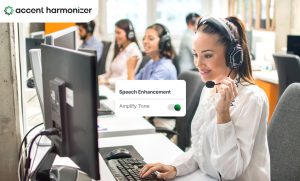

Every misunderstood word cost time, trust, and resolution speed. Real-time accent localization is the AI layer that eliminates communication friction — without asking agents to change who they are.
The Hidden Cost of Accent Friction in Global Contact Centers
Accent friction is not an edge case. In any global contact center where agents in Manila, Mumbai, or Medellín handle calls for customers in Manchester or Miami, phonetic mismatches occur hundreds of times a day. The problem is not competence — it is acoustic familiarity.
When a customer hears an unfamiliar accent pattern, their brain works harder to decode meaning. That extra cognitive load creates hesitation, requests for repetition, and a low-grade frustration that accumulates across the call. By the time the interaction ends, the CSAT damage is already done.
What Is Real-Time Accent Localization?
Real-time accent localization is an AI speech processing layer that analyzes an agent’s voice during a live call, detects the phoneme patterns most likely to cause comprehension difficulty for the listener, and applies targeted acoustic adjustments — all within milliseconds, before the audio reaches the customer.
The critical distinction: it improves intelligibility without replacing the speaker’s voice. The agent still sounds like themselves. Their warmth, pace, and tone are preserved. Only the specific sounds creating friction are adjusted.
- Agent Voice: Raw speech captured via headset or softphone in real time
- Acoustic Analysis: AI maps pitch, rhythm, and phoneme patterns against listener model
- AI Harmonization: Friction-causing phonemes adjusted; voice identity preserved
- Clear Output: Clarity-optimized audio delivered to customer with zero perceptible delay
Accent Neutralization vs Accent Localization vs Accent Harmonization
Buyers in this category encounter overlapping terminology. The distinctions are consequential — each approach produces fundamentally different results in a live CX environment.
| Approach | How It Works | Key Limitation / Outcome |
|---|---|---|
| Accent Training | Human coaching programs to modify speech patterns. | Months to deploy; outcomes inconsistent across agents. |
| Accent Neutralization | Flattens accent characteristics toward a “neutral” target. | Strips vocal warmth; agents sound robotic or detached. |
| Voice Conversion | Replaces the speaker’s voice with a synthetic version. | Identity loss; customers notice inauthenticity. |
| Accent Harmonization | Adjusts only clarity-impairing phonemes in real time. | Natural voice preserved; sub-200ms latency. |
Why Voice Clarity Matters for Global BPO and Offshore CX Teams?
The global BPO industry is built on geographic arbitrage — skilled agents in lower-cost markets handling calls for customers in high-cost regions. The operational logic is sound. The communication challenge is structural.
| Region | Market Context & Friction Points | Primary Accent Pair |
|---|---|---|
| Philippines | Largest English-speaking BPO hub globally. Highly proficient agents encountering phoneme friction on numbers, consonant clusters, and vowel distinctions. | Filipino ↔ North American |
| Latin America | Fast-growing nearshore market. Spanish-influenced intonation and vowel differences create measurable friction on product-critical vocabulary. | LatAm ↔ US English |
| Eastern Europe | Expanding multilingual hub. Consonant-heavy phonology and rhythmic patterns require adaptation for Western European listener profiles. | Eastern EU ↔ DACH / Benelux |
In each of these markets, accent training alone is insufficient. The agent population turns over. Training timelines are long. And even well-trained agents revert under call pressure. Real-time AI harmonization operates independently of training outcomes — it works on every call, from day one.
Real Business Impact of AI Voice Clarity Solutions
Accent Harmonizer by Omind AI delivers measured outcomes across the CX metrics that operations leaders track most closely — with results verifiable from the first month of deployment.
| Metric | Impact with Accent Harmonization |
|---|---|
| Average Handle Time (AHT) | −18% First-pass clarity shortens interactions measurably |
| CSAT / NPS | +22% Effortless conversations score significantly higher |
| Agent Efficiency | +26% Agents focus on empathy and outcome rather than repetition |
| Communication Errors | −18.5% Fewer miscommunications lead to fewer callbacks |
How Real-Time Accent Localization Fits Your Infrastructure?
For IT and Operations leaders, the priority is integration without disruption. Accent Harmonizer is designed to sit within your current call flow—not replace it.
Zero-Disruption Architecture
The platform processes the agent’s audio stream in the milliseconds between the call platform and the customer. This “invisible” integration ensures:
Platform Agnostic: Works alongside existing CCaaS, VoIP, and softphone systems.
Operational Continuity: No changes to call routing, recording workflows, or agent-facing interfaces.
Seamless Delivery: Harmonized audio is passed downstream in real time with zero perceptible latency.
How to Evaluate AI Accent Localization Platforms
Enterprise buyers comparing platforms in this category should move beyond demos and feature lists. These five criteria separate production-grade systems from experimental tools.
- Sub-200ms Latency: Any perceptible delay in the audio stream disrupts conversation. Demand benchmark evidence, not marketing copy.
- Voice Identity Preservation: The system must adjust only friction-causing phonemes — not tone, warmth, or overall character. Test with blind audio comparisons.
- Multilingual & Accent Coverage: Verify model performance for your specific agent-customer accent pairings — not just generic English-to-English scenarios.
- Enterprise Security Compliance: Real-time audio processing carries data protection obligations. Verify applicable certifications and regional sovereignty requirements.
- Deployment Speed & Agent Adoption: Time-to-value matters. Solutions with high agent adoption (Accent Harmonizer reports 97%) deliver ROI faster than those requiring behavioral change.
Cross-Accent Communication with AI
Real-time accent localization is the first generation of a broader transformation in AI-driven voice infrastructure. The next wave of innovation is already in development.
- Sentiment-Aware Voice Adaptation: Harmonization models that adjust not just clarity but prosodic warmth and pacing in response to customer emotional state — in real time, within the same processing pipeline.
- Hyper-Regional Accent Tuning: Models trained in sub-regional accent data, enabling finer-grained phoneme targeting specific listener demographics.
- AI-Driven Call Clarity Analytics: Real-time clarity scoring integrated with QA platforms — enabling supervisors to track voice quality trends, identify accent friction hotspots, and correlate clarity data with CSAT outcomes at scale.
Contact centers that deploy accent harmonization today are not just solving an immediate problem. They are building the infrastructure for a CX environment where voice quality is measurable, manageable, and no longer dependent on where an agent happens to be located.
See Real-Time Accent Harmonization in Action
Hear before-and-after audio comparisons. Test clarity improvements on your specific accent pairings. Explore how Accent Harmonizer performs at your call volume.