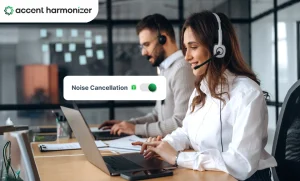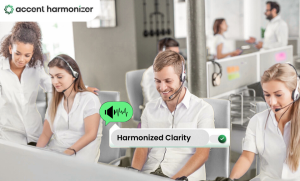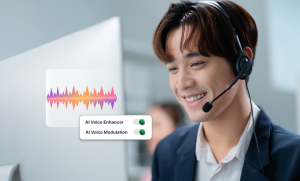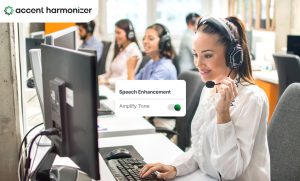

Every “Could you repeat that?” adds seconds to a call—and millions to operational costs on a scale. Accent friction isn’t a training problem. It’s a real-time infrastructure problem. Here’s how leading contact centers are solving it.
In a global contact center, accent mismatch between agents and customers is one of the most expensive friction points no one openly talks about. The damage is incremental—a repeated phrase here, a misunderstood number there—but at the scale of thousands of calls per day, the cumulative cost in average handle time (AHT), first call resolution (FCR), and customer satisfaction is enormous.
Real-time AI accent changer fixes this equation. Not by altering who agents are, but by improving how they’re heard.
What Is a Real-Time AI Accent Changer?
A real-time AI accent changer is an audio-layer speech processing system that modifies phoneme-level articulation during a live call. It doesn’t replace an agent’s voice or create a synthetic persona. It adjusts specific sounds—the building blocks of speech—so they land more clearly on the listener’s ear, in real time, mid-conversation.
This is a critical distinction. Accent changers are frequently confused with:
- Accent training — a months-long coaching process that’s expensive, inconsistent, and doesn’t scale
- Voice filters — cosmetic audio effects with no linguistic function
- Voice conversion — full identity replacement, which destroys the authentic human connection agents build with customers
Real-time accent adaptation sits in a different category: it preserves the agent’s identity while reducing the cognitive effort required from the listener. Think of it as accent adaptation, not accent erasure.
The Hidden Cost: Listening Load at Scale
Cognitive scientists use the term listening load to describe the mental effort a listener expends to parse unfamiliar speech patterns. When that load is high—because of accent distance, unclear phonemes, or unfamiliar rhythm—comprehension drops and frustration rises.
Accent friction doesn’t just slow down calls. It compounds. A customer who has to ask for a repeat is already less satisfied before the issue is resolved.
In contact centers, high listening load translates directly to measurable outcomes:
- Longer calls,
- More repetitions,
- Lower FCR scores, and
- Declining CSAT
Internal pilot data from deployments of accent clarity software has shown meaningful reductions in average repetition events per call—often 20–30%—once a real-time clarity layer is in place. For a center handling 50,000 calls a month, that’s a significant reclaim of both time and customer goodwill.
What Happens During a Live Call
The technology operates invisibly across five stages:
- Audio Capture— the agent’s voice is intercepted at the audio layer before transmission
- Phoneme Detection— the system identifies specific phonemes in real time using acoustic models
- Accent Adaptation Engine— target phonemes are mapped to the listener’s expected speech patterns
- Real-Time Synthesis— adjusted audio is reconstructed within sub-150ms latency windows
- Output Delivery— the modified stream is delivered to the customer; the original continues flowing to recording and QA systems unchanged
The latency threshold matters enormously in enterprise deployment. A lag above 150ms introduces perceptible delay that disrupts natural conversational rhythm. In production environments maintaining that threshold under peak load is where many solutions fail.
Accent Changer vs. Accent Translation vs. Harmonization
The market uses several overlapping terms. Here’s how they differ:
| Voice & Accent Processing Approaches – Quick Comparison | |||
|---|---|---|---|
| Approach | Real-Time? | Voice Preserved? | Best For |
| Accent Adaptation | Yes | Yes | Live call clarity |
| Accent Harmonization | Yes | Yes | Reducing accent distance between pairs |
| Accent Translation | Partial | Partial | Post-call transcription alignment |
| Voice Conversion | Varies | No | Entertainment; not enterprise CX |
Where It Delivers ROI—and Where It Fails
The highest-impact deployments share a common profile: high call volume, global agent pools, and clarity-sensitive customer segments. BPO and offshore CX operations see the broadest gains. Financial services and healthcare applications benefit from improved accuracy on critical information like account numbers and medication names. Sales teams using accent clarity tools have reported measurable lift in lead conversion, with one deployment citing a 4x improvement in callback rates from outbound campaigns.
But failure modes are real—and competitors rarely discuss them. The most common:
| Common Deployment Pitfalls in AI Voice Harmonization | |
|---|---|
| Latency spikes under concurrent load | High concurrent call volumes overwhelm processing infrastructure → noticeable delays disrupt conversation flow and increase customer frustration. |
| Poor coverage of regional dialect pairs | Model trained on major accents but weak on less common regional variants → suboptimal harmonization, persistent friction, and uneven performance across teams. |
| Agent rejection when output sounds unfamiliar | Even subtle changes can feel “off” to the speaker → resistance, reduced adoption, and lower agent satisfaction if not managed with proper change communication and monitoring. |
| Demo-to-production performance gaps | Lab/demo conditions (clean audio, controlled accents) vs real-world noise, overlapping speech, and diverse dialects → lower-than-expected clarity gains if not stress-tested properly. |
| Inadequate CCaaS platform integration | Poor WebRTC/SIP compatibility, missing metadata, or latency in signaling path → choppy audio, dropped harmonization, or failed calls in production. |
The gap between a polished demo and a stable production deployment is where most enterprise buyers get burned. Any serious evaluation must include a controlled pilot under real call volumes, with real accent pairings from your actual agent population.
What to Demand from Enterprise Accent AI Software?
When evaluating vendors, frame your criteria around enterprise risk, not just feature lists. The questions that matter most:
- Does sub-150ms latency hold at your actual peak concurrent volume?
- How many accent pairs does the system support—and does it cover your specific agent-to-market combinations?
- Can it integrate with your existing CCaaS stack (Genesys, NICE, Five9)?
- Does it meet your compliance requirements (SOC 2, HIPAA)?
The buyer who evaluates it against infrastructure risk criteria will make the right call.
From Communication Barrier to Competitive Advantage
Accent friction has been quietly absorbing cost and suppressing customer satisfaction in global contact centers for decades. The solutions like coaching programs, localization hiring, and script rewriting are slow, expensive, and never fully effective.
Real-time accent translation reframes the problem entirely. It’s not a training intervention. It’s a voice infrastructure upgrade—one that pays back in AHT reduction, CSAT improvement, and the ability to hire from a genuinely global talent pool without compromising the customer experience.
The enterprises moving fastest on this are treating accent clarity not as a communication nicety, but as a core operational lever. That reframing is the competitive advantage.
Ready for a Change?
Experience real-time accent clarity on your own calls before you commit to a deployment decision.