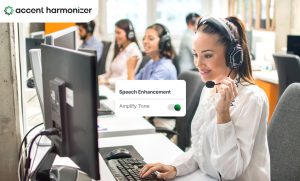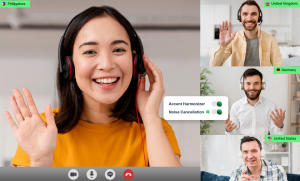

Global customer support has changed. Contact centers today serve customers across regions, time zones, and linguistic backgrounds. While this global model unlocks scale and efficiency, it also introduces a persistent challenge: speech clarity during live conversations.
Importantly, this challenge is rarely about accents themselves. Most customers do not object to how someone sounds. What creates friction is difficulty understanding, especially in fast-paced, high-pressure interactions.
Speech accent reduction software does not replace people and reduce avoidable communication friction.
What Is Speech Accent Reduction Software?
Speech accent reduction software uses AI-driven speech processing to adjust certain pronunciation patterns in real time, with the goal of improving intelligibility while preserving the speaker’s natural voice.
Unlike older approaches that attempted to “neutralize” accents entirely, modern systems focus on:
- Reducing mispronounced phonemes
- Smoothing pacing and stress patterns
- Improving clarity without flattening vocal identity
In practice, accent modification software let customers hear speech that is easier to follow, while agents continue to sound like themselves.
Why Customers Struggle with Understanding — Not Accents
Accent-related issues rarely appear directly in customer feedback. Instead, they surface indirectly through:
- Repeated clarifications
- Longer call durations
- Escalations labeled as “communication issues”
- Lower QA scores despite correct process adherence
Comprehension challenges usually stem from speech intelligibility, not accent identity. Intelligibility is influenced by factors such as:
- Pronunciation of specific consonants or vowel sounds
- Stress placement within words
- Speaking speed under pressure
- Audio quality and background noise
Two agents may have equally strong accents, yet only one consistently causes misunderstandings. The difference lies in how easily the speech is processed by the listener — not where the speaker comes from. Accent neutralization software is designed to address this specific gap.
How Modern Speech Accent Reduction Software Works?
While implementations vary, most accent harmonization systems follow a similar high-level flow:
- Speech capture: The agent’s voice is processed in real time during the call.
- Phonetic pattern detection: AI models identify pronunciation patterns that commonly reduce clarity for listeners.
- Context-aware adjustment: Only selected speech elements are modified — not the entire voice.
- Voice preservation: The output maintains the agent’s natural tone, pitch, and rhythm.
Common Contact Center Use Cases
Speech accent reduction software is typically most effective in structured, high-volume environments.
- Inbound customer support
- Global BPO operations
- New agent onboarding
- Seasonal or surge staffing
- Technical or process-driven support
Accent Reduction Software vs Traditional Accent Training
Traditional accent training has long been used in global contact centers, but it comes with structural limitations.
| Traditional Training vs Speech Accent Reduction Software | ||
|---|---|---|
| Aspect | Traditional Training | Speech Accent Reduction Software |
| Time to impact | Weeks or months | Immediate |
| Scalability | Limited | High |
| Consistency | Agent-dependent | Standardized |
| Cognitive load | High | None during calls |
| Ongoing effort | Continuous | Minimal |
Training still plays a role in communication development, but software-based approaches help address real-time conversational challenges that training alone cannot solve.
When to Deploy Accent Reduction Technology?
| When Accent Harmonization Delivers High vs Low Impact | ||
|---|---|---|
| Category | Works Best When… (High Impact) | Less Effective When… (Low Impact) |
| Conversation Type | Flows are defined and structured (e.g., service scripts, technical support). | Conversations are highly emotional, personal, or nuanced. |
| Call Volume & Pace | Calls are high-volume and strictly time sensitive. | Calls are infrequent or do not rely on speed of resolution. |
| Operational Scope | Teams operate across multiple global regions with diverse linguistic backgrounds. | Teams are localized or face minimal language-based friction. |
| Infrastructure | QA frameworks and monitoring processes are already established. | There is no existing process for monitoring or improving conversation quality. |
| Technical Environment | Audio environments are clear and stable. | Audio environments are unstable or contain heavy background noise. |
Recognizing these boundaries prevents unrealistic expectations and supports responsible deployment.
How to Evaluate Speech Accent Reduction Software?
Before adoption, teams typically assess solutions across several dimensions:
- Real-time speech processing capability
- Natural voice preservation
- Latency tolerance
- Adaptability across accents
- Data privacy and compliance controls
- Compatibility with telephony and QA platforms
Some organizations explore speech accent reduction software through solutions such as Accent Harmonizer, which focuses on improving speech intelligibility in real time while preserving an agent’s natural voice.
Conclusion
Accent diversity is a natural part of global communication. The challenge for contact centers is not how agents sound, but how effectively conversations flow. Speech accent reduction software, when applied thoughtfully, helps reduce avoidable misunderstandings that affect customers, agents, and operational performance.
The most effective strategies focus on intelligibility, transparency, and governance ensuring technology supports human communication rather than replacing it. As customer expectations for clarity continue to rise, the role of intelligent, agent-supportive communication tools will only become more central to modern CX operations.
For teams exploring how speech accent reduction software can support clearer customer conversations, Accent Harmonizer offers a practical example of how real-time intelligibility support can be applied in contact center environments. Learn more or request a demo to know more.