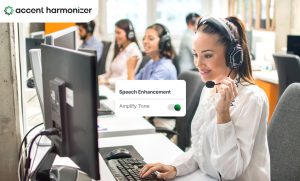
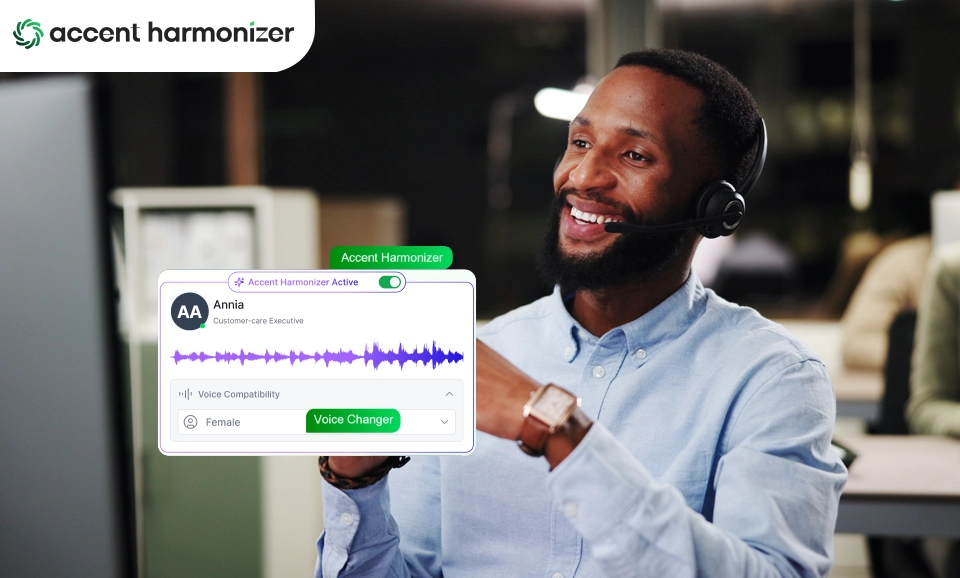
Global contact centers rely on diverse, multilingual teams to help customers in different regions and time zones. This diversity is a strength, but it can also make speech clarity a challenge. Customers sometimes have trouble understanding agents because of differences in pronunciation, speaking speed, or unfamiliar accents, even when agents follow scripts and quality standards.
More companies are now looking into speech clarity AI. This voice technology helps make conversations clearer and more consistent during live calls in contact centers.
Accent Variability and the Modern Contact Center Challenge
Accent differences naturally happen when companies hire globally. As contact centers expand across different locations, agents bring their own language backgrounds, pronunciation styles, and speech rhythms to customer conversations.
The problem isn’t the accent itself. The main challenge is how easily customers can understand agents during calls. If customers have trouble understanding, conversations slow down, agents repeat themselves more, and customers must work harder. Over time, these issues can affect customer experience and the center’s efficiency.
Traditional quality management programs often assess data after the call ends. And they rarely address how speech is perceived during the conversation itself.
What does Speech Clarity AI Means for Real Contact Center Conversations?
AI-based voice processing tools for contact center use technology to make speech easier to understand without altering the agent’s identity. The goal is to help listeners understand better, not to change the agent’s natural way of speaking.
In practical contact center scenarios, speech clarity AI helps:
- Improve pronunciation perception
- Smooth inconsistencies in speech delivery
- Support clearer exchanges during live calls
- Strengthen agent confidence
Unlike training or coaching, which happens after the call, speech clarity AI works in real time. It helps reduce misunderstandings as they happen, not just afterward.
How AI Voice Processing Works in Contact Centers?
AI voice processing listens to spoken audio and makes small adjustments to help people better understand, while preserving the agent’s natural voice.
Voice Signals AI Can Process Without Altering Identity
Modern AI systems can work with several speech-level signals, including:
- Phonetic articulation patterns
- Speech tempo and pacing
- Pronunciation consistency
- Audio artifacts such as overlaps, long pauses, or unclear transitions
These features can be improved at the audio level, making speech clearer without changing the agent’s accent or emotional tone.
AI Voice Processing Within Contact Center Infrastructure
AI voice processing tools for contact centers work with the systems you already have, instead of replacing them. They usually process voices in real time, alongside your current call and phone systems.
This approach allows organizations to:
- Preserve existing agent workflows
- Avoid changes to routing or workforce systems
- Apply clarity enhancements during live conversations
This creates a simple, focused layer that improves voice clarity without adding much extra work.
Speech Clarity as an Output, not a Transformation
It’s important to note that speech clarity AI makes audio clearer but doesn’t change the agent’s voice. Agents still sound like themselves, and language diversity stays the same. Technology aims to make speech easier to understand, not to replace or convert voices.
AI Accent Conversion vs Accent Harmonization
People often talk about “AI accent conversion” in the industry, but this term can be confusing. Converting an accent means replacing one accent with another, which can bring up ethical, cultural, and practical concerns.
In contrast, many enterprise voice solutions emphasize accent harmonization. It aligns speech output for clarity and consistency while respecting the agent’s natural speaking style. The framing supports communication quality without positioning accent diversity as a problem to be corrected.
Knowing the difference between conversion and harmonization is important for contact centers that want to choose speech technology responsibly.
| Accent Conversion vs. Harmonization | ||
|---|---|---|
| Feature | Accent Conversion | Accent Harmonization (Omind Approach) |
| Primary Goal | Replace the speaker’s accent with a different one. | Improve clarity and phonetic articulation. |
| Identity | Alters the agent’s vocal “DNA” and identity. | Preserves the agent’s natural voice and heritage. |
| Ethics | It can feel like “erasing” cultural backgrounds. | Supports Inclusion by focusing on mutual understanding. |
| UX Impact | Can sound “robotic” or uncanny if not perfect. | Sounds natural; reduces customer effort without friction. |
Practical Benefits for Contact Center Voice Quality
When used well, speech clarity AI can help contact centers reach several important goals:
- Improved customer understanding: Clearer speech reduces the need for repetition and clarification.
- More efficient conversations: Fewer misunderstandings help calls progress smoothly.
- Consistent experience across regions: Customers experience similar levels of clarity regardless of agent location.
- Support for diverse agent teams: Agents do not need to change how they speak, which supports inclusion and morale.
These results are about improving communication, not promising specific performance improvements.
Where Speech Clarity AI Fits in the Contact Center Technology Stack?
Speech clarity AI has a specific role in the contact center technology mix. It works alongside analytics, quality assurance, and workforce management tools without replacing their functions.
For example, Accent Harmonizer by Omind act as speech clarity layers during live calls, making voices clearer while working with your current contact center systems. In this setup, speech clarity AI improves the sound of conversations, while other tools measure performance before or after the call.
This setup lets organizations improve how people communicate without changing their usual ways of working. The layered approach makes it easier to integrate voice processing into their current systems.
Contact Centers Exploring Speech Clarity AI
Contact centers usually consider speech clarity AI when they face situations like:
- Expansion into new geographies or language groups
- Customer feedback related to understanding or repetition
- Longer call durations driven by clarification loops
- Pressure to improve experience without changing hiring models
In these cases, speech clarity AI is one way to help improve conversation quality across the whole organization.
Conclusion
Accent differences are a normal part of global contact centers, not a problem. As customers expect clearer, faster conversations, more organizations are using speech clarity AI to help people understand each other while preserving diversity and identity.
Real-time AI voice processing and speech clarity technology offers a practical way to improve voice clarity in contact centers. It works with your current systems instead of replacing them.
Exploring Speech Clarity AI in Practice
For organizations interested in speech clarity AI for their contact center conversations, Accent Harmonizer by Omind is here for you. Our AI voice processing is designed to support more transparent communication while maintaining agent individuality. Let’s book a demo to know more.