
In large, distributed contact centers, operational leaders often focus on staffing ratios, training depth, and workflow optimization. Yet one underlying factor quietly reshapes nearly every KPI—live speech clarity. When customers or agents mishear even a sentence, it introduces micro-delays that accumulate across thousands of interactions, inflating Average Handling Time (AHT), increasing cost per contact, and elevating error rates.
This blog reframes speech clarity not as an interpersonal challenge, but as an infrastructure variable with direct economic impact.
Hidden Cost of Misheard Sentences in AHT
A single “Sorry, could you repeat that?” may feel insignificant, yet across a high-volume operation, clarification cycles become expensive. For a contact center handling 50,000 calls a month, an extra 10 seconds per call translates into 138 hours of wasted capacity—capacity that could have been redeployed toward service levels or backlog reduction.
- According to the Erlang C staffing model, even a 5% rise in AHT can require a 10% increase in headcount to maintain the same wait times.
- Gartner research indicates that “clear communication” is a primary driver of Customer Effort Scores (CES), and customers experiencing high effort are 96% more likely to churn.
When clarity drops—due to accents, bandwidth noise, inconsistent microphone quality, or agent fatigue—every second becomes an operational tax. The result: swollen queues, overstretched teams, and budget pressure.
How Poor Speech Clarity Creates Compliance Exposure?
Operational audits often classify errors as “human error,” but many originate from audio friction rather than agent competency. Research on Cognitive Load Theory shows that when agents strain to decipher unclear audio, they have fewer mental resources for precision tasks such as data capture or regulatory disclosure delivery.
| How does AI QMS close the enterprise compliance gap? | ||
|---|---|---|
| Feature | Traditional Manual QA | AI QMS |
| Interaction Coverage | 1% – 2% (Random Sampling) | Upto 100% |
| Risk Detection | Reactive (Found after the fact) | Proactive (Real-time alerts & flags) |
| Consistency | Subjective (Varies by auditor) | Objective (Standardized AI logic) |
| Feedback Loop | 24–72 hours (Delayed) | Instant (Real-time coaching & insights) |
| Scalability | Linear (Requires more staff) | Exponential (Handles unlimited volume) |
| Compliance Accuracy | 70% – 80% (Prone to human error) | 95%+ (Rule-based & ML validation) |
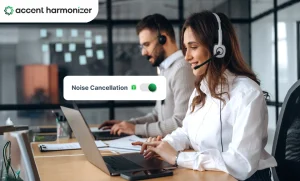
Auditing teams can identify what went wrong after the fact, but they cannot intervene during the moment of miscommunication. This gap is why real-time voice clarity tools—such as the adjustments referenced in this example of noise-cancellation technology—are emerging as a new quality layer. They help prevent errors as they happen, rather than diagnosing them 48 hours later.
Three Signs Point to Clarity Issues in Your Metrics
These diagnostic patterns often signal that the problem isn’t agent behavior—it’s the auditory environment.
- AHT Variability Across Regions
When two teams follow the same process but show wide AHT deviation, accent friction or regional background noise may be the underlying driver.
- High Politeness Scores, Low Resolution Scores
If customers rate interactions as “courteous” but still mark “issue unresolved,” it often means they misheard or misunderstood key steps. This aligns with the silent FCR dips seen in operations with clarity challenges.
- End-of-Shift Accuracy Drops
Studies on auditory masking fatigue show that prolonged exposure to unclear audio increases cognitive strain, causing error rates to rise during the final hours of a shift.
These signals help leaders differentiate coaching needs from infrastructure challenges.
Why Speech Clarity Should Be Treated as Core Infrastructure?
Contact centers increasingly rely on global talent pools. According to the World Economic Forum, workforce dispersion will continue to grow as organizations scale with remote and hybrid models. This diversity strengthens operations—but accents, background noise, and uneven device quality can create friction during high-stakes conversations.
Historically, organizations tried to solve clarity challenges through:
- accent-neutralization coaching
- repeated communication workshops
- heavier QA monitoring
These methods are expensive, slow, and often ineffective because they target people, not the environment.
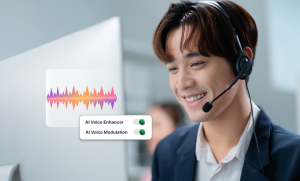
A more modern approach is accent harmonization—treating clarity as a technical layer similar to VoIP latency, jitter thresholds, or noise-suppression standards. Real-time clarity enhancement tools, such as Accent Harmonizer by Omind AI, support scalable communication without altering natural speech patterns.
When clarity becomes shared infrastructure:
- AHT becomes more predictable
- Error rates decrease
- CES improves
- Agent fatigue drops
- Compliance accuracy stabilizes
In other words, clarity becomes a controllable operational variable rather than an unpredictable interpersonal one.
Conclusion
Misheard sentences don’t show up as line items in a budget, but they influence nearly every cost and experience metric. From inflated AHT to compliance exposure and rework effort, clarity gaps create avoidable friction that compounds across teams and regions.
By approaching speech clarity as infrastructure—not coaching—leaders can reduce operational drag, stabilize performance, and support diverse global talent with minimal process change. If you are considering real-time clarity solutions, a small A/B test with even 5–10 agents can quickly reveal measurable differences in call accuracy and handling time.
If you’re exploring ways to reduce clarity-driven AHT and improve real-time accuracy, we can provide a brief walkthrough. Let’s book a short demowith the team.