
During calls, customers complain about not understanding agents due to accent differences.
When a call opens with “sorry, could you repeat that?” the trajectory is already set. Repetition loops drive up average handle time, exhaust agents, and quietly erode customer trust. It’s a clarity problem and AI voice accent harmonizer fixes these issues by reframing the solution. And that reframe matters, because the solutions are completely different. While accent training takes months, phonetic clarity can be improved in milliseconds.
What is a Voice Accent Harmonizer?
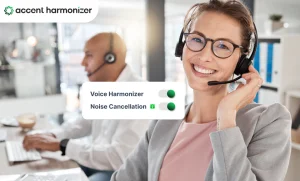
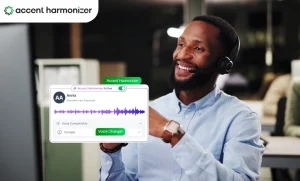
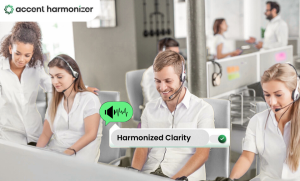
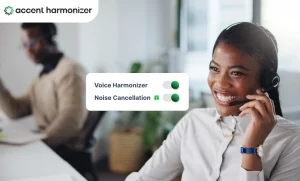
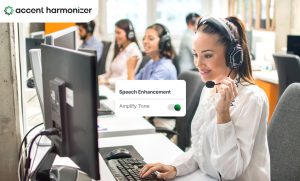
A voice accent harmonizer is a real-time speech processing layer that adjusts phonetic elements of a speaker’s voice as the conversation happens — not after. The result is improved listener comprehension without altering the speaker’s identity, pace, or personality.
It’s worth being precise about what this is not:
- Accent training
- Voice cloning,
- text-to-speech
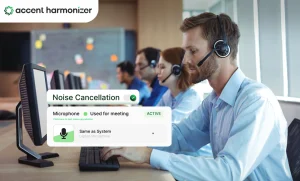
The technology behind real-time accent conversion ensures that audio processing completes within an ultra-low latency window. To the listener, it simply sounds like a clearer, more professional call.
Why Existing Fixes Don’t Scale?
Contact center leaders have tried to solve clarity for decades. Each approach has a structural flaw that limits its effectiveness at scale.
Traditional approach
- Accent training: slow, inconsistent, doesn’t transfer under pressure
- Script optimization: limits expression, doesn’t fix live speech and increases cognitive load.
- QA feedback: reactive — the call is already over
- Coaching cycles: high cost, months before impact
Real-time approach
- Works on every call from day one
- No behavior change required from agents
- Acts in the moment, not after the fact
- Consistent across all agents and geographies
What Changes When Clarity Is Fixed In Real Time?
The operational effects of improved clarity compound across your entire call volume. Even small per-call improvements become significant on a scale.
Faster calls without rushing
Repetition is one of the most underdiagnosed contributors to AHT. When customers understand the agent clearly on the first pass, AHT is reduced through improved voice clarity rather than rushing the conversation.
Higher customer engagement and trust
Communication effort is inversely related to trust. This is why accent neutralization software improves CSAT almost immediately upon deployment.
Reduced agent cognitive load
Agents who know they’re being understood stop overcompensating. This frees up cognitive capacity for empathy and problem-solving, which are critical for improving First-Call Resolution (FCR).
Where This Fits in Your CX Stack
An accent changing software doesn’t replace QA, coaching, or scripting. It fills a gap that every other tool leaves open: the real-time layer. QA operates after the call. Training operates between calls. Scripts operate before the call. Harmonization is the only intervention that operates during the call.
For most teams, it integrates cleanly with existing telephony infrastructure and session recording workflows. Agents require no training to use it — the improvement is transparent to them and immediate for customers.
Use Cases Where It Drives Measurable Impact
- High-volume support teams: When you’re handling thousands of calls per day, a 90-second reduction in average handle time translates directly into capacity and cost savings. Clarity improvements at volume are compounding, not linear.
- Sales and revenue calls: Sales teams use accent harmonization to build trust faster in international markets, reducing objection loops and higher close rates on first-call attempts.
- Offshore and distributed teams: Distributed operations introduce natural variation in communication patterns. A harmonizer creates a consistent baseline across geographies, without enforcing accent uniformity or penalizing natural speech variation. It expands contact center talent pools by allowing you to hire for skill and empathy rather than regional proximity.
Common Misconceptions
Three objections come up consistently in evaluations:
- Does it neutralize accents? It adjusts phonetic clarity to the listener’s perception layer. The speaker’s regional voice, personality, and cadence remain intact. Understanding the distinction between harmonization and neutralization is critical for enterprise procurement.
- Does it sound artificial?When implemented correctly, the output sounds like a clearer version of the same voice — not a synthesized one. The goal is transparency, not transformation. Unlike generic voice changers, harmonization preserves the agent’s natural identity.
- Is this only for offshore teams? Clarity challenges exist across all agent populations and geographies. The tool applies wherever phonetic perception creates friction.
How To Know If You Need It?
Four signals indicate that real-time clarity should be evaluated:
- QA flags consistently cite “communication clarity” as a category;
- AHT is elevates without an obvious process explanation;
- Customer scores trend high despite low resolution times; and
- Training hasn’t moved the needle on repetition rates after multiple cycles.
If two or more of those are true, the gap is likely operational, not behavioral — and a behavioral fix won’t close it.
Ready to Make a change?
Clarity issues don’t show up as a single metric. They show up in longer calls, repeated questions, and customers who leave the interaction feeling like they worked too hard. A voice accent harmonizer targets the exact moment those issues begin — before they compound.