
Subscriber retention in the telecom sector often hinges on the resolution of complex billing and technical issues. When these high-stakes conversations fail, the culprit is frequently a lack of voice clarity for telecom contact centers, leading to phonetic misunderstandings and customer exhaustion.
Unlike generic service environments, telecom interactions involve dense alphanumeric data—such as IMEI codes and proration figures—where even minor audio friction triggers a cascade of repeat calls and escalated disputes. By prioritizing real-time clarity, providers can directly stabilize First Call Resolution (FCR) and protect the subscriber relationship from avoidable churn.
Telecom CX and the Accent Friction Problem
Telecom contact centers operate in one of the most churn-sensitive environments in the global service economy. According to PwC’s Global Telecom Outlook, while service revenue is projected to rise, it remains a mature, low-growth market where customer retention is the primary driver of profitability.
Industry benchmarks indicate that the average provider loses 20% to 30% of its subscriber base annually. Research from Harvard Business Review and Gartner underscores the stakes: while a 5% reduction in churn can boost profits by up to 25%, over 51% of customers who switch cite the need to call more than once to resolve an issue as their primary reason for leaving.
The Dominance of the Voice Channel
Despite the rise of digital self-service, voice interactions remain the dominant channel for high-complexity inquiries, including:
- Technical Troubleshooting: Alphanumeric device IMEI codes and step-by-step network resets.
- Billing Disputes: Complex probation, contract modifications, and service outage credits.
- Account Security: Verification of PINs and alphanumeric security questions.
Why Telecom is Uniquely Vulnerable to Accent Friction?
Telecom interactions contain a high density of high-risk communication elements that amplify phonetic ambiguity.
- Phonetic Ambiguity: In troubleshooting flows, the inability to distinguish between characters like ‘B’ and ‘D’ or ‘M’ and ‘N’ can misdirect a device reset, leading to failed resolutions and unnecessary hardware replacements.
- Numerical Precision: Billing explanations involve dollar amounts and dates. A customer who hears “fifteen” instead of “fifty” leaves the call with incorrect expectations, leading to “re-churn” once the next statement arrives.
- The “Cognitive Load” Barrier: Research shows that listeners require more “processing effort” to interpret unfamiliar phonetic structures. In a high-stakes troubleshooting call, this extra effort leads to interruption cycles and partial understanding, which many customers mistake for resolution until the issue resurfaces.
The BPO Impact: Metrics That Drive Contract Renewals
For Telecom BPOs, accent-driven service failures aren’t just a “customer feel” issue, they directly degrade the KPIs that govern contract expansion:
- First Call Resolution (FCR): Misunderstood instructions are the leading cause of “repeat calls.”
- Average Handle Time (AHT): Frequent repetition of alphanumeric code inflates call duration without adding value.
- Net Promoter Score (NPS): Effortless communication is the strongest predictor of whether a customer will recommend a provider or become a “Detractor.”
Telecom Calls Are Vulnerable to Accent Misunderstanding
Telecom interactions contain a concentration of high-risk communication elements that amplify the impact of accent friction. Account numbers, PINs, device IMEI codes, and plan identifiers involve long alphanumeric sequences where phonetic ambiguity between characters like B and D, F and M and N can misdirect an entire troubleshooting flow.
Technical troubleshooting instructions require step-by-step precision. When an agent says navigate to settings, then network and internet, then reset network settings, each instruction must be clearly parsed by the customer. Accent-related misunderstanding at any step creates a cascade of incorrect actions that extend the call and reduce resolution confidence.
Billing conversations involve dollar amounts, proration calculations, and date-specific charges that require numerical precision. A customer who hears fifteen instead of fifty, or July instead of January, leaves the call with incorrect expectations that generate a callback.
The telecom industry’s heavy reliance on offshore and nearshore delivery compounds these challenges. Agents in the Philippines, India, Latin America, and Eastern Europe each bring distinct phonetic patterns to English-language interactions, creating varied comprehension challenges depending on the customer’s listening context.
Real-Time Accent Harmonization as Telecom CX Infrastructure
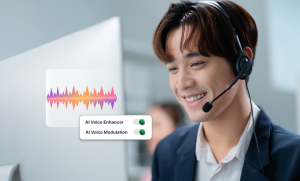
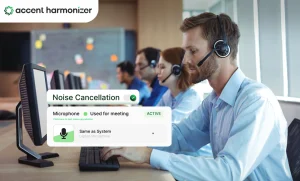
Real-time accent harmonization addresses telecom voice clarity at the audio stream level. The technology processes live agent speech identifies phoneme patterns most likely to cause misunderstanding for the listener and applies targeted corrections. Processing occurs within 150 to 200 milliseconds, well below the threshold of perceptible delay in natural conversation.
The critical distinction from accent neutralization is preservation of the agent’s natural voice. Harmonization does not replace or synthesize a different voice. It refines specific phonetic elements that create friction while maintaining the speaker’s tone, pace, emotional register, and vocal identity. Agents sound like themselves, just clearer.
For telecom contact centers, this means deploying voice clarity as a layer within the existing technology stack rather than a behavioral change program. The solution integrates at the telephony level, compatible with major CCaaS platforms, without requiring changes to IVR logic, routing rules, or agent desktop applications.
The downstream benefits extend beyond customer interaction. Speech analytics engines produce more accurate transcriptions when input audio is clearer, which means sentiment analysis, topic detection, and compliance monitoring all generate better data. Voice clarity improves everything that sits on top of it in the CX technology stack.
Measurable Impact on Telecom Operations
Deploying real-time voice clarity transforms subjective “better calls” into objective operational recovery. Telecom BPOs utilizing accent harmonization consistently see gains across three core pillars:
1. Efficiency & Cost Recovery
- AHT Reduction (8% – 12%): Driven by the elimination of “repetition cycles” during alphanumeric data verification (IMEIs, PINs) and troubleshooting.
- Capacity Gains: For a center handling 100k monthly calls, a 10% AHT reduction recovers thousands of agent hours, directly improving bottom-line profitability.
2. Resolution & Retention
- FCR Improvement (10% – 15%): High-precision clarity ensures customers execute technical instructions correctly the first time, preventing “frustration callbacks.”
- Reduced Queue Congestion: Higher FCR lowers overall call volume and improves agent availability during peak outages or billing cycles.
3. Sentiment & Data Integrity
- NPS & CSAT Growth: Effortless communication is a leading indicator of retention. Reducing “comprehension effort” elevates the customer’s perception of service quality.
- Downstream AI Performance: Clearer audio input significantly improves the accuracy of Speech Analytics (sentiment/topic detection) and automated QA scoring.
The Competitive Case for Voice Clarity in Telecom
The telecom outsourcing market is intensely competitive, with carrier clients evaluating BPO partners primarily on their ability to deliver measurable CX outcomes. Voice clarity technology provides a differentiator that is difficult to replicate through training alone and that delivers results from day one of deployment.
As AI voice agents and automated troubleshooting flows become more common in telecom, accent harmonization also improves the performance of these systems. Voicebots and IVR systems that receive clearer audio input from customers produce more accurate intent recognition and higher self-service completion rates.
For telecom BPO leaders, the decision to deploy accent harmonization is increasingly a question of competitive positioning. In a market where customer retention is essentail, removing friction from voice interactions is one of the highest-ROI investments available.
Explore the New
As carriers pivot toward AI-heavy troubleshooting, Accent Harmonizer by Omind ensures your human-led interactions remain your strongest asset. It provides a technical layer that is difficult for competitors to replicate through training alone.
Ready to see the ROI? Schedule a demo to see how Accent Harmonizer integrates into your existing telephony stack.