Most leaders treat accent friction as a training deficiency. Yet even the top call center agent coaching software can’t coach an agent out of a real-time phonetic misunderstanding.
When a customer says, “I’m sorry, can you repeat that?”, the clock doesn’t just stop—it starts costing you money. Traditional coaching methods are reactive, and arriving days after the friction has already deflated your CSAT scores. Consequently, managers spend hours reviewing calls for “soft skills” when the actual culprit is a simple lack of auditory clarity. Furthermore, the cognitive load of constant repetition leads to rapid agent burnout and attrition.
In this post, you’ll learn why real-time accent harmonization is the missing link in your performance stack. We will explore how a “clarity layer” removes the comprehension burden from both the agent and the customer. Finally, you will discover how to scale your global footprint without sacrificing the quality of your customer interactions.
What is Accent Changing Software and How Has It Evolved?
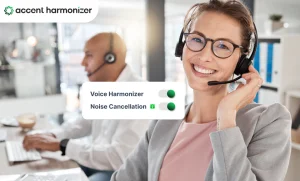
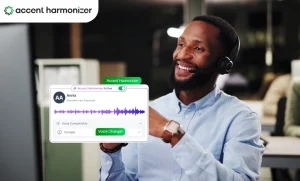
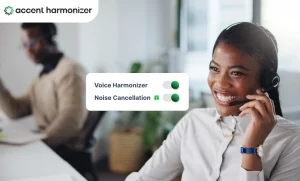
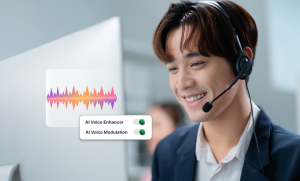
AI-powered accent changing solutions optimizes the listener’s comprehension in the moment. It works as a clarity layer in BPO call infrastructure.
The agent’s voice enters the system, AI processes it in under a second, and the customer hears speech that’s easier to parse. It is done without delay, distortion, or stripping away the agent’s natural identity.
Category Shift: Accent neutralization → Accent harmonization → Real-time clarity layer.
Each generation moves closer to the listener’s experience rather than the speaker’s performance.
Why Traditional Coaching Fails Without Accent Changing Software?
When a customer asks for repetition, the call doesn’t just slow down—it compounds. Agents spend cognitive resources re-phrasing, and customers increase their effort to comprehend. Understanding speech intelligibility vs. accent is key here. Most coaching software focuses on the words said but fails to address the clarity of the delivery.
How Real-time Accent Conversion Works in a Live Call?
The “real-time” qualifier is doing a lot of work in this space, and vendors use it loosely. True effectiveness requires ultra-low latency voice AI to ensure conversation remains natural. Anything above roughly 200 milliseconds create a perceptible lag.
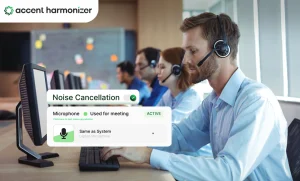
The technical flow in a production deployment looks like this: the agent speaks into their headset, the audio stream routes through an AI processing layer, and the adjusted output reaches the customer in near-real time. Unlike post-call analytics or training-based interventions, this operates at the exact moment of communication.
Accent Changing vs. Voice Clarity: Which Framing Wins
This framing shapes and optimizes KPIs. Accent neutralization vs. harmonization is a common comparison for enterprises.
| Strategic Framework: Linguistic Alignment vs. Business Outcomes | ||
|---|---|---|
| Approach | Focus | Preferred Metric |
| Neutralization | Speaker output (sounding “native”) | Accent similarity |
| Harmonization | Balanced identity and intelligibility | Agent confidence |
| Clarity Layer | Outcome-driven comprehension | AHT, FCR, and CSAT |
The clarity-first model also sidesteps the ethical complexity of accent removal, focusing instead on reducing cognitive load for both parties.
Accent Changing vs. Accent Translation: Clearing Up the Confusion
Search behavior around this category is genuinely confused, and understandably so. “Accent translation software” surfaces regularly, conflating two different problems. Language translation changes the words. Accent modification software changes how those words are delivered. Both affect whether a customer understands, but through entirely different mechanisms.
If your agents speak the customer’s language but intelligibility is suffering, harmonization is the right tool. Buying the wrong category means solving a problem you don’t have while the voice communication barriers in BPO persist.
Evaluating Real-Time Speech AI: A Procurement Checklist
The market is still consolidating, which means vendor claims are outrunning product maturity in some cases. When you evaluate real-time speech AI, use this checklist:
- Real-time processing with documented sub-200ms latency
- Natural voice output—no robotic artifacts or unnatural cadence flattening
- Preservation of voice authenticity
- CCaaS and VoIP integration without custom engineering work
- Agent transparency control agents should know and ideally hear the output
- KPI instrumentation built in—AHT, FCR, and CSAT linkage out of the box
The Strategic Advantage of an AI Clarity Layer in BPOs
For organizations expanding support capacity, the traditional friction point has been accent-related CSAT variance. That variance creates pressure for either over-train agents, hiring geography, or accept quality inconsistency.
A real-time clarity layer removes that constraint. With Accent harmonization software, contact centers can hire from a broader talent pool, scale faster, and maintain consistent customer experience.
Takeaway
Accent diversity is not the problem. Communication clarity is variable. Real-time AI solves this now, it matters—not in next quarter’s training cycle.
See real-time accent harmonization in action
Book a live call demo or get a custom clarity impact report for your contact center.