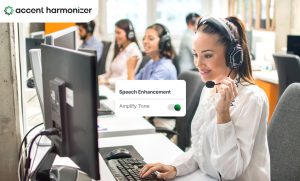

In the high-stakes world of global contact centers, communication breakdowns are rarely the result of a lack of knowledge. Agents follow scripts, navigate complex systems, and provide technically correct solutions—yet customers still struggle to understand them. The “Clarity Gap” is a silent killer of KPIs, leading to inflated Average Handle Times (AHT), plummeting First Call Resolution (FCR), and agent burnout.
For decades, the industry has relied on a single, labor-intensive solution: behavioral coaching. But as operations scale and customer expectations for instant resolution rise, a fundamental question has emerged: Should organizations invest in training agents to speak differently, or deploy call center voice clarity solution that ensures they are understood in real time?
The debate of accent harmonization vs accent training is a critical operational decision. One approach treats clarity as a long-term personal skill, while the other treats it as essential technical infrastructure. Understanding the difference between these two paths is the key to bridging the gap between a frustrated customer and a seamless resolution.
Understanding Accent Training and Harmonization
What Is Accent Training?
Accent training is a structured, human-led process designed to improve pronunciation, speech clarity, and communication confidence over time. It typically includes:
- Phonetic coaching
- Pronunciation drills
- Listening and repetition exercises
- Feedback sessions with trainers
While valuable, it is often less effective than infrastructure-level changes when managing thousands of agents.
What Is Accent Harmonization?
Accent harmonization takes a fundamentally different approach. Instead of changing how agents speak, it adjusts phonetic clarity while preserving tone, emotion, and identity..
It works by:
- Adjusting phonetic clarity in real time
- Aligning stress and rhythm patterns with listener expectations
- Preserving tone, emotion, and identity
It is infrastructure development, operating directly within the call environment.
The Core Difference: Behavioral vs Infrastructure Solution
At a high level, accent training and accent harmonization solve different problems.
Accent training is:
- Behavioral
- Time-dependent
- Individual-focused
Accent harmonization is:
- System-level
- Instant
- Scalable across the entire operation
The distinction matters because contact center performance is driven by consistency, not individual improvement.
Why Accent Training Struggles in Live BPO Environments?
Accent training has been the traditional solution for decades. However, in modern high-volume environments, its limitations are difficult to ignore.
- It Does Not Work in Real Time: Training improves future performance, not current conversations. When a customer struggles to understand an agent, there is no mechanism to intervene mid-call.
- Results Are Inconsistent: Agents must solve problems while monitoring their own speech. Real-time tools reduce this cognitive load, allowing agents to focus on the customer.
- It Creates Cognitive Load: Agents are expected to:
- Solve the customer’s issue
- Navigate systems
- Manage emotions
- Monitor their own speech
- It Does Not Scale Efficiently: Rolling out training across hundreds or thousands of agents requires:
- Scheduling
- Trainers
- Monitoring
- Continuous reinforcement
Why Accent Harmonization Is Gaining Momentum?
Accent harmonization addresses the problem at the point where it occurs during the conversation. Because it is listener-optimized rather than speaker-standardized, ensures the customer understands the first time, every time.
- Immediate Impact on Live Calls: Unlike training, harmonization works instantly. From the first call, clarity improves without requiring behavioral change.
- Consistency Across All Interactions: Every agent, regardless of experience or background, benefits from the same level of clarity enhancement.
- Zero Cognitive Load: Agents do not need to “think about” how they speak. They can focus entirely on solving the customer’s problem.
- Scales With Infrastructure: Once integrated, the solution applies across:
- All agents
- All calls
- All regions
Accent Harmonization vs Accent Training: A Practical Comparison
| Strategic Comparison: Manual Training vs. Real-Time Harmonization | ||
|---|---|---|
| Selection Criteria | Accent Training | Accent Harmonization |
| Time to Impact | Weeks to months (Slow ramp) | Immediate (Day 1 deployment) |
| Live Intervention | No — relies on agent memory | Yes — active signal adjustment |
| Consistency | Variable (Agent-dependent) | Uniform across all interactions |
| Scalability | Limited by instructor bandwidth | Unlimited (Edge or Cloud scale) |
| Agent Cognitive Load | High — focuses on sounds, not customers | None — software handles phonetics |
| ROI Durability | Fragile — investment lost with attrition | Persistent — institutionalized clarity |
What Actually Happens During a Live Call?
An offshore agent explains a billing issue clearly. The customer, however, asks for repetition multiple times—not because the explanation is wrong, but because it is difficult to process.
With Accent Training:
- The agent attempts to slow down
- Over-explains to compensate
- The call length increases
- The customer may still feel uncertain
With Accent Harmonization:
- The speech signal is optimized in real time
- Key phonetic elements become clearer
- The customer understands on the first pass
- The call is resolved faster
The Hidden Cost of Getting This Wrong
Organizations often underestimate the cost of communication friction. Poor clarity leads to:
- Increased AHT due to repetition
- Lower FCR from misunderstood resolutions
- Higher call volumes from repeat contacts
- Agent fatigue and frustration
- Lower CSAT
These issues compound across thousands of daily interactions. Fixing clarity at the source is a direct ROI driver for reducing repeat calls.
Where Accent Training Still Adds Value?
Despite its limitations, accent training is not irrelevant. It plays a meaningful role in areas such as:
- Confidence building
- Public speaking improvement
- Soft skills development
- Long-term communication growth
When Should You Choose Each Approach?
Choose Accent Training If:
- Your goal is long-term skill development
- You are focusing on agent growth programs
- You have smaller teams where individual coaching is manageable
Choose Accent Harmonization If:
- You need immediate improvement in call clarity
- You operate at scale across multiple regions
- You want measurable impact on KPIs like AHT and FCR
- You want consistency across all interactions
Conclusion: Clarity Is No Longer a Training Problem
Contact center industry has treated communication friction as a “people problem.” BPOs have invested in coaching, hoping that it will help drop AHT and push CSAT.
We are moving past the era where an agent’s natural voice is treated as a hurdle to be overcome. In the modern, AI-integrated contact center, intelligibility is a utility. While accent training will always have a place in professional development and long-term soft-skill refinement, it is fundamentally a legacy approach to live-call performance.
Accent harmonization offers what training never could: immediate impact, systemic consistency, and the preservation of agent identity.
Ready To Hear the Difference Clarity Makes?
See how real-time accent harmonization improves call outcomes—using your own call scenarios.